Friday, June 13, 2008

sod

We're now at the last of the posts on the PaRDeS words, and we'll be discussing the word sod סוד. Unlike remez which doesn't appear in the Tanach at all, and derash which has many possible meanings in Biblical Hebrew, sod has two usages. Even Shoshan's concordance lists 16 verses where the word means "assembly" and five where it means "secret" - the more common meaning today. The development between "secret" and "assembly" isn't very hard to grasp, when we place the term "secret advice" in between them. A parallel set of terms in Hebrew is moetza מועצה - "assembly" and etza עצה - "advice". In English we also have the related terms "council" and "counsel".

However, for our purposes, it is important to determine which meaning came first. Without looking at other evidence, I can easily see either one leading to the other. But if we want to see if there are related words in Hebrew or in other Semitic languages, we need to know which meaning came first.

In this regard, we have a number of opinions amongst the sources I've checked. Klein, for example, provides the following order:

1. counsel
2. secret counsel
3. council, assembly
4. (Post Biblical Hebrew) secret

And he gives this etymology:


Related to Syriac סודא, סוודא (= friendly, confidential speech), Arabic sawada (= he spoke in secret).
Kaddari has a similar order: 1) secret thought, 2) consultation with trusted friends, 3) consultation with a group, 4) assembly.

The Theological Dictionary of the Old Testament in its comprehensive entry on sod, writes that the word might be related to the Arabic root swd, meaning "to be black". If this is the case, it would be related to the country Sudan:

from Arabic Bilad-al-sudan, lit. "country of the blacks," from sud, pl. of aswad (fem. sauda) "black."
As well as the word "soda" (and the related "sodium"):

"alkaline substance," from It. sida (or M.L. soda) "a kind of saltwort," from which soda is obtained, probably from Arabic suwwad, the name of a variety of saltwort exported from North Africa to Sicily in the Middle Ages, related to sawad "black," the color of the plant.
(It should be noted, however, that Klein gives a different etymology for "soda":

Med L. soda, from sodanum, lit: "headache remedy", from soda (=headache), from Arabic suda, in vulgar pronunciation soda (= splitting headache), from sada'a (=he split).

I have not found a Hebrew cognate for this Arabic root.)


However, the Daat Mikra claims that the primary meaning of sod is assembly (and actually gives a higher percentage of usage to that meaning than does Even-Shoshan.) For example, Amos Chacham writes on Tehillim 25:14 that "sod in Biblical Hebrew means proximity and connection, not necessarily in secret, but even in public, as in Tehillim 111:1 - אוֹדֶה ה', בְּכָל-לֵבָב; בְּסוֹד יְשָׁרִים וְעֵדָה. - 'I praise God with all my heart; in the assembled congregation of the upright'".

Jastrow seems to follow this same line of thought, and writes that sod derives from a root סדד, meaning "to join". He lists a number of other words from this root. One is sad סד, a Biblical word meaning "stocks for torturing, blocks", which he connects to the Arabic sadda - "to obstruct, to block". This is the source of the English word "sudd" - "a floating mass of vegetation that often obstructs navigation in tropical rivers". Jastrow also writes that the word sadan סדן - "block, anvil" is related to sad. From here we get the modern word sadna סדנה - meaning "workshop".

(Klein connects Arabic sadda to the Hebrew שדד, meaning to "overpower, rob". I would therefore assume he would not connect sadda to sod.)

Another derivative he provides is yesod יסוד, meaning "foundation". According to Jastrow, the development is "to join, to fasten, to found, to establish". From here we get the word musad מוסד - "establishment, institution", well known as the Mossad - Israel's intelligence agency (institution).

Steinberg has a similar theory to Jastrow - also connecting sod, sad and yesod. However, unlike Jastrow, who writes that the common root means "to join", Steinberg feels it means "to establish on a base, to sit in a place". Therefore the original meaning of sod was "sitting together of friends". He also connects the word sadin סדין to the same root. This I have trouble with. I can put aside the fact that current research says that sadin derives from a Sumerian word, since I'm guessing Steinberg didn't have access to that information. However, while in Mishnaic (and current) Hebrew sadin means "sheet", in Biblical Hebrew sadin meant "garment". His attempts to show that based on Mishnaic use the word originally meant "sheet" (which covers the the base where one sleeps) is a bit of a stretch.

However, Steinberg does present a theory which I did find some more modern support. He writes that the root סוד - meaning "to establish, sit" has Indo-European cognates, in the Sanskrit sad, the Latin sedere, and the English "sit". He's referring to the base *sed, which is the source of many related words in English. Starostin connects the IE root here to our Semitic root here (although if I follow it correctly, only to yesod, not sod.) Of course all the normal caveats apply to the Nostratic hypothesis, but Steinberg might have been on to something.

So we can see from here that if sod originally meant "secret", then it might be related to "soda". If it originally meant "assembly", then there's a chance it's related to "sit". But there's almost no possibility it's related to both.

Another thing to rule out is my own theory from before I started researching this post. I thought perhaps the original root meant "to cover up" - which would have connected it to the Biblical word sid שיד - "whitewash". In Talmudic Hebrew the root becomes סוד, but no one makes any connection to our sod. I did even find a theory that the town Sedom (Sodom) סדום is related to שיד, as it was found in Emek HaSidim עמק השדים.

Had that theory worked out, I would have been able to connect sawad - black to sid - white, via sod. But while that connection didn't work out, if you'd really like to connect black to white - you can read this post from almost two years ago that did the same thing...

Friday, June 06, 2008

derash

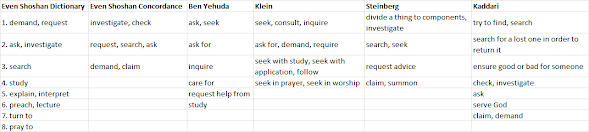
The next word in our series of PaRDeS words is derash דרש -'interpretation" or "exegesis". The root דרש is unlike the previous word, remez. First of all, רמז does not appear at all in the Tanach, where as דרש appears well over 100 times. And the meaning of remez is fairly simple - "hint", but darash has many definitions, of which none can explain all of the occurrences. Sometimes when a word has a variety of usages, it is possible to point to the earliest, "original", meaning. This does not seem to be easy with darash. The dictionaries didn't help much. I looked at six Hebrew dictionaries, all of which pay attention to the history of the word. Usually, the first definition listed is considered to be the original one. But as you'll see below, each dictionary came up with a different list, with a different order:


Most of these meanings appear somewhere in the Tanach (with the exception of "preach, lecture"). So we can't claim biblical usage as a sign of original meaning.

Klein actually provides an etymology:


JAram.-Syr. דרש, Mand. דרש (= he examines; he instructed, taught). Arabic darasa (= he learned, studied), Ethiopian darasa (= he expounded, interpreted) are Aramaic loan words. The original meaning of this base probably is 'to tread, trample, rub', hence ultimately identical with base דרס.

Klein defines דרס as "to tread, trample" but doesn't explain the connection to darash there either. Perhaps one of you can see the connection between דרס and דרש, but nothing seems obvious to me.

Stahl, in his Arabic dictionary, connects דרש to both דרס and also to דוש, which means "to tread, thresh" (possibly based on Gesenius here). He writes (my translation):


studying requires repetition, as does the threshing of grain

He points us to the word "studio" for similar development. From the Online Etymology Dictionary for the word "study":

c.1125, from O.Fr. estudier "to study" (Fr. étude), from M.L. studiare, from L. studium "study, application," originally "eagerness," from studere "to be diligent" ("to be pressing forward"), from PIE *(s)teu- "to push, stick, knock, beat"

The problem with this theory is that darash only appears once in the Tanach with the meaning "to study" - in Ezra 7:10. This seems to be a pretty late source, and none of the dictionaries put that meaning near the top. Heschel, in Heavenly Torah: As Refracted through the Generations,   (pages 251-252) describes the shift of meaning in Ezra's time:


Scripture says that Ezra "dedicated himself to seek out the meaning [lidrosh] of the Torah of the Lord" (Ezra 7:10)

and in footnote 45, there continues:


It is worth noting that this verse expresses something of historic importance. Previously, the root drsh was used for seeking out God, that is, for consulting an oracle, a priest or a prophet. Now it is used for the teaching of God, for the Torah. Ezra begins to inquire of a test, and thus we are signaled that the era of prophecy is at an end.

The Encyclopedia Judaica article on "Midrash" (found here), also points to the Latin studium, but has a somewhat different description than Stahl:


The term Midrash itself derives from the root drsh (דרש) which in the Bible means mainly “to search,” “to seek,” “to examine,” and “to investigate” (cf. Lev. 10:16; Deut. 13:15; Isa. 55:6; et al.). This meaning is also found in rabbinic Hebrew (cf. BM 2:7: “until thou examine [tidrosh] thy brother if he be a cheat or not”). The noun “Midrash” occurs only twice in the Bible (II Chron. 13:22 and 24:27); it is translated in the Septuagint by βίβλοs, γράφη i.e., “book” or “writing,” and it seems probable that it means “an account,” “the result of inquiry (examination, study, or search) of the events of the times,” i.e., what is today called “history” (the word history is also derived from the Greek root ίστορὲω which has a similar meaning). In Jewish literature of the Second Temple period the word Midrash was first employed in the sense of education and learning generally (Ecclus. 51:23), “Turn unto me, ye unlearned, and lodge in my house of Midrash,” which the author’s grandson translated into Greek, “house of instruction or of study”; compare the similar development of the Latin studium which originated in the verb studeo which means “to become enthusiastic,” “to make an effort,” “to be diligent,” etc. and only in a secondary sense, in the post-Augustan era, in the sense of learning (with diligence and the noun studium passed through the same stages of meaning; cf. Ger. studium; Fr. étude, etc.).

So if I understand Moshe David Herr's EJ article, he says that first the word darash meant "to search" or "to seek", and from there developed to the sense of "to study", with a similar pattern in Latin. However, that leaves an obvious question. Where would the connection to דרס fit in to Herr's theory?

In the Theological Dictionary of the Old Testament, Wagner has an extensive discussion about the usage and meaning of the root דרש, on pages 293-307. In the section on etymology, he writes:


The root drs is found in several Semitic languages: Aramaic, Arabic, Ethiopic, Syriac and Mandean, and is attested in Ugaritic (as yet only once, according to Bauer's reconstruction). It is debatable whether Akkadian darasu has anything to do with the same root. The original meaning of drs is hard to determine. It is probably correct to translate it by the English words "seek," "ask," "inquire (of)" (Ugar. "interrogate, question"?). The root must have undergone a change of meaning in the course of its use. In late Semitic languages such as Middle Hebrew, Jewish Aramaic and Syriac one encounters meanings like "interpret," but also "tread," "trample".

So Wagner basically reverses Klein's theory and says that דרס followed דרש.

Gesenius supports Klein, by saying that the original meaning was "to tread a place, i.e. to go or come to it, to frequent" and from there "to seek, to search for". I'm not sure who's right. Gesenius is the only one to flush out Klein's theory (of course Klein read Gesenius, not the other way around), but it seems somewhat forced. And the fact that darash never actually means "to tread" in Biblical Hebrew leads me to give more weight to Wagner's theory.
Regardless of the original meaning, by Talmudic times the verb darash came to be almost exclusively associated with study, meaning "to expound, interpret" or "to teach, lecture". The former sense gave us the word מדרש midrash (actually appearing once in the Tanach - Divrei Hayamim II 13:22) meaning "homelitical interpretation", and the latter sense we find in both the words derasha דרשה - "sermon" and beit midrash בית מדרש - "house of study".
This Philologos column discusses the connection between the Hebrew beit midrash and the Arabic madrasah - "school":
Madraseh, like many terms used by the world's Muslims, comes from Arabic, in which it is a nominal form of the verb darasa, "to study." In contemporary Arabic, however, madrasa does not necessarily mean a religious seminary. It is the generic word for "school," so that a second-grader learning to read and write is attending a madrasa, too. It is only in non-Arabic languages spoken by Islamic peoples that the word specifically refers today to a religious institution of higher learning.
...
As for the Jewish beit midrash, or "house of study," it comes from the verb darash, "to seek" (exactly as the talib of "Taliban" comes from talaba, "to seek"), and goes back to early rabbinic times in Palestine — that is, to the very beginning of the Common Era. Jewish education in this period began with a beit sefer, a "house of the book" (the generic Hebrew word for "school" to this day) in which young children were taught reading, writing and Bible; continued with a beit talmud, or "house of learning," in which some Mishna and simple rabbinic jurisprudence was taught to older children, and progressed to a beit midrash, in which advanced students sat at the feet of famous rabbis. The original beit midrash was thus similar to what eventually came to be known among Jews as a yeshiva, literally, "a sitting." Over the centuries, however, as the word yeshiva replaced beit midrash for an institute of higher Jewish learning, beit midrash came to denote an informal place of study in which anyone could sit and learn on his own in the presence of a library of sacred books.
...
The interesting question is whether the linguistic connection between the Muslim madrasa and the Jewish beit midrash is more than a matter of the general kinship between Arabic and Hebrew and actually has a causal element — i.e., whether the word madrasa was modeled on beit midrash. Although I can't think of any way of proving or disproving this, my instincts tell me that it was probably what happened. Rabbinic Judaism had an enormous influence on early Islam, and many Islamic institutions and concepts were knowingly or unknowingly taken from it. Moreover, when one reflects that pre-Islamic Arab society had no system of formal education at all; that the word kuttab is allied to kitab, "book," like sefer in beit sefer, and that the original beit midrash was an institution of higher religious learning just as the madrasa was, it seems likely that early Islam borrowed its terminology for different kinds and stages of schooling at least partly from Jewish sources.
In Modern Hebrew, as often happens, we've returned to the Biblical sense, and the most common usage of דרש is "to require".
In the spirit of seeking and studying, I'd like to ask (not demand!) from my readers some help. In the course of researching this post, I found this page. In the section discussing Sanskrit, they write:
Among the derivative verbal systems are the causative and the desiderative ("desire to"); the former has an affix -ay- (gam-ay-a-ti "makes to go," kar-ay-a-ti "has do") or, after roots in -a, -pay- (stha-pay-a-ti "sets in place"). The desiderative is formed with -sa- and reduplication (repetition of a part of the root)--di-drk-sa-te "desires to see" (root drsh). The desiderative also has an agent noun in -u--di-drk-s-u "who wishes to see."
Does anyone know if there's a suggested connection between the Sanskrit and the Hebrew drsh? Let's keep the suggestions in the realm of peshat, not derash...

***********
Update: I've given the question of darash / daras some more thought, and I think I overlooked something. In addition to daras, we have another verb that clearly means "tread" - דרך darach. Klein says that darach is related to דרג - also meaning "to walk". So now we have three roots that mean "to tread/ walk", which leads me to believe that perhaps we're talking about an early two-letter Hebrew root. We might also be able to add דדב - "to be accustomed, be trained" and דרר - "to flow abundantly, run swiftly". In that case, it's not so farfetched to think that darash is also connected, maybe similar to Gesenius. First "to walk", then "to seek".

Friday, May 30, 2008

remez

Back in December, I started a series of words, but never finished them. Do you remember the series? I'll give you a hint...

I was discussing the words that make up the acronym PaRDeS, and I had already reviewed the word peshat. Today we'll look at the word remez רמז, meaning "hint".

Klein says the verb רמז means "to wink, beckon, hint, allude, make signs", and is related to the Arabic ramaza - "he winked with the eyes". Stahl points out that the Arabic name Ramzi, meaning "symbol" derives from this root. In Modern Hebrew we have the word ramzor רמזור, "traffic light", which is a compound of רמז - "he made a sign" and אור or - "light".

Remez
only appears in post-Biblical Hebrew. However, many feel that a metathesized form of the word appears in the Tanach. The problem is it only found once, in Iyov 15:12

מַה-יִּקָּחֲךָ לִבֶּךָ; וּמַה-יִּרְזְמוּן עֵינֶיךָ.

This is in the section where Eliphaz is criticizing Iyov's attitude toward God. The classic commentaries (Rashi, Ibn Ezra) as well as Klein in his dictionary say that the root רזם here means wink, and is a form of רמז. They would therefore translate the verse as:

"How your heart has carried you away, and what do your eyes wink / hint at."
This article says that perhaps the Talmudic name murzema, cognate to the Arabic mirzam, meaning "flamingo", might derive its name from remez as "hint", as a euphemism for the bird's loud call.

Kaddari, however, thinks that the two roots are not necessarily related. He says that רמז is borrowed from Aramaic and Syriac, but רזם appears in the Lachish letters.

Ben Yehuda also claims the roots are not related, but he goes further, and says that the root רזם means "to weaken", and only in the Middle Ages was the root used as a synonym for רמז. It would seem that if רזם means "weak", it might be related to the root רזה, meaning "thin, lean". This is the New JPS Translation as well, "how your eyes have failed you", although they do note that "meaning of Hebrew uncertain".

In the footnote for Ben Yehuda's entry on רזם, he refers us to the commentary of Tur-Sinai on Iyov (actually it was probably Tur-Sinai himself doing the referring, since he was the editor of the volume.) Tur-Sinai disagrees with Shadal, who emends the verse in Iyov to read ירומון instead of ירזמון. (See footnote 25 here, and here for a full discussion of Shadal and textual emendation. Tur-Sinai was no stranger to emendation - his Biblical commentary seems to suggest one for every difficult verse.)

Shadal's suggestion of ירומון - "how you have raised your eyes" or "why are your eyes lifted up" does make sense in the context. "Raised eyes" - עינים רמות - enayim ramot, is a common biblical image for pride (see Mishlei 6:17, 21:4, Tehillim 18:28, 101:5). Eliphaz is criticizing Iyov for excessive pride. He asks him, "Were you the first man born ... Have you sole possession of wisdom ... What do you know that we do not know?" So certainly it would make sense that he was accusing Iyov of pride - perhaps more so than winking or failing eyes.

However, in this case, I think Shadal might have relied on something more than the contextual meaning. The Septuagint translates ירזמון as ephnegkan - επηνεγκαν, which means "carry, lift up." The root of this word is pherein - "to carry", and is the source of the words infer, aquifer and fertile (and we've also seen it in the Hebrew word apiryon אפריון).

But if Shadal's emendation was based on the Septuagint, I might have a suggestion that would not require changing the text. We've mentioned the theory that רזם might mean "weak" based on an Arabic root. But רזם in Arabic can also refer to a "bundle or package". Maybe "carrying (a bundle)" was the meaning of רזם that the Septuagint was trying to convey?

Stahl writes that the word ruzmeh (or rizmah) went from the general meaning of "bundle" to the specific meaning of "bundle of paper". From here we get the English word "ream (of paper)":


from O.Fr. reyme, from Sp. resma, from Arabic rizmah "bundle" (of paper), from rasama "collect into a bundle." The Moors brought manufacture of cotton paper to Spain. Early variant rym (1470s) suggests a Du. influence (cf. Du. riem), probably during the time of Spanish Hapsburg control of Holland.
The American Heritage Dictionary has a similar entry for the Semitic root rzm:

Arabic root, to bundle. ream, from Arabic rizma, bundle, from razama, to bundle.
In the end, with the word ירזמון only appearing once in the Tanach, we may never really know. But these kinds of words leave a lot open to interpretation, which is why the Tanach has so many levels - one of which is remez (allegory)...

Thursday, May 15, 2008

balashon logo

I'd like to add some sort of logo or graphic to Balashon, that I could use to represent the site, and use to dress up the site a bit. I have no real graphic skills, so if any of you readers out there would like to try to come up with something, it would be great. I was thinking maybe something with the word בלשון with each letter in a different Hebrew script (Ivri, Ashuri, Rashi, etc), but I'm open to ideas. A link to my email is in the sidebar. Thanks...

*** Update: Thanks to Joel Nothman, I've updated the page header. As always, I'd appreciate your feedback on any issues of layout...

why not in hebrew?

(This post is explaining why this site is not written in Hebrew).


לפעמים שואלים אותי, "אם אתה כותב על לשון העברית, למה האתר לא בעברית?"


יש שתי סיבות:


א) למרות שאני אוהב ללמוד על עברית, ויש לי נסיון בכתיבה בעברית, יש לי עדיין הרבה טעויות, בדקדוק ובאיות. אני חושש שהשגיאות האלה יסיחו את דעתו של הקורא מתוכן המאמר.


ב) אני כותב הרבה על השינויים של משמעויות של מילים בעברית במשך הדורות. קשה מאד לעשות את זה בכתיבה בעברית, כי אז לא ברור אם אני מדבר על המילה או על המושג. קחו את המאמר הזה לדוגמא. אני טוען שמה שקוראים "חורף" היום זה בעצם סתיו, ו-"סתיו" הוא חורף.

הרבה יותר קל לעשות את זה באנגלית, שבה אני יכול להגיד ש:


While today stav means "autumn", originally it referred to winter


בעברית זה היה "היום סתיו זה סתיו אבל במקור היה חורף"


רואים את הקושי?


אז אני מתנצל לאלה שקשה להם באנגלית, אבל אני מניח בסוף גם הם ילמדו משהו על העברית...

Sunday, May 11, 2008

degel

Degel דגל is an interesting word. Ask any Israeli - or any Hebrew speaker for that matter - and they will tell you that it means "flag". That certainly is the uncontested meaning in Modern Hebrew. But I imagine that only a precious few will know the meaning the word had in Biblical Hebrew (do you?). And as far as when that meaning changed? I'm still working on it myself...

In the Tanach, the word degel primarily appears in the beginning of the book Bamidbar, in the section describing the arrangement of the camp. Verse 1:52 says:

וְחָנוּ, בְּנֵי יִשְׂרָאֵל, אִישׁ עַל-מַחֲנֵהוּ וְאִישׁ עַל-דִּגְלוֹ, לְצִבְאֹתָם

The JPS translation is: "The Israelites shall encamp troop by troop, each man with his division and each under his standard". The translation of degel here is "standard", which originally meant a "flag or other conspicuous object to serve as a rallying point for a military force".

Similarly, verse 2:2 -

אִישׁ עַל-דִּגְלוֹ בְאֹתֹת לְבֵית אֲבֹתָם, יַחֲנוּ בְּנֵי יִשְׂרָאֵל: מִנֶּגֶד, סָבִיב לְאֹהֶל-מוֹעֵד יַחֲנוּ.

is translated, "The Israelites shall camp each with his standard, under the banners of their ancestral house; they shall camp around the Tent of Meeting at a distance"

However Milgrom, in his (JPS) commentary on Bamidbar, disagrees with the translation of degel as "standard". On 2:2 he writes:

Hebrew degel possibly originally meant a military banner. This is supported by the Akkadian dagalu, "to look", and diglu, "sight". The meaning "banner" was later extended by association to include the army division, just as shevet and matteh, the two terms for "tribe", were probably derived from the "rod" that served as the official tribal insignia (cf. 1:45; 14:17-18). The meaning "unit" better fits the context here, as verse 3 shows, and is supported by the Targums and the Septuagint as well as by Aramaic usage as evidenced from the Persian period by an ostracon from Arad (no. 12) and the papyri from Elephantine. It comprised a garrison of 1,000 men that lived together with their families and, as attested by the Aramaic documents of the Persian period, was an economic and legal unit as well as a military one. This situation corresponds closely to the makeup and function of the Israelite tribes in the wilderness, as depicted in the Book of Numbers. The meaning "military unit" is also present in the War Scroll from Qumran.
Verse 3 that Milgrom refers to says:

וְהַחֹנִים קֵדְמָה מִזְרָחָה, דֶּגֶל מַחֲנֵה יְהוּדָה לְצִבְאֹתָם

The JPS translates it as "Camped on the front, or east side: the standard of the division of Judah, troop by troop." But Milgrom notes that the translation should read

Rather, "camped ... the unit". The verb "camped" renders the translation of degel
more likely as "unit" than "standard"
(As an interesting side note, there are those who claim that the Akkadian word dagalu can be traced even further than its Semitic roots, and is related to the Indo-European root *deik, meaning "to show", and is the source of many English words including "teach" and "diction". My friend Mike Gerver, who is more familiar with this theory than I am, recommended that I add "a caveat that it is highly speculative (but still respectable).")

Moskowitz in the Daat Mikra on Bamidbar also agrees that "unit" is the meaning of degel here. He writes that this was the meaning not only in the Tanach, but in Rabbinic Hebrew as well, as in the Midrash (Shmot Rabba 16:7) - אין דגלים אלא צבאות "Degalim means none other than troops". He writes that the word is related to the Arabic dajjalah - "a large crowd". Unlike Milgrom, he claims that the meaning of "flag" is secondary, and derived from the original meaning of "division, unit".

Either the development from "flag" to "the unit under the flag", or from "unit" to "the flag representing the unit" is easy to accept. However, most scholars say that throughout the Tanach, degel meant unit. (The other instances - a few in Shir HaShirim and one in Tehillim, are often translated as if degel means "flag", but are explained by the Daat Mikra and others as either relating to sight or to a military unit). In Talmudic Hebrew, all the examples of degel that I could find were discussing or quoting the section above from Bamidbar. (The word digla דגלא appears in Beitza 30a and Bava Metsia 83a, but other manuscripts have the word appearing with a different spelling.)

So it would seem that the adoption of degel as flag happened in the post-Talmudic period. Rav Saadia Gaon on 1:52 translates degel as מרכז merkaz - which Kapach says means "the designated place that a soldier is assigned" - i.e. a military unit.

If we go even further, we get to Rashi. Rashi writes on 2:2 -

כל דגל יהיה לו אות מפה צבועה תלויה בו

Before I continue, I'd like to note that I often get asked why I don't write this site in Hebrew. Aside from the fact that my inevitable mistakes in Hebrew grammar would distract from my content, I think there's an inherent difficulty in writing about a language in that language. This Rashi is a good example of that. I'm sure Rashi knew exactly what he meant when he wrote the word degel. But it is not as clear to his readers, and so I have found two different translations of Rashi, each with an entirely different meaning of degel.

The first is the Metsudah edition of Rashi, as quoted here. They translate the commentary as:

Each banner shall have [as] its insignia a colored cloth hanging from it
They translate degel as "banner", which is certainly the popular understanding of the word. However, it does not make much sense in this context - why would a banner have a cloth hanging from it?

Judaica Press, brought here, changes the translation, so that degel means division:

Every division shall have its own flag staff, with a colored flag hanging on it
They translate ot אות, as "flag staff", which is likely to having a flag hanging from it. (This site says that degel actually means flagpole. This would be a fitting parallel to shevet and matteh, which Milgrom mentioned above - however, I have not found their source. Perhaps it's their own interpretation of Rashi.)

Artscroll also offers "division" for degel, with a slight variation in translation from Judaica Press:

Every division shall have for itself a sign, namely, a colored sheet of cloth hanging in its midst.
The main difference is how they translate ot - Artscroll says that the ot was the cloth. In their notes on Rashi on 1:52, they write:

Unlike other commentators, who understand דגל as "flag", Rashi sees it as "division, disposition of forces, military formation." This is indicated by his comments to 2:2 ... See Rashi to Isaiah 5:26, s.v. נס לגוים, where he describes a flag in detail, yet never once uses the word דגל. See also his comments to Psalms 20:6, Song of Songs 2:4 and 5:10
Who are these "other commentators"? Probably the earliest one I could find is Ibn Ezra, who on 2:2 writes that "the insignia were on every degel" and goes on to describe the images on the degel of each tribe (he's also the earliest example given by Ben-Yehuda). By the 19th century, Shadal needed to write that


degel didn't originally mean banner or flag, because that is the meaning of ot, as in "each with his degel, under the banners (otot)". But rather it is like Onkelos and all the early translations, "an ordered grouping" ... and you will see that throughout the section degel refers to people, not banners ... But after time, the word was borrowed for the meaning "flag", since every degel had a flag...
And in the end, as I mentioned above, Ben-Yehuda writes that today, in both speech and literature, the only meaning of degel is "flag".

So we've seen a word transform from referring to an actual group of people, to a flag that symbolizes them. My father often quotes the Polish-American philosopher Alfred Korzybski, who said that "the map is not the territory". (We've already noted that the English word map comes from the Hebrew word mapa - meaning banner.) The idea here is not to confuse the description of something with the thing itself.

And in a way, that concern is mentioned in the official song for the 60th anniversary of the founding of the State of Israel (click here for the song with Hebrew subtitles). In this great song, which blogger Esther Kustanowitz describes as follows:

Subliminal's collaborating with the legendary Israeli band Givatron, creating a new version of their song "Bat Shishim" (sixty years old) in commemoration of Israel's 60th birthday this spring. The song, written 26 years ago for Russian olim to Israel, now gets reborn as part folk, part hip-hop.

we find the following lyrics:

כי אמיתית היא ולא סמל ולא דגל ולא אות העבר מאחוריה היא צופה אל הבאות

which Esther translates:

For she is true, and not a symbol, nor a flag, nor a sign.
The past now behind her, she looks forward to what is coming.

So all I can add is that maybe the State is much more real than a degel according to its current meaning, but I hope (by looking to the past?) that we are becoming a chevra mesuderet חברה מסודרת - "organized society" - as Shadal wrote...

Monday, May 05, 2008

mangal

Israel celebrates its Independence Day this week - Yom HaAtzamaut. And in recent years, one of the most widespread symbols of the day, perhaps even competing with the flag, is the mangal מנגל - Israel's barbeque. What is a mangal - and where does the word come from?

A number of years ago, David Bogner of Treppenwitz asked the same question. In the end he was less concerned about the etymology than he was about how much he enjoyed manning the grill for the soldiers in the area. Some of his readers suggested that the origin was Turkish. Another veteran blogger, Allison Kaplan Sommer, agreed, and wrote:

I made my little etymological discovery this year on my vacation in Istanbul, Turkey. I was touring one of the palaces, and they were showing us the little portable stoves that would be moved from room to room so that the sultans and their families could enjoy fresh tea anywhere. And the stoves were called....Mangals! So I guess the term is leftover from the Ottoman Empire days.

The best English translation for mangal is brazier, as defined here:

1. A metal pan for holding burning coals or charcoal.
2. A cooking device consisting of a charcoal or electric heating source over which food is grilled.

In Ottoman Turkey the mangal was primarily used for heat, and cooking over it was a secondary function. I found a number of sources from the 19th century describing the mangal (see here, here and here). The last one, from 1868, describes the mangal as follows:

The "mangal" is a large dish of live charcoal, and on the introduction of this into the room or ward they are dependent for warmth.
Other regions under Ottoman rule also borrowed the word, and so we find in Romanian, Albanian and other regional languages that mangal means "charcoal". In modern Hebrew, mangal came to mean almost exclusively a stove for grilling, and now refers also to the barbecuing event itself.

However, where did the Turks get this word? According to an article by Amnon Shappira of the Hebrew Language Academy (Leshonenu Le'Am 45:3), the Turks borrowed it from the Arabic word mankal (מנקל) - also meaning stoves. Where did the switch from mankal to mangal occur? Shapira brings up the theory that it could be from Bedouins or even Yemenite Jews, who substitute "g" for "k". However, he writes that the use of the mangal was not as common on the Arabian peninsula, but more likely entered Turkish via Persian, which makes a similar consonant switch.

What does mankal mean in Arabic? The root of the word is נקל, which means "transport, transmit, convey". So as Allison wrote, the "little portable stove" became known as mankal. (The Hebrew acronym for CEO - מנכ"ל, is not related).

This Arabic root is the source of the word nagla נגלה - which originally meant "load" (as in donkey-load) and took on the meaning "round" or "trip" in Modern Israeli slang. In this case, according to Stahl, the switch from nakla to nagla is via Bedouin pronunciation.

Another word deriving from the same root is the game mancala (also mankala / manqala). This game (popular with my kids, although I haven't actually played it yet), involves transferring stones around a board.

There is actually one classical Hebrew word that might be cognate to the Arabic. That is the word makel מקל - meaning "staff" or "walking stick", and it is found in the Tanach (although far less frequently than the words mateh מטה and shevet שבט, of similar meaning.) The etymology of the word is unclear, and Ben-Yehuda lists many theories. One of them is that it is related to נקל. Stahl says this because the stick was used to move animals from place to place, as in Bamidbar 22:27:
וַיַּךְ אֶת-הָאָתוֹן בַּמַּקֵּל "and he struck the donkey with his stick"

I think perhaps another verse that could show a connection would be Bereshit 32:11, where Yaakov says "with my staff I passed over this Jordan" - כִּי בְמַקְלִי, עָבַרְתִּי אֶת-הַיַּרְדֵּן הַזֶּה

However, in the end, both Klein and Even-Shoshan say that makel might actually derive from the Egyptian word ma-qi-ra.

Let's end on a slightly more patriotic note. The official Hebrew word for mangal is matzleh מצלה, and nagla is masov מסוב. I haven't heard one yet for mancala...

Wednesday, April 30, 2008

shoah and holocaust

This week Israel observes Yom HaShoah - יום השואה, whose full name is Yom HaZikaron laShoah ve-laGvura יום הזיכרון לשואה ולגבורה. This is generally translated as "Holocaust Remembrance Day". However, it is very common for Jewish writers to use the Hebrew word "Shoah" instead of the English word "Holocaust". Why is that?

Let's start by looking at the word "holocaust". Here's the Online Etymology Dictionary entry:

c.1250, "sacrifice by fire, burnt offering," from Gk. holokauston, neut. of holokaustos "burned whole," from holos "whole" + kaustos, verbal adj. of kaiein "to burn." Originally a Bible word for "burnt offerings," given wider sense of "massacre, destruction of a large number of persons" from 1833. The Holocaust "Nazi genocide of European Jews in World War II," first recorded 1957, earlier known in Heb. as Shoah "catastrophe." The word itself was used in Eng. in ref. to Hitler's Jewish policies from 1942, but not as a proper name for them.
The word "holocaust" referring to a burnt offering sacrifice can be seen clearly in this Jewish Encyclopedia article on sacrifices. In the article, written over 100 years ago, the term holocaust as a sacrifice appears frequently. The United States Holocaust Memorial Museum discusses the development of the term:

While the word holocaust, with a meaning of a burnt sacrificial offering, does not have a specifically religious connotation, it appeared widely in religious writings through the centuries, particularly for descriptions of "pagan" rituals involving burnt sacrifices. In secular writings, holocaust most commonly came to mean "a complete or wholesale destruction," a connotation particularly dominant from the late nineteenth century through the nuclear arms race of the mid-twentieth century. During this time, the word was applied to a variety of disastrous events ranging from pogroms against Jews in Russia, to the persecution and murder of Armenians by Turks during World War I, to the attack by Japan on Chinese cities, to large-scale fires where hundreds were killed.

Early references to the Nazi murder of the Jews of Europe continued this usage. As early as 1941, writers occasionally employed the term holocaust with regard to the Nazi crimes against the Jews, but in these early cases, they did not ascribe exclusivity to the term. Instead of "the holocaust," writers referred to "a holocaust," one of many through the centuries. Even when employed by Jewish writers, the term was not reserved to a single horrific event but retained its broader meaning of large-scale destruction. For example:

You are meeting at a time of great tragedy for our people. In our ... deep sense of mourning for those who have fallen ... we must steel our hearts to go on with our work ... that perhaps a better day will come for those who will survive this holocaust. (Chaim Weizmann, letter to Israel Goldstein, December 24, 1942)

What sheer folly to attempt to rebuild any kind of Jewish life [in Europe] after the holocaust of the last twelve years! (Zachariah Shuster, Commentary, December 1945, p.10)

By the late 1940s, however, a shift was underway. Holocaust (with either a lowercase or capital H) became a more specific term due to its use in Israeli translations of the word sho'ah. This Hebrew word had been used throughout Jewish history to refer to assaults upon Jews, but by the 1940s it was frequently being applied to the Nazis' murder of the Jews of Europe. (Yiddish-speaking Jews used the term churbn, a Yiddish translation of sho'ah.) The equation of holocaust with sho'ah was seen most prominently in the official English translation of the Israeli Declaration of Independence in 1948, in the translated publications of Yad Vashem throughout the 1950s, and in the journalistic coverage of the Adolf Eichmann trial in Israel in 1961.

Such usage strongly influenced the adoption of holocaust as the primary English-language referent to the Nazi slaughter of European Jewry, but the word's connection to the "Final Solution" did not firmly take hold for another two decades. The April 1978 broadcast of the TV movie, Holocaust, based on Gerald Green's book of the same name, and the very prominent use of the term in President Carter's creation of the President's Commission on the Holocaust later that same year, cemented its meaning in the English-speaking world. These events, coupled with the development and creation of the United States Holocaust Memorial Museum through the 1980s and 1990s, established the term Holocaust (with a capital H) as the standard referent to the systematic annihilation of European Jewry by Germany's Nazi regime.


Clearly, it can be understood why it might be considered offensive to describe the murder of millions as a sacrifice, particularly a religious one. So even though the term had been so used before the Nazi genocide, once the phrase "The Holocaust" came to describe the acts of the Nazis, there was a need for a more appropriate term, and many began using the Hebrew "Shoah" in English as well. This is Yad Vashem's explanation of the use of the term Shoah in languages other than Hebrew:

The biblical word Shoah (which has been used to mean “destruction” since the Middle Ages) became the standard Hebrew term for the murder of European Jewry as early as the early 1940s. The word Holocaust, which came into use in the 1950s as the corresponding term, originally meant a sacrifice burnt entirely on the altar. The selection of these two words with religious origins reflects recognition of the unprecedented nature and magnitude of the events. Many understand Holocaust as a general term for the crimes and horrors perpetrated by the Nazis; others go even farther and use it to encompass other acts of mass murder as well. Consequently, we consider it important to use the Hebrew word Shoah with regard to the murder of and persecution of European Jewry in other languages as well.


What is the origin of Shoah? The word שואה meaning "catastrophe, devastation" derives from the root שאה. According to Klein, this root originally meant "to make a din or crash", then "crash into ruins", and then "to ruin, lay waste". The original sense of making noise can be found in the related word teshua תשואה - "noise, tumult", which doesn't have a negative connotation at all (see Zecharia 4:7).

Monday, April 28, 2008

bagel

One of the columnists who inspired this site is Philologos of The Forward. He writes about Jewish words and phrases, and specifically has a good knowledge of Yiddish (which I do not share). Nowhere on the site is his name given, but most of the speculation on the internet indicates that it's the writer Hillel Halkin. I have no inside knowledge to confirm or deny this, but there are some hints in his writing. For example, in this week's column he quotes Prof. Meir Bar-Ilan, who happens to be Halkin's cousin. (We've also seen him quote Halkin's uncle Rabbi Saul Lieberman before, but Lieberman was such a well known expert that it doesn't necessarily indicate a family relationship.)

Until recently, I hadn't read any of Halkin's identified writings. But not long ago, I started reading a very interesting book by him called Letters to an American Jewish Friend: A Zionist's Polemic. The book consists of long letters that Halkin, living in Zichron Yaakov in the 1970s, wrote to an American friend. The letters discuss the roles of Israel and the diaspora, and the importance of making aliya. I haven't finished the book yet, but although it's over 30 years old, I think it still seems very relevant (and some of the anachronisms are fun too.)

At one point reading the book, I got a feeling that if Halkin isn't Philologos, they certainly share an interest in Hebrew etymology (as of course, I do.) On page 22, Halkin quotes his anonymous American correspondent:

It's a little like that butt of so many old jokes, the bagel. What other item of food is more quintessentially Jewish in America? And then you come to Israel and discover that there is something called a bagel there too, or rather, a bageleh (Moisheleh, Saraleh, imaleh, why not bageleh?), and that it shares certain properties with the bagel you know: it's round, there's a hole in the middle, etc. ... only the taste just isn't the same. (For one thing, it's sprinkled with sesame, and I happen to hate sesame. The hole is too big, the dough is too soft, I won't even mention cream cheese or lox, which you can look high and low for - a grilled porkchop is far easier to find in your Jewish state.) One could, I suppose, investigate the common European ancestor of the two to determine which is more authentic, but this would lead to the discovery of a third bagel, resembling the first two yet unique unto itself. And why should one have to choose among them?
And regarding the bagel, Halkin responds:

Concerning the real sesame on your metaphorical bagel, by the way, it certainly is not European in origin; in fact, it derives from the Arabs, who bake a hard, round doughnut calld ka'ak similar to the Israeli; yet this only complicates the problem, since it's likely that the Arab ka'ak is a descendant of an ancient Palestinian Jewish bagel or ka'ach that is referred to in the Mishnah. Such are the strange dialectics of the return of a people to its land.
So this is one of those anachronisms - today it's easy to find in Israel lox, cream cheese and "American bagels". (Haven't tried looking for pork chops for comparison). But lets look a little further at how the Israeli bageleh and the American bagel diverged.

Clearly the words have the same origin. The Online Etymology Dictionary provides the following origin for "bagel":

1919, from Yiddish beygl, from M.H.G. boug- "ring, bracelet," from O.H.G. boug, related to biogan "to bend" and O.E. beag "ring"
William Safire (the first language columnist to inspire me) writes in this 1994 column:

The bagel, according to the Yiddishist Leo Rosten, was first cited in the community regulations of Cracow, Poland, in 1610; the toroidal roll was said to be a gift to women in childbirth. (That strikes me as apocryphal; next we'll hear that the Civil War expression about bearing pain, to bite the bullet, was rooted in to bite the bagel. Not so.)

The word for the medieval jawbreaker was imported into English from the Yiddish beygl, which in 1919 was spelled beigel and in 1932 was shortened to bagel. According to the Barnhart Dictionary of Etymology, it is rooted in the Old High German boug, related to biogan "to bend," from the Proto-Germanic biuzanan and the Indo-European bheugh-, the pronunciation of which is a melancholy exhalation.


If bending, ring shaped dough reminds you of another food - the pretzel - that's not a coincidence. In her book Classic Russian Cooking, Elena Molokhovets writes that

Pretzels are a very old form of baked goods and were referred to in Jewish sources as early as the first half of the thirteenth century. (A bagel is simply a type of pretzel.) Bagels, with many local variations, were known throughout the historic territory of the Ashkenazi Jews.

The term bageleh in Hebrew therefore refers to pretzels. The original association of course is with soft bagels, not the hard ones found in vending machines, but the term applies to both.

If you're finding it difficult to make the connection between bagels and pretzels, take a second and try to describe the difference (other than the sesame seeds mentioned above - I always been a fan of sesame bagels.) It turns out that the difference is in the boiling process:

Homemade pretzels and soft pretzels are often made much the same way as bagels, by poaching them in boiling water before baking, the difference being that bagels are usually poached in salt water rather than water and baking soda.
So we today find in Israel bageleh בייגלה - pretzels and bageleh amerikai - American bagels. What about ka'ach כעך?

While it might be the more official word, it seems to be much less popular than bageleh. This is evidenced by the discussion on the Hebrew Wikipedia page, where the writers aren't sure whether a ka'ach is a bagel or a pretzel.

Stahl writes that the word ka'ach was chosen in Modern Hebrew because of its use in Talmudic Hebrew (see Pesachim 48b and Brachot 38a where it appears as כעבין). Then it seemed to mean small loaves of bread. Klein defines it as "ring-shaped cake", and provides the following etymology:

Aramaic כעכא, borrowed from Persian kak, whence also Arabic ka'k.
Stahl says that there are even earlier references in Ancient Egyptian and Coptic. The word kahk seems rather similar to the English word "cake", with cognates in other European languages. However, Stahl writes that linguists do not feel that the words are connected, but perhaps both developed independently from baby-talk, similar to "mama" and "papa".

I'll end with a cute joke I found while researching this topic.


שני בייגלה יושבים על המדף בחנות.
פתאום בא מישהו
ולוקח אחד מהם, אז השני צועק: "לאא!!!! היינו כאחים!!"

"Two bagelach were sitting on the shelf of a store. Somebody comes and takes one of them, and the other shouts - 'No!!! We were k'achim!! (literally 'like brothers')"

Friday, April 25, 2008

new category: Shir HaShirim

Since I started this site, I've found that Shir HaShirim שיר השירים (which we'll be reading tomorrow, the seventh day of Pesach) has some of the most interesting words in Hebrew. I don't have a new one to write about today, but I've put all the posts that refer to words in Shir HaShirim in the following category:

http://www.balashon.com/search/label/Shir%20HaShirim

In the meantime, I'm working on an interesting post for next week, but because it's chametz related, I won't mention the topic until after the holiday...

Wednesday, April 23, 2008

ken

One of the first words people often learn in Hebrew is ken כן - "yes". However, that meaning only began in the Middle Ages. In the Bible it appears frequently, but as an adverb with the more general sense of "so" or "thus". Klein provides two possible etymologies. One is that the word, and its Semitic cognates

probably derive from the Semitic demonstrative base *ka- . Compare כה, כי and אכן.
The other theory is that

according to some scholars כן derives from כון, hence literally means "established, confirmed" and is related to כן [second definition]
That second entry for ken is an adjective and means "right, truthful, honest". The root כון "set up, establish, be firm; prepare, ready; straighten, direct", and its related form כנן "regulate, adjust" provide us with many common Hebrew words:
  • konan כונן - rack, computer disk drive (from "set up, established")
  • konanit כוננית - shelf, book stand
  • konanut כוננות - preparedness
  • hachana הכנה - preparation
  • muchan מוכן - ready
  • mechina מכינה - preparatory class, school
  • nachon נכון - correct
  • techuna תכונה - originally "arrangement", now "character"
  • kavana כונה - intention (from "he directed")
  • kivun כיוון - direction
  • machon מכון - fixed place, later institute, institution
In the Bible we also find the word mechona מכונה meaning "base, stand". In the Haskala period the word mechona was used to mean "machine" - only due to its similar sound. From here, Itamar Ben-Avi (Ben-Yehuda's son) coined the term mechonit מכונית for "automobile" (originally agala mechonit עגלה מכונית - "mechanical carriage"). According to Kutscher here, monit מונית - "taxi" is also connected:

There is no end to innovations in the domain of technology. Understandably, few were founding ancient sources and the majority have been borrowed from foreign tongues. The Greek mekhane has been given a Hebrew garb in mekhona for “machine.” Hence mekhonit for “motor-car,” and, by dropping the “kh” we have monit, a taxi, which looks as if it were related to the root מנה (mnh – “to count”) and is thus closer to the original meaning of “taxi” (which, of course, is short for “taximeter”).


The word ken appears in a number of common words and phrases as well:

  • בכן - if so, thus
  • לכן - therefore
  • שכן - because
  • אחר-כן - afterwards
  • אם כן - if so
  • אלא אם כן - unless
  • אף על פי כן - nevertheless
  • על כן - therefore
  • גם כן - also
  • כמו-כן - likewise
While many of these phrases appear with these meanings in the Tanach, the last one - kmo khen - has a very different origin. Avshalom Kor in Higiya Zman Lashon writes that the origin of this phrase is from Yeshayahu 51:6 -

שְׂאוּ לַשָּׁמַיִם עֵינֵיכֶם וְהַבִּיטוּ אֶל-הָאָרֶץ מִתַּחַת, כִּי-שָׁמַיִם כֶּעָשָׁן נִמְלָחוּ וְהָאָרֶץ כַּבֶּגֶד תִּבְלֶה--וְיֹשְׁבֶיהָ, כְּמוֹ-כֵן יְמוּתוּן; וִישׁוּעָתִי לְעוֹלָם תִּהְיֶה, וְצִדְקָתִי לֹא תֵחָת.

The JPS translates it as:

Raise your eyes to the heavens,
And look upon the earth beneath:
Though the heavens should melt away like smoke,
And the earth wear out like a garment,
And its inhabitants die out as well,
My victory shall stand forever,
My triumph shall remain unbroken.

The phrase kmo khen yemutun is translated as "will die as well", where kmo khen means as we offered above "as well". But Kor points out that the singular of kinim כינים - "lice" is ken כן - "louse", just as the singular of izim עיזים - "goats" is ez עז -"goat" (another example is ניסים nissim - "miracles", and nes נס.) While we are more familiar with the singular form kina כינה, Kor writes that it is only the feminine of ken (as iza עיזה is the feminine of ez).

He writes that the structure of the verse indicates that a better translation would be "die like a louse", because the previous two examples were "melt away like smoke" and "wear out like a garment". To die "as well" doesn't make sense in the context.

While we do find kmo and ken connected (but not adjacent) in the Tanach - Mishlei 23:7 - this is a nice way of showing how our initial assumption of the meaning of the phrase can be affected by its more common use. Or maybe we just don't like to think about lice...

Sunday, April 13, 2008

mesubin

I had thought of writing a post on mesubin over two years ago - when I started this site. We are all familiar with the fourth question at the Seder:

שֶׁבְּכָל הַלֵּילוֹת אָנוּ אוֹכְלִין בֵּין יוֹשְבִין וּבֵין מְסוּבִּין, הַלַּיְלָה הַזֶּה כּוּלָנוּ מְסוּבִּין.

This is generally translated as "On all other nights we eat either sitting or reclining, but on this night, we all recline." However, I recalled hearing or reading an explanation that said that mesubin in this case might mean "gathered around" and not "reclining".

So for two years this sat in my queue, until this year. And in the spirit of of the Haggadah, I decided to ask a question of my own: What was the original meaning of mesubin and when did it come to mean reclining? I asked this question of many experts - some regular readers of this site, others well known researchers. While I can't thank them all individually here - I would like to express my appreciation for all of their help.

So let's start explaining the term mesubin - מסובין (I'll discuss the vowelization of the word, with couple of alternatives at the end of the post.) I will review in parallel both the meaning of the word, and the practice of reclining.

Biblical Period: The root of the word mesubin is סבב, which appears frequently in Biblical Hebrew. However, it almost always means "surround, encircle, turn around." There are only two verses where it might be related to dining. One is Shir HaShirim 1:12 - עַד-שֶׁהַמֶּלֶךְ, בִּמְסִבּוֹ. While most translations have "while the king was at his table", Kaddari says it means "at his circle."

The other verse is from Shmuel I, and might be able to teach us more about the origin of the word. In chapter 16, the prophet Shmuel is visiting the family of Yishai, looking for the future king. The family is reluctant to bring the youngest brother, David, but Shmuel insists that they bring him. In verse 11, he says to bring David - כִּי לֹא-נָסֹב עַד-בֹּאוֹ פֹה. There are commentaries that explain this verse as "we will not continue (i.e. turn away) until he comes." But most translations offer "we will not sit down to eat until he comes". On the assumption that they were not going to be reclining on beds (as we will see shortly), the literal meaning would have been "sit around the table to eat". The association with reclining developed later.

Did they recline at meals in Biblical times? First of all, it is important to understand that the reclining we are discussing is not the leaning that we do today at the Seder. To eat while reclining meant reclining on a bed, with a small table below the bed for each diner. (Some pictures of this can be seen here.) However, as Meir Ish-Shalom points out in his commentary on the Haggadah Meir Ayin, the ideal images of dining in the Tanach involved all the participants in the meal sitting around one table:

בָּנֶיךָ, כִּשְׁתִלֵי זֵיתִים-- סָבִיב, לְשֻׁלְחָנֶךָ. - "Your sons, like olive saplings around your table" (Tehillim 128:3)

טָבְחָה טִבְחָהּ, מָסְכָה יֵינָהּ; אַף, עָרְכָה שֻׁלְחָנָהּ. - "She has prepared the feast, mixed the wine, and also set the table" (Mishlei 9:2)

The earliest examples of reclining at a meal are from the book of Amos. However, the practice is viewed as decadent and is highly criticized by the prophet:

וְעַל-בְּגָדִים חֲבֻלִים יַטּוּ, אֵצֶל כָּל-מִזְבֵּחַ; וְיֵין עֲנוּשִׁים יִשְׁתּוּ, בֵּית אֱלֹהֵיהֶם - "They recline by every altar on garments taken in pledge, and drink wine bought with fines they imposed, in the house of their god " (2:8)

הַשֹּׁכְבִים עַל-מִטּוֹת שֵׁן, וּסְרֻחִים עַל-עַרְשׂוֹתָם; וְאֹכְלִים כָּרִים מִצֹּאן, וַעֲגָלִים מִתּוֹךְ מַרְבֵּק - "They lie on ivory beds, lolling on their couches, feasting on lambs from the flock and on calves from the stalls".

The prophet Yechezkel also criticizes the practice: וְיָשַׁבְתְּ עַל-מִטָּה כְבוּדָּה, וְשֻׁלְחָן עָרוּךְ לְפָנֶיהָ - "you sat on a grand couch with a set table in front of it" (23:41).

By the time we get to the book of Esther, the practice was viewed more neutrally, and we find Esther reclining on a bed: וְהָמָן נֹפֵל עַל-הַמִּטָּה אֲשֶׁר אֶסְתֵּר עָלֶיהָ - "Haman fell on the bed where Esther reclined" (7:8). In fact, Ish-Shalom claims that the common practice of reclining at meals began during the Persian period, and from Persia spread to Greece and Rome.

Post Biblical Period: In the Book of Ben-Sira (9:11) we first find the certain association of סבב and reclining. (Segal says that perhaps here it is already in the hif'il form, which is the form we are familiar with - mesubin and haseiba.) Guggenheimer quotes 41:19 - "With a married woman do not lie on the elbow, and do not lie on a couch- אל תסב עמה- with her mixing drinks." Based on the verse from Shmuel above, we can say that perhaps the meaning changed from "sit around and eat" to "recline and eat" - because that was the common way of eating. Another possibility is that the root סבב developed from "revolve", to "rotate", to "recline".

Period of the Mishna: By Greek and Roman times, reclining was the only proper way for free people to eat (primarily men for the Greeks, with the Romans we also find women reclining more). The Targumim (Onkelos and Yonatan) translated nearly every verse which included sitting and eating with the Aramaic root סחר - by which they meant "reclining", which was the practice when the Targumim were composed. (The exception that Ish-Shalom brings is Yechezkel 44:3, since it refers to sitting and eating before God, where reclining would not have been respectful). This root is identical with סבב - both mean "to turn, surround". However, it is not clear to me that the root סחר independently means "to recline" in Aramaic. I have only found its use in translations, and it seems to me they were perhaps trying to use a word that was similar to סבב. Rav Hai Gaon on Brachot 42b (mentioned also in the Arukh, as well as a number of Rishonim) uses the translations of Onkelos on Bereshit 37:25 and 43:33 as proof that the Hebrew word mesubin originally meant "to sit around the bread". He doesn't mention reclining at all.

There was a rather elaborate method of proper dining that involved reclining. From here we get the word mesiba מסיבה - a festive meal which naturally included reclining. This type of meal is referred to in the Mishna in Pirkei Avot (4:21):

רבי יעקוב אומר, העולם הזה דומה לפרוזדוד בפני העולם הבא; התקן עצמך בפרוזדוד, כדי שתיכנס לטרקלין.

"Rabbi Yaakov said: This world is like a vestibule before the world to come; prepare yourself in the vestibule that you may enter the banquet hall [traklin]". The word traklin, which in some manuscripts is spelled טריקלין - triklin, comes from the Latin triclinium and Greek triklinion - "a dining room with three couches". The Tosefta (Brachot 4:8) explains more about what happened before entering the triclinium:


כיצד סדר הסעודה אורחין נכנסין ויושבין על גבי ספסלים וע"ג קתדראות עד שיכנסו כולן נכנסו כולן ונתנו להם לידים כל אחד ואחד נוטל ידו אחת מזגו להם את הכוס אחד ואחד מברך לעצמו הביאו להם פרפריות כל אחד ואחד מברך לעצמו עלו והסיבו נתנו להם לידים אע"פ שנוטל ידו אחת נותן לשתי ידיו מזגו להם את הכוס אע"פ שבירך על הראשונה מברך על השניה הביאו לפניהם פרפריות אע"פ שבירך על הראשונה מברך על השניה ואחד מברך לכולן [הביאו לאחד] שלש פרפריות אין [לו] רשות ליכנס

What is the order of the meal? The guests enter [the house] and sit on benches, and on chairs until all have entered. They all enter and they [servants] give them water for their hands. Each one washes one hand. They [servants] pour for them the cup; each one says the blessing for himself. They [servants] bring them the appetizers; each one says the blessing for himself. They [guests] go up [to the dining room] and they recline, for they [servants] give them [water] for their hands; although they have washed one hand, they now wash both hands. They [servants] pour for them the cup; although they have said the blessing over the first cup, they say a blessing also over the second. They [servants] bring them the dessert; although they said a blessing over the first one, they now say the blessing over the second, and one says the blessing for all of them. He who comes after the third course has no right to enter.

This Tosefta can help us understand the first Mishna of the tenth chapter of Pesachim. It says there:

ערב פסחים סמוך למנחה, לא יאכל אדם עד שתחשך. אפילו עני שבישראל, לא יאכל עד שיסב

"Pesach eve close to mincha, one may not eat until it becomes dark. And even a poor person in Israel may not eat unless he reclines."

The above translation is from the English Kehati, and it reflects the common understanding of the Mishna. But Tabori in his book Pesach Dorot, has a different understanding, in light of the above Tosefta. Since reclining was practiced at every meal, there didn't need to be a specific instruction to do so at the Seder. Rather the Mishna was telling the participants that they could not eat until (not unless) they recline. There could be no appetizers before the Seder meal as there were in other meals throughout the year.

Talmudic Period: In the times of the Amoraim, particularly in Bavel, reclining at meals was no longer the norm, but only an elite few practiced it. Haseiba had previously represented an established meal (unlike "casual" sitting). That status had been replaced by the significance of a number of diners sitting around one table (which indicated a communal meal). So the Amoraim interpreted the mishna in Pesachim to mean that reclining was an obligation in and of itself, because it represented a sign of freedom and high status. From here we get the halachic discussion about which parts of the seder require haseiva.

Geonim: By now reclining was so uncommon in ordinary meals, that it was regulated to the Seder. This was the time when the fourth question was formulated: "On all other nights we eat either sitting or reclining, but on this night, we all recline." (Ironically, they didn't really recline any other nights, but then again, they didn't probably eat much matza other nights of the year as well.) As the Vilna Gaon pointed out - that question was not included in the Mishna, since reclining was the common way of eating at that time. (Rav Kasher in the Haggadah Shleimah p. 115-6 has an entirely different approach, which Goldschmidt challenges in his Haggadah - p. 13, note 18).

Rishonim: By this point, reclining was viewed as so foreign that a number of Rishonim suggested dropping it from the Seder altogether, as it no longer even represented freedom or high status. However, due to the fact that the "strange" behavior could encourage children to ask questions, haseiva is still widely practiced today.

Modern Hebrew: We seem to have returned to our Biblical roots. Today mesubim מסובים means "diners, participants in a meal", and a mesiba means "party" with no reclining necessary. Perhaps even a better use of mesiba would be mesibat itonaim מסיבת עתונאים - "press conference", which describes a gathering where people are surrounding the speaker.

A note about the pronunciation: The early acharon R' Shabtai Sofer, quoting R' Yosef Kimchi (the father of the Radak) writes that the word מסבין should be pronounced musabin - like the מוּסַבֹּת that appears in Bamidbar 32:38. He claims that the common vowelization mesubin is likely a scribal error.

However, the Teimanim spell the word meisabin, as described here:

In the "Mah Nishtanah" in some Yemenite Haggadah texts the two forms messubin (מְסוּבִּין) and meissabin (מֵיסַבִּין) both appear in the following sequence: "bein yoshvim uvein m'ssubin" בין יושבין ובין מסובין (whether sitting or reclining), "wahalaylah hazeh kulanu meissabin" והלילה הזה כלנו מיסבין (but this night we all recline). In other texts the form m'ssubin appears twice as it does in the versions of Rav Sa'adiah Gaon and Maimonides. One Yemenite scholar - Rabbi Yechiya Bashiri who lived in the 16th century - saw this differentiation in form as a definite semantic difference, as well. He noted: "m'ssubin" (מסובין) – "they assembled, and "meisabin" (מיסבין) - in the sense of "reclining," since it was the custom of the sons of the kings to recline on their left sides. This Yemenite scholar interpreted "m'ssubin" (מְסוּבִּין) to mean "coming together," and "meisabin" מֵיסַבִּין as "reclining" (from the Hebrew "hasibah"הַסִּיבָּה ), or sitting at the table in a slightly reclined position, in the manner of a free man.
Both of the forms in question come from the root samoch - bet - bet סבב in the "hiphil" construction. The form m'ssubin מסובין should have been m'ssibin מסיבין (as in the root qof - lamed – lamedקלל : meikelמיקל / m'kilimמקילים ) How then did the form m'ssubin actually come into being? What we have here is a distinctive linguistic - phonetic phenomenon called assimilation, accordingly the chirak (ִ) in the letter samoch (ס) becomes a "u" sound in order to assimilate to the labial consonant which follows it immediately [ב=bet]: missibin > m'ssubin.
The form meisabin (מֵיסַבִּין) which is found in the Yemenite Haggadah may possibly be explained as another example of the preservation of a basic vowel form, specifically, the vowelized singular from meisav מֵיסַב (as it appears in the Yemenite tradition, as opposed to meiseiv מֵיסֵב as it is pronounced by other communities ) was left in its place in the plural form, as well (and not replaced by a shva) thus producing the form meisabin.
Despite the convincing arguments of R' Shabtai Sofer on the one hand, and the Yemenite scholars on the other, Kohut in the Aruch Hashalem justifies the common pronunciation mesubin. He writes that from the term mesiba was derived the single participant mesuba מסובה. The plural of that should be מסוביין mesubayin, but this became assimilated to mesubin.