Sunday, January 14, 2024

tiron and turai

After a soldier enlists in the Israeli army, there are two words to describe him (or her, although I'm providing the male forms of the words): טִירוֹן tiron - "new recruit" and טוּרַאי turai - "private" (his initial rank). While the two words apply to a similar time in the military, and look somewhat similar, they are actually not related etymologically.

Tiron entered Hebrew in the rabbinic period, borrowed from the Latin tiro. The English word "tyro" has the same meaning and origin:

"a beginner in learning anything," 1610s, from Medieval Latin tyro, variant of Latin tiro (plural tirones) "young soldier, recruit, beginner"

That Online Etymology Dictionary entry says that the pre-Latin origin is unknown, but Nicholas Ostler, in his book Ad Infinitum, says derives from Etruscan, which provided other military terms to Latin as well.

The more general sense of "novice" is seen in the early uses of tiron in Hebrew. For example, see this midrash:

 בְּשָׁעָה שֶׁנִּגְלָה הַקָּדוֹשׁ בָּרוּךְ הוּא עַל משֶׁה טִירוֹן הָיָה משֶׁה לַנְּבוּאָה

"At the moment that The Holy One blessed be He appeared to Moses, Moses was a novice at prophecy" (Shemot Rabbah 3:1)

Today as well tiron can have that meaning, but it seems to me that it may be more influenced from its use in the military (since so many Israelis serve in the army) as opposed to its more ancient origins.

In contrast, turai is of much more recent coinage. Linguists such as Gilad and Rosenthal note that it was coined by Ze'ev Jabotinsky and Edwin Samuel in World War I. Rosenthal is quoted here:

In later years, Ze’ev Jabotinsky – who served in the Jewish Legion in World War I together with Edwin Samuel, the son of the first High Commissioner of Palestine Herbert Samuel – published a two-page glossary of commands in Hebrew. One of their innovations was the rank of turai (private) since they marched in line formation (tor).

Others, such as Kutscher, point out that turai was likely influenced by the Russian word for "private" (not surprising considering Jabotinsky's background.)

That Russian word is рядовой (ryadovoy), related to the word meaning "row." It also has the sense of "rank and file," which has a similar meaning in English:

1590s, in reference to the horizontal and vertical lines of soldiers marching in formation, from rank (n.) in the military sense of "number of soldiers drawn up in a line abreast" (1570s) + file (n.1). Thence generalized to "common soldiers" (1796) and "common people, general body" of any group (1860).

So based on the Hebrew tur טור - "row", Jabotinsky and Samuel came up with turai. Rosenthal adds that there was actually a suggestion to change it to shurai שוראי or shuran שורן, from the synonym for row in Hebrew, shura שורה, but that was never adopted.

Monday, January 08, 2024

bedimos

How did the word בְּדִימוֹס bedimos (sometimes pronounced bedimus) come to mean "retired, emeritus "?


In Talmudic literature, we find the word dimos דִימוֹס meaning "pardoned, acquitted." For example:

 אמר לו הואיל והאמנתי עליך דימוס פטור אתה

"The officer said to him: Since you put your trust in me, you are acquitted [dimos]; you are exempt." (Bavli Avoda Zara 16b)

 בְּנוֹהַג שֶׁבְּעוֹלָם מֶלֶךְ בָּשָׂר וָדָם יוֹשֵׁב וְדָן כְּשֶׁהוּא נוֹתֵן דִּימוּס הַכֹּל מְקַלְּסִין אוֹתוֹ

"Usually in the world, if a king of flesh and blood sits in judgment, if he dismisses [dimus] (=throws out the indictment), everybody acclaims him." (Yerushalmi Berachot 9:5)

Klein provides the following etymology:

דִּימוֹס m.n.  PBH  1 he was freed, was acquitted.   NH  2 he resigned (from office).  [Probably from Latin dīmissus, p. part. of dīmittere (= to send away, dismiss, release), from – (= apart, asunder), and mittere (= to send). .] 
This makes dimos cognate with the English "dismiss":

early 15c., dismissen, "release from court restraint or legal charges;" late 15c., "remove from office, service, or employment," apparently from Latin dimissus, past participle of dimittere "send away, send different ways; break up, discharge; renounce, abandon," 
But I asked about the form bedimos. Where does it come from?

We also find it in Rabbinic Hebrew. For example here:

בִּשְׁתֵּים עֶשְׂרֵה יָצָא בְּדִימוּס. אָמַר הַקָּדוֹשׁ בָּרוּךְ הוּא לְאָדָם, זֶה סִימָן לְבָנֶיךָ כְּשֵׁם שֶׁעָמַדְתָּ לְפָנַי בַּדִּין הַיּוֹם הַזֶּה וְיָצָאתָ בְּדִימוּס, כָּךְ עֲתִידִין בָּנֶיךָ לַעֲמֹד לְפָנַי בַּדִּין בְּיוֹם זֶה וְיוֹצְאִין לְפָנַי בְּדִימוּס, אֵימָתַי בַּחֹדֶשׁ הַשְּׁבִיעִי בְּאֶחָד לַחֹדֶשׁ.

"In the twelfth [month], [Adam] was pardoned [yatza bedimus]. The Holy One, blessed be He, said to Adam, 'This is a sign for your children: In the same way that you stood in front of Me in judgement on this day and were pardoned, so too in the future will your children stand in front of Me in judgement on this day and be pardoned in front of Me.'" (Vayikra Rabbah 29:1)

This is the meaning until modern times. Why then, did it change from "pardoned" to "retired"?

The linguist Elon Gilad answers the question in this article. He notes that the first time we find the modern sense of the word is in 1890, when Nahum Sokolow wrote in his newspaper that "before Bismarck retired [yatza bedimos]..." After writing that phrase, "יצא ביסמארק בדימוּס", he adds the following word in parentheses: דימיסיאן. Sokolow does not note what language this foreign word is being transliterated from. 

Gilad proposes it's a Yiddish word, coming from the Polish dymisja, meaning "resignation" or "dismissal" from a position. His theory is that this Yiddish meaning is what influenced the change in meaning in Modern Hebrew. Zuckermann here concurs, noting other European languages with cognate words with similar meanings, including Russian demissiya, French demission, and Italian dimissioni. All of these words derive from the Latin dimissio and dimittere (to send away, dismiss) - just as the Hebrew dimos does. The only difference is that dimos took on the sense of "freed from judgement," while the European words also included "freed from a position," i.e., "resigned."

In Gilad's article, he continues by writing that the phrase yatza bedimos spread widely in the early 20th century, and by the 1930s, retired officers were already being referred to simply with the phrase bedimos (without the verb yatza). By the middle of the century, bedimos had generally replaced yatza bedimos. It is typically used to refer to people who retired from high-level positions, like judges or military officers. The word dimos, without the preposition be, is rarely, if ever, found in Hebrew today.


Tuesday, January 02, 2024

andarta

What is the origin of the word andarta אַנְדַּרְטָה - "monument, memorial"?

The word first appears in rabbinic Hebrew, where it was spelled אַנְדְּרָטָא. The meaning in those sources in the Talmud, midrashim, and Targumim is "statue" and usually had the negative associations with idolatry and worshipped statues of emperors and kings.

That original meaning is reflected in the etymology as well. Here's Klein's entry:

PBH, respectively NH feminine noun. statue, image, bust.  [Gk. andrias, genitive andriatos (= the image of a man, statue), from aner, genitive andros (= man), which is cognate with Old Indian náram (= man), na’ryaḥ (= virile). compare דֶּנֽדִּי and the first element in אַנְדּֽרוֹלוֹמוּסְיָא, אַנְדּֽרוֹמֶדָה and in אַנְתּֽרוֹפּוֹלוֹגֽיָה.] 

The reference to the Greek andrias and andros ("man") makes andarta cognate with such English words as anthropology, android, and the name Andrew.

But did you notice that Klein only gave the definitions "statue, image, bust"? Those are indeed the meanings found in rabbinic Hebrew, as we mentioned. But why not "monument, memorial"? Here Klein is likely following Ben-Yehuda, who has no entry for andarta in the dictionary compiled in the first half of the 20th century. So when did it take on its current meaning?

Both the linguist Ruvik Rosenthal and the columnist "Philologos" wrote about this. Philologos writes :

With the end of Greco-Roman antiquity — and with it, the custom of publicly displayed royal statuary — the word andarta disappeared from the Hebrew language. In the first volume of Eliezer Ben-Yehuda’s monumental Dictionary of the Hebrew Language, which came out in 1908 and included all Hebrew words starting with the letter alef, andarta did not even appear. The first prominent modern memorial to fallen Jewish heroes in Palestine, Abraham Melnikov’s 1934 statue of a roaring lion, commemorating the pioneers who died in the 1920 battle of Tel Hai in the Galilee, was not called an andarta, either. It was referred to as a matseva — a word traditionally designating the headstone on a grave.

It is hard to say just when andarta entered Hebrew as the accepted word for a war memorial of the sort found all over Israel today. The earliest documented use of it is, oddly, in some light verse published in 1950 by Nathan Alterman, a leading 20th-century Hebrew poet with a strong grasp of Jewish sources. Reacting to a government refusal to cancel purchase taxes on books and paper because they were not considered crucial commodities, Alterman wrote that if this was the official attitude, it was time to erect an andarta shel even, “a stone monument,” to the printed word. Perhaps it was he who reintroduced andarta to modern Hebrew; perhaps there were others before him. 

Rosenthal notes that the new meaning (along with the modern spelling) began after the founding of the State of Israel, when people began commemorating the many fallen soldiers in memorial monuments. He adds that in 1952, in the journal Leshonenu La'am, a reader asked about the origin of the word andarta, noting that it was recently being used to describe memorials. In response, the linguist Eli Eitan wrote that the new use of the word was objectionable, since the memorials weren't statues of people, and so better alternatives would be the Hebrew words מצבה matzevah or יד yad

Neither columnist, however, really explains why this new meaning of andarta was introduced and became so popular that it overruled the objections of official linguists.

My theory is one that I've mentioned many times. Just as nature abhors a vacuum, the Hebrew language abhors synonyms. When two words have the same meaning, one will begin to take on a new meaning, particularly one that there's no good match for at the time.

It's true that the original meaning of andarta was "statue." But Hebrew already has its own word for statue - pesel פסל. And yes, as Eitan noted there are already words for monument - matzevah and yad. Yet the common meaning of matzevah is "tombstone," not the more general "monument". And while yad does mean "memorial" (as in the biblical source of the name of the museum Yad Vashem), certainly the word yad is overwhelmingly associated with its primary meaning, "hand." 

So when some clever individual (or individuals) saw that andarta was up for grabs, they "converted" it into its modern meaning of "memorial monument of a person or event". Nothing unusual here - that's just how language works!


Tuesday, December 26, 2023

ukhlusiya

What is the origin of the word אֻכְלוּסִיָּה uchlusiya - "population"?

This is a word that entered into Hebrew in the Talmudic period (for example, Yevamot 36b) with the sense of "multitudes", borrowed from the Greek ochlos, meaning "crowd."

Klein says that the Greek word is "perhaps related to ochein (= to carry), and cognate with Latin vehere (= to carry, convey)." 

In the entry for the the related word ochlocracy - "government by the rabble", the Online Etymology Dictionary adds the following:

"government by the rabble," 1580s, from French ochlocratie (1560s), from Greek okhlokratia (Polybius) "mob rule," the lowest grade of democracy, from kratos "rule, power, strength" (see -cracy) + okhlos "(orderless) crowd, multitude, throng; disturbance, annoyance," which is probably literally "moving mass," from PIE *wogh-lo-, suffixed form of root *wegh- "to go, move."  "Several possibilities exist for the semantic development: e.g. an agent noun *'driving, carrying, moving', or an instrument noun *'driver, carrier, mover'. ... An original meaning 'drive' could easily develop into both 'stirred mass, mob' and 'spiritual excitement, unrest'" [Beekes]. For sense development, compare mob (n.). Related: Ochlocrat, ochlocratic; ochlocratical. Greek also had okhlagogos "mob-leader, ochlagogue."

While the Greek word and its English descendants have a negative connotation, implying orderless rabble, the Hebrew uchlusia doesn't have those associations. (Perhaps because the Hebrew word המון already connects means "crowd" and has the sense of a noisy group.) However, beyond the meaning "population" (as in the total number of people in an area), ukhlusiya can also refer to the specific inhabitants of that area, in the collective sense. 

Thursday, October 19, 2023

hamas

 Hamas - Etymology and Hebrew Cognates

Israel is still grieving and reeling from the barbaric massacre carried out by the terrorist organization Hamas on Simchat Torah. And now we are about to read Parashat Noach, which describes the terrible state of humanity before the flood:

וַתִּשָּׁחֵת הָאָרֶץ לִפְנֵי הָאֱלֹהִים וַתִּמָּלֵא הָאָרֶץ חָמָס׃

 "The earth became corrupt before God; the earth was filled with violence." (Bereshit 6:11)

This has led many to wonder - is there a connection between the word for violence in Hebrew - hamas - and the Arabic name of the violent organization Hamas?

Let's look at each of these words. The Hebrew root חמס means "to do violence, to wrong, to rob." Klein says that it might be the source of the name of one of the unkosher birds mentioned in Vayikra 11:16 and Devarim 14:15 - the tachmas תַּחְמָס, presumably because it is a bird of prey. Another such animal is the hamos חָמוֹס - a ferret, or weasel. Klein doesn't include it as an entry in his dictionary, but the Even-Shoshan dictionary does connect its name to the root חמס. Even in English the name "ferret" comes from a Latin word meaning "thief."

The name of the terror group Hamas, on the other hand, is an acronym. Here's the etymology from the  Wiktionary entry for Hamas:

an acronym for حَرَكَة اَلْمُقَاوَمَةِ الْإِسْلَامِيَّةِ‎ (arakat al-muqāwama l-'islāmiyya, “Islamic Resistance Movement”). 
(In Hebrew, this is even more clear, with its spelling חמאס).

But that choice of acronym was influenced by the Arabic word حَمَاس‎ ḥamās, which means "enthusiasm, zeal."

Does this Arabic word have any Hebrew cognates? 

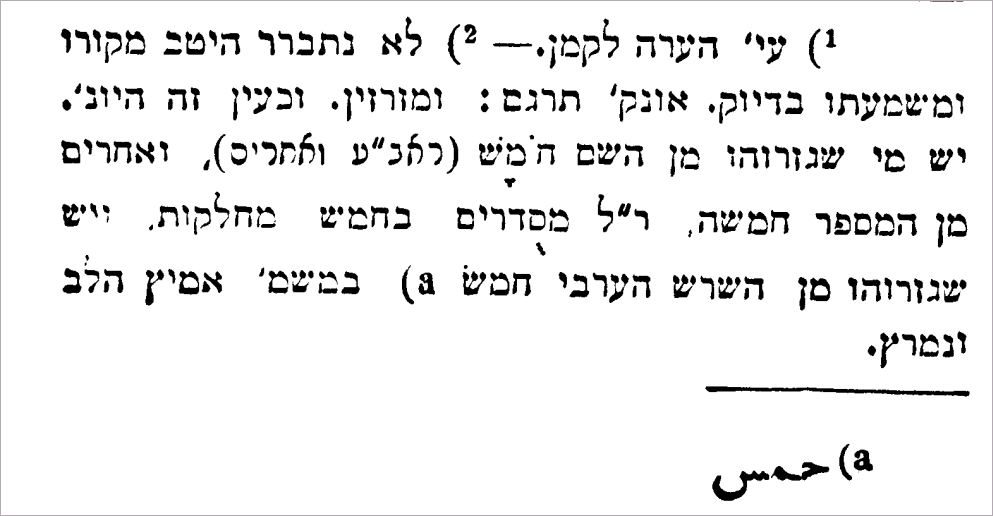
According to scholars, there might be in one meaning of the Hebrew root חמש. Here's what Gesenius writes:


We've discussed this root in the past:

The Hebrew word for the number five is חמש - chamesh. Another set of words that would seem to have the same root are chamush חמוש - armed and tachmoshet תחמושת - ammunition. Is there a connection between them?

The earliest source that might provide an answer is Shemot 13:18 - וַחֲמֻשִׁים עָלוּ בְנֵי-יִשְׂרָאֵל, מֵאֶרֶץ מִצְרָיִם. "Bnei Yisrael went up, chamushim, from the land of Egypt". Most translators and commentaries explain chamushim here as meaning "armed."

In that post, I didn't mention then any connection to the Arabic root meaning "zeal." However, I found now a significant source that supports this connection: the Aramaic translation of Onkelos, who renders the phrase as:

וּמְזָרְזִין סְלִיקוּ בְנֵי יִשְׂרָאֵל מֵאַרְעָא דְּמִצְרָיִם

According to Sokoloff (in his Dictionary of Jewish Babylonian Aramaic), the Aramaic root זרז essentially means "to arouse, strengthen." He then provides three usages (with examples): one meaning "to arouse, encourage," a second meaning "to arm," and the third "to strengthen." (See similar cases in Jastrow.)

How should we understand the usage by Onkelos here?  Rashi (certainly according this translation) understands the Aramaic root זרז as meaning "armed" in this case. R. Aryeh Kaplan in The Living Torah, on the other hand, explains the Targum as "with eagerness" or "with enthusiasm." 
 
It seems to me that even if Onkelos did mean "to arm" in this case, the overall association of זרז with enthusiasm (even in terms of being armed) confirms that Onkelos associated this usage of חמש with the same meaning of hamas in Arabic (which therefore may have been present in the related Aramaic as well.)

The connection between the Arabic hamas and this particular use of חמש is also noted in footnote 2 in the Ben Yehuda dictionary for חמש (as armed):


I find it convincing. As we've previously discussed regarding the word hamsin, the Hebrew חמש becomes hams in Arabic.

As far as the claim by Gesenius of a link to other roots like חמץ and our focus, חמס, to a more general sense of "sharpness: well, that depends on how far we are willing to connect different roots that begin with the same two letters. It's certainly possible that חמש, חמץ and חמס are related (and I could even consider additional roots like חמד - "to covet", which is linked to robbing in Shemot 34:24), but I would need to see more research on the subject.

For now, I just pray that this prophecy will come true very soon - both regarding Hamas and חָמָס:

לֹא־יִשָּׁמַע עוֹד חָמָס בְּאַרְצֵךְ

"Violence [hamas] shall no more be heard in your land..." (Yeshaya 60:18)


Monday, October 02, 2023

Kohelet - A Map To Eden

I'm so happy to share with all of you that after nearly six years of work, my first book, Kohelet - A Map to Eden, is available:


While it doesn't deal with etymology per se, it does use a linguistic lens to discover connections and parallels between Kohelet (Ecclesiastes) and the opening chapters of Bereshit (Genesis). 

It's a genuine page-turner, and shows how Kohelet - often viewed as depressing, confusing, and even tedious - tells a real story, and provides a powerful message of hope. 

Kohelet – A Map to Eden is not simply a running commentary on Kohelet, although I do delve into the explanation of its verses. Rather, think of it as a captivating story. As you read through its pages, you will embark on a journey with me, where I uncover the parallels between Kohelet and Bereshit, and the analogies between the lives of Shlomo and Adam. You’ll then witness how these connections lead to the story of the Spies and how those episodes of downfall find redemption in the mitzva of tzitzit, the Yom Kippur service, and the profound words of Kohelet itself.

It is available on both the US and Israel sites of Koren Publishers, where you can also see a preview of the first 30 pages.


Israel customers can order it here:


US and other international customers can purchase it here:


Those using the korenpub.com site can use the code 𝐤𝐨𝐡𝐞𝐥𝟏𝟎 at checkout to get a 10% discount.

It is also available at many other online booksellers and in-person bookstores. (And a Kindle version is available at Amazon!)

Also, as a first-time author, I’d be grateful for any assistance you might offer during this process. If you enjoy the book, please consider telling friends and family about it. Even sharing this post will help!

If you know anyone who might be interested in publicly reviewing the book, please put them in touch with me. And of course, I’m happy to discuss the book with you in person or online, or speak to any groups (schools, synagogues, etc.) who would be interested in hearing more about my discoveries and methods.

Book reviews:

Podcast interviews:

My talks about the book:

  • Book launch at the Women's Beit Midrash of Efrat and Gush Etzion - YouTube recording (and pictures on Facebook)

Wednesday, August 30, 2023

"Kohelet - A Map to Eden" is now available in Israel!

My book, Kohelet - A Map to Eden is now fully available in Israel!


It is available in many of the book stores in Israel that carry Judaica books in English, as well as on the Koren website:

Through that website you can also see a preview of the first 30 pages. For more information about the book, see my post where I first announced its release

I hope you enjoy the book, and looking forward to your feedback!

Sunday, August 20, 2023

takif and tekufa

This post is part of a series about words from Kohelet, in honor of the release of my new book, Kohelet - A Map to Eden. For more information about the book, and how to get a discount for your purchase, see this Balashon entry.

 A word that only appears in Kohelet is the adjective takif תַּקִּיף:

מַה־שֶּׁהָיָה כְּבָר נִקְרָא שְׁמוֹ וְנוֹדָע אֲשֶׁר־הוּא אָדָם וְלֹא־יוּכַל לָדִין עִם (שהתקיף) [שֶׁתַּקִּיף] מִמֶּנּוּ׃ 

"Whatever happens, it was designated long ago and it was known that it would happen; as for man, he cannot contend with what is stronger than he." (Kohelet 6:10)

(The kri reading - takif - is preferred over the ketiv התקיף. And while this concordance considers the ketiv as a verb, most scholars see it as an adjective as well - either as a compound of שהוא תקיף or as Gordis suggests, a conflation of עם התקיף  and עם שתקיף - "with the One mightier than he." See Gordis, p. 263).

The biblical meaning of takif as "strong, mighty, powerful," is recalled in its modern sense as "decisive, resolute, tough."

The word comes from the root תקף, which only appears a few other times in the Tanakh, all in books featuring later Biblical Hebrew. It appears once more in Kohelet as a verb (4:12) meaning "to attack." In Iyov 14:20 and 15:24, the verb means "to overpower." It also appears as a noun, tokef תֹּקֶף in Daniel 11:17 and Esther 9:29 & 10:2, meaning "strength, might, power". This noun later took on the more specific meaning of "authority" in Rabbinic Hebrew, and today also means "validity, legality."

All of these together - the adjectives, verbs, and nouns - express a sense of strength and power. And there is consensus among linguists that the few Hebrew mentions in the Tanakh were borrowed from or influenced by Aramaic (and in the Aramaic sections of the Tanakh it appears as well.)

Klein expands on this in his etymology:

BAram. תְּקַף (= was strong), Aram.–Syr. תְּקֵף (= was strong, prevailed), which is related to Nab. תקף (= authority). Many scholars connect Aram.–Syr. תּֽקֵף with Arab. thaqafa (= he attained to, overtook, overpowered). However, in this case the base would be שׁקף in Hebrew (Arab. th corresponds to Heb. שׁ). Haupt connects this base with Akka. pashqu (= arduous), pushqu (= hardship, necessity).

His rejection of the connection to Arabic thaqafa is earlier found in the Ben Yehuda dictionary. Despite the standing of those sources, I found others who do maintain a connection (Even-Shoshan and BDB for example.) 

The Arabic cognate root means "to be clever, smart" or "to educate." I think the best parallel in English would be the word "mastery," which means "to be in control, dominant" over both places and people (which is how the root תקף is expressed in Hebrew) and over a a realm of knowledge (in the Arabic sense.)

The Comprehensive Aramaic Lexicon provides another interesting cognate in Arabic. In the entry for the Aramaic root tqp  - "to be strong" many Biblical and post-Biblical occurrences (such as in the Talmud and translations in the Targum) of תקף are cited. The end of the entry contains this note:

Not in Old Aramaic, where the original etymon yqp (=Arabic wqf, "to stand, withstand") still occurs. This accounts for the later form אתוקף, from which the simplified root tqp developed.

This would make takif cognate with the Arabic waqf. That term is known in Israel as the Jordanian organization that manages the Islamic sites on the Temple mount. But more generally, a waqf is an endowment made by a Muslim to a religious cause, and literally means "stoppage, immobilization," since the donated money or property cannot move from that dedication (similar to the Jewish hekdesh).

Therefore, according to the theory suggested in the CAL above, the root ykp - "to stand, withstand", eventually came to be tkp - "to be strong." 

If this is the case, then takif may have another Hebrew cognate. In his entry for the root נקף, meaning "to go round," Klein provides the following etymology:

Aram. אַקִּיף (= he surrounded), Syr. נְקֵף (= he clung to, stuck to, was joined), Arab. waqafa (= he stood still).

Stahl makes a similar argument in his Arabic etymological dictionary in his entry for וקף, citing Yeshaya 29:1 חַגִּים יִנְקֹפוּ - "the festivals circling round." He goes on to compare this concept of the holidays to another term used for them in Tanakh - atzeret, which like waqf, also means "stoppage." (I must concede that I don't fully understand Stahl's explanation which seems to link "stopping" with "circling", and says that both were likely originally dancing terms. Perhaps he means that instead of moving forward, the root indicated assembling together, surrounding one spot, and stopping.)

Among the Hebrew words deriving from נקף include hakafa הַקָּפָה - "encirclement" (and the dancing done on Simchat Torah, i.e., Shemini Atzeret) and hekef הֶקֵּף - "perimeter, circumference." 

And perhaps most surprisingly, Klein also links נקף to tekufa תְּקוּפָה. Originally meaning "circuit, revolution", since it was applied to the revolution of the sun, it came later to mean "season," and then "period, epoch, era." 

Looking at takif and tekufa in Hebrew - תקיף and תקופה, it might appear that they come from the same root: תקף. That is certainly not the case - the latter comes from נקף, not תקף. But a little digging has shown us that while not siblings, takif and tekufa may indeed be cousins. 

Monday, August 14, 2023

pesher and efshar

This post is part of a series about words from Kohelet, in honor of the release of my new book, Kohelet - A Map to Eden. For more information about the book, and how to get a discount for your purchase, see this Balashon entry.

 The eighth chapter of Kohelet opens with this verse:

מִי כְּהֶחָכָם וּמִי יוֹדֵעַ פֵּשֶׁר דָּבָר חׇכְמַת אָדָם תָּאִיר פָּנָיו וְעֹז פָּנָיו יְשֻׁנֶּא׃

"Who is like the wise man, and who knows the meaning of the adage: 'A man’s wisdom lights up his face,
So that his deep discontent is dissembled'?" (Kohelet 8:1)

The word translated here as "meaning" is the Hebrew pesher פֵּשֶׁר. Other translations render it as "solution", "explanation," or "interpretation."

In his commentary, Alter notes:

Pesher, “solution,” occurs only here in the Bible, though it is common in later Hebrew. It is cognate with patar, the verb used for Joseph’s solving the enigma of dreams, and would seem to suggest laying open a hidden meaning.

Klein also notes that pesher "is related to base פתר" (patar). Patar is generally translated today as "to solve", and is the root of pitaron פִּתְרוֹן - "solution." This is different from pesher which still is defined as "meaning, explanation", but is more commonly used in contexts where the meaning is unknown or lacking, as in "what is the pesher" or "there is no pesher."

Klein also connects pesher to two other uses of the root פשר - "to compromise, reconcile" and "to thaw, melt." Here's his full entry:

פשׁר to melt, dissolve; to be or become lukewarm; to solve, interpret.
Qal - פָּשַׁר 1 melted, was dissolved; 2 was or became lukewarm; 3 he interpreted.
 Pi. - פִּשֵּׁר PBH 1 he disengaged, freed; PBH 2 he arbitrated, compromised; NH 3 he explained.
Hiph. - הִפֽשִׁיר PBH 1 he caused to melt; PBH 2 he made lukewarm; MH 3 he compromised.

BAram. פְּשַׁר (= he interpreted a dream), Aram. פְּשַׁר (= it melted, was dissolved; he interpreted a dream, solved a riddle), פַּשֵּׁר (= he disengaged; he interpreted a dream, solved a riddle), Syr. פּֽשַׁר (= it melted, was dissolved; he interpreted a dream, solved a riddle), פַּשֵּׁר (= he melted, solved, liquefied; he interpreted a dream), Akka. pashāru (= to solve, to interpret dreams). Arab. fassara (= he explained), is prob. a Syr. loan word.

Klein's etymologies often follow those offered in Ben Yehuda's dictionary. In the notes for שרש in that dictionary, it says that the basic meaning of the root פשר is "the release/loosening of a concrete or abstract thing." 

So this would apply to the physical dissolving of a solid in the process of melting or thawing, and the abstract release of a problem when it is solved, or a dispute when a compromise (פְּשָׁרָה peshara) is reached. This is similar to the relationship in English between the words "solve" and "dissolve." The Online Etymology provides this origin for "solve":

late 14c., solven, "to disperse, dissipate, loosen," from Latin solvere "to loosen, dissolve; untie, release, detach; depart; unlock; scatter; dismiss; accomplish, fulfill; explain; remove," [...]  The meaning "explain, clear up, answer" is attested from 1530s.

And dissolve similarly originally meant:

"to loosen up, break apart," from dis- "apart"  + solvere "to loosen, untie"

Klein connects פשר to two more possible roots. One is שבר shever. It can also mean "interpretation (of a dream)", as in Shoftim 7:15. Since the root שבר generally means "to break", Klein writes that it probably means a "solution (i.e., 'breaking') of a dream." But he also quotes the linguist Jacob Barth, who connects this meaning of shever to pesher, presumably through metathesis.

The other word he sort of connects to pesher is efshar אֶפְשָׁר, usually translated as "possible/possibly", "permitted." or "perhaps." In his entry for פשר, he adds "compare to אפשר." But in the entry for אפשר, he writes:

Of uncertain origin. The usual connection with פָּשַׁר (= it melted, dissolved), must be rejected for semantic reasons.
This also is a case where Klein follows the Ben Yehuda dictionary, which notes the pesher - efshar connection is suggested by Levy, Kohut, and Jastrow, but remains unconvincing. 

However, Even-Shoshan writes in the entry for efshar that maybe it comes from פשר. It does sound reasonable - efshar is something possible, "released" from the realm of impossibility. 

Let's leave it as a possible solution - pesher efshari...

Sunday, August 06, 2023

sandak

Taking a quick break from the series of Kohelet posts, for an investigation of a special word: sandak סַנְדָּק. Our daughter just gave birth to our first grandchild, and this past Shabbat, I had the privilege of being the sandak at his brit milah - meaning he was placed on my lap during the ceremony. 

It was one of the most special moments of my life, so I thought it deserved a post. 

The word sandak doesn't look Hebrew, and indeed isn't. Here are Klein's definition and etymology:

סַנְדָּק m.n. MH    ‘sandak’, godfather, one who holds the child on his knees for circumcision).  [Either from Gk. synteknos (= foster brother; lit.: ‘a child growing up with another’), or from Gk. syndikos (= one who helps in a court of justice, advocate).

These are certainly the most popular etymologies I found online. The second theory he presents, that sandak  is an advocate, is easily recognized from the origin of the English word "syndicate" ( a "council or body of representatives"). It comes from an earlier word, "syndic", with this origin:

c. 1600, "a civil magistrate, especially in Geneva," from French syndic "chief representative" (14c.), from Late Latin syndicus "representative of a group or town," from Greek syndikos "public advocate," as an adjective, "belonging jointly to," from syn- "together"  + dike "judgment, justice, usage, custom" 
The first theory that Klein offers actually fits the meaning of sandak somewhat better. It doesn't have  obvious English cognates. Like syndicate, it is comprised of syn ("together"), but the second half is téknon - Greek for "child." (The closest cognate to an English word - and this is pretty distant is "thane", but I had never heard of it before.) So synteknos  would be translated as "companion of (literally, "with") a child." 

However, there's a problem with both of these suggestions. The term sandak doesn't appear in rabbinic Hebrew until the Middle Ages, which is strange for a role in such an important religious ceremony. Philologos in this 2006 column after quoting both theories that Klein mentioned, notes:

Although circumcision is probably the most ancient of all the Jewish rites that are practiced today, neither of these two words is anywhere near as venerable. The older of the two, sandak, is a Hebrew loan word from Greek, as easily can be seen from its earliest appearance in Jewish sources in the 13th-century midrashic anthology Yalkut Shimoni, where it occurs as sandakos, with the Greek first-declension, nominative-case singular ending. This is curious, since nearly all Greek borrowings in old Hebrew date to the pre-Islamic period, when Greek was the spoken language of the eastern Mediterranean world.

Presumably, then, sandakos was in use among Jews for hundreds of years before this but simply left no record.

He goes on to focus more about the origin of kvater, a Yiddish word also associated with the brit milah. Today it means one of the people carrying the baby from the mother to the sandak. But originally it simply meant "godfather" and was may have been synonymous with the sandak. (In fact, kvater is simply a Yiddish version of the German gevatter, which like the Latin parallel compater meant "joint father". While the sources I found say that godfather comes from God+father in English, I can't help but wonder if it really just derived from the Old English version of gevatter - gefædera - and the later spelling Godfather was just the result of a folk etymology to give it religious meaning. But let's get back to sandak...)

It's noteworthy that Philologos wrote his column in 2006. In the following year, Prof. Hillel Newman of the University of Haifa, published an essay in the Jewish Quarterly Review entitled, "Sandak and Godparent in Midrash and Medieval Practice." (Thank you to Elon Gilad who shared that article with me, along with his Hebrew summary published two years ago in HaAretz.)

Newman presents the two etymologies we've discussed, along with others, but doesn't feel comfortable with any of them. The article goes very deep into the history, and it's worth a read. But to summarize, he points to the the midrashic origin of the term sandak in Midrash Tehillim (also quoted in a slightly different form in Yalkut Shimoni). It's a beautiful midrash, showing how all parts of the body are used to serve God. The relevant line for our purposes describes the knees:

בברכיי אני נעשה סינדיקנוס לילדים הנימולים על ברכיי

"With my knees I become a syndikenos for the children circumcised on my knees."

After much deliberation, with extensive comparison of various sources in midrash and Medieval Jewish literature, Newman ends up convinced that the correct version of the midrash should not be "I become a a sandak" but rather "I make a sandak" (relying on versions that use the verb עושה instead of נעשה).

Based on this, he suggests that we shouldn't be looking at the original meaning of sandak as a type of person, but rather a thing that the person makes. He offers the Greek word σάνδυξ ("sandux"), meaning "chest, casket, box." He writes:

As it turns out, it is not difficult to find a satisfactory lexical solution to the problem if we unburden ourselves of our old semantic prejudice. To put it simply, we are looking for a word, probably Greek, which could be transcribed into Hebrew as סנדיקוס and which satisfies the sense of the passage: a word for something which one might either do or form with one’s knees or lap to facilitate a child’s circumcision. [....] it is σάνδυξ  of Hesychius which is phonetically the closest to סנדיקוס of Yalkut Shim‘oni. The resulting image is of the body objectified, a picture of an adult cradling the infant on his or her lap during the circumcision in the manner of a vessel intended for holding one’s precious personal possessions. In this way, yet another part of the body is enlisted in performing the commandments.

This word meaning "crate, box" has cognates in an astonishing number of languages, including: Arabic sanduk (which has entered Hebrew slang with the same meaning as well), Russian sunduk, Persian sanduq, and many more. Almost all theories point to an ultimate Greek origin. The Arabic Etymological Dictionary says it comes from the Greek syndocheion (perhaps related to synecdoche - "receiving together"?). Others suggest suntíthēmi - "to place or put together", which would make it cognate with "synthesis."

Whatever the ultimate Greek etymology, I found the meaning "to make a cradle" for the baby incredibly moving (and this was certainly influenced by having finished reading his essay shortly before the brit.) In the past, I had used many of my body parts to perform the mitzvot as described in the midrash. But I had never used my knees in such a way. What an honor to do so for my beloved grandson.

Tuesday, August 01, 2023

holelut and hallel

This post is part of a series about words from Kohelet, in honor of the release of my new book, Kohelet - A Map to Eden. For more information about the book, and how to get a discount for your purchase, see this Balashon entry.

The word holelut (or holelot) הוללות appears in Kohelet, and only in Kohelet (1:17, 2:12, 7:25, 9:3, 10:13). It is an abstract noun, and Gordis notes that it means "madness, mad revelry, wickedness." Alter expands on this idea and writes:

The common rendering of holelut as “madness” (for which in biblical Hebrew, as in the modern language, the primary term would be shigaʿon) confuses this idea; holelut suggests a wild and unruly indulgence of the senses in which lucidity is lost—hence “revelry.”

A different version, הולל holel (but always in the plural הוללים holelim) appears in Tehilim (5:6, 73:3, 75:5).  This has a different meaning. It refers to the wanton, to evildoers. For example:

לֹא־יִתְיַצְּבוּ הוֹלְלִים לְנֶגֶד עֵינֶיךָ שָׂנֵאתָ כׇּל־פֹּעֲלֵי אָוֶן׃

"Wanton men cannot endure in Your sight, You detest all evildoers" (5:6)

There is also the verb הלל, which means to "act foolishly". This appears 13 times, in the books of Shmuel I, Yeshaya, Yirmiya, Nachum, Tehilim, Iyov, and Kohelet. It seems that the negative connotations of this verb affected the nouns we saw earlier. Acting foolishly can lead to both madness/revelry, as well as wantonness. 

I imagine that by now you're wondering how this unfavorable root is so similar to the very positive root הלל - "to praise." This is a much more common root in Biblical Hebrew. The verb הלל with this meaning appears nearly 150 times in the Tanakh, and in Rabbinic Hebrew we find the noun Hallel הלל indicating particular sections of Tehilim that are used for praise in our prayers.

So why would הלל mean both to act foolishly, and to praise (frequently to praise God)?

Before we answer that question, it's important to note that there is one more meaning of הלל. It only 
appears in four verses (Yeshaya 13:10; Iyov 29:3, 31:26, 41:10), and means "to shine." 

Gesenius suggests the following development: From the initial meaning "to be clear, be brilliant", came the meaning "to be bright." Another path led to "to make a show". From this came the sense of being boastful and arrogant  (which both Gesenius and BDB say apply to many of the negative meanings we quoted above.). This led to "be foolish", for as he writes, "the more anyone boasts, the more he is regarded as being foolish." But this same sense of "make a show," when referring not to one's self but to others, is considered praise. 

TDOT (4:411) quotes a few different theories, including:

  • a parallel to the Akkadian alalu meaning "shout, sing, rejoice, boast" which would apply to both the "boasting" and "praise" senses of הלל.
  • going to the root meaning "to shine", the foolish holelim should be considered "moonstruck". (This doesn't address a possible connection to "praise," however.
Of course some linguists don't make no connection between any of the three meanings of הלל (for an example of that approach, see this column.) Personally, I do find the idea that boasting about oneself would be considered negative, but would be viewed positively if praising others (and certainly praising God.) But a) I know from experience that not every comfortable theory is necessarily the correct one, and b) this requires identifying the various negative words we mentioned above as referring to arrogance and not revelry, wickedness, or foolishness.

Regardless of the ultimate etymology, if the negative uses do mean "boasting", I think we might have an example of what we've referred to previously as a contronym - where a word (or its homonym) also means its opposite. Other terms used to refer to these words include "auto-antonym" and Janus word (after the Roman deity with two faces).

In light of this, I'd like to dedicate this post to the memory of Gene Schramm, professor of linguistics at the University of Michigan. I didn't know Gene personally, but he's the father of my friend Rivky Schramm Krestt. Rivky delivered a moving tribute to her father last week, and mentioned that he was one of the first scholars to describe this phenomenon in Biblical Hebrew (see here for example of a citation). I hope to share more of his insights here in the future.


Sunday, July 23, 2023

takana and tikun

This post is part of a series about words from Kohelet, in honor of the release of my new book, Kohelet - A Map to Eden. For more information about the book, and how to get a discount for your purchase, see this Balashon entry.

In the Tanakh, the Hebrew root תקן appears only in Kohelet (1:15, 7:13, 12:9). As Klein notes, it means "to be or become straight", as in its first appearance in Kohelet:

מְעֻוָּת לֹא־יוּכַל לִתְקֹן וְחֶסְרוֹן לֹא־יוּכַל לְהִמָּנוֹת׃

 "That which is crooked cannot be made straight: and that which is wanting cannot be numbered." (Kohelet 1:15)

It also appears once in the Aramaic section of Daniel, with the meaning "to establish":

... וְעַל־מַלְכוּתִי הׇתְקְנַת ...
"And I was [re]established over my kingdom." (Daniel 4:33).

As we've noted before, Kohelet uses words that appear more frequently in Rabbinic Hebrew, and were often borrowed from Aramaic. That is the case here as well. The verb has a number of related meanings:

  • to become straight
  • to repair
  • to prepare
  • to arrange
  • to establish
  • to amend
Klein provides this etymology:

Borrowed from JAram. תַּקֵּן (= he fixed, arranged, prepared), which is related to BAram. הָתְקְנֵת (= I was established), Arab. ’atkana (= he confirmed, perfected, brought to perfection), Akka. taqānu (= to be well ordered).

He then suggests comparing תקן to the root תכן.  Despite that suggestion, in that entry he surprisingly says (following Ben-Yehuda):

Usually connected with, but prob. not related to base כון or base תקן.

The root תכן originally meant (according to Klein) "to weight, examine, estimate", and only in Modern Hebrew came to mean "to regulate, arrange, fix" (which would be parallel to תקן). But the root כון (as we discussed here) always meant "to set up, establish" and also has many of the other meanings that we listed for תקן (including "to straighten"). Daat Mikra on the verse in Daniel writes that תקן is the Aramaic version of כון, although without making an etymological association. 

However, earlier researchers such as Gesenius, and more recent ones like Kaddari (in his Dictionary of Biblical Hebrew) do imply a common origin to תקן and תכן. They both emphasize more the Akkadian etymology (over the Aramaic one that Klein mentioned). While Akkadian was a Semitic language, it did not use the Hebrew/Aramaic alphabet. So there are times where two Hebrew words/roots, with different spellings, both derived from Akkadian - in a similar fashion to how foreign words are imported into Hebrew today.

The root תקן has many applications today. In addition to the ones mentioned above, we have the verb hitkin  התקין - "to install" (as in software) and the adjective takin תקין - "intact, in order, proper,"

There are also a number of nouns. Two of the most common are takana תקנה and tikun תיקון.

Takkanah originally meant "arrangement, ordinance, ruling", and today means "rule", usually as set by a legislative or executive body. It is the source of the related takanon תקנון - "set of rules, bylaws."

Tikkun has many more meanings. In a different book, The Medieval Heritage of Modern Hebrew Usage [Hebrew], Kaddari devoted an entire essay to the development of the word (pp. 91-106). I will try to summarize some of the most common usages and their histories.

As a gerund of תקן, tikun can mean "correction, fixing, improvement, emendation, regulation." But it has taken on many more specific meanings over time:

  • tikun soferim תיקון סופרים: This phrase has two meanings. Recalling the sense of תקן as "to prepare," it refers to the book scribes would use to prepare when writing a Torah scroll. A version of this for those preparing the reading of the Torah is known as a tikun korim תיקון קוראים.
    But the other meaning of תקן - "to correct" or "to amend" - gives us a different meaning of tikun soferim. In this other sense, it refers to corrections or emendations to a text that the scribes themselves made (see for example, Midrash Tanchuma, Beshalach 16)
  • A tikun can also refer to a set of readings proscribed by kabbalistic practice to be recited at certain special times. These include tikun chatzot תיקון חצות (read at midnight) and Tikun Leil Shavuot תיקון ליל שבועות (according to the original practice recited/read on Shavuot night, and now extended to any learning done that night). According to Kaddari, these tikunim got their names because of their ability to enact repairs in the "Higher Worlds".
  • Tikkun Olam תיקון עולם - Literally meaning "repairing", "improving" or "establishing" the world, it has been adopted for different purposes over the centuries. The Wikipedia entry divides them as follows:
    • In Rabbinic literature, it referred to "legal enactments intended to preserve the social order" (for example, Mishna Gittin 4:2-9)
    • In the Aleinu prayer, it refers to "the eradication of idolatry."
    • In Kabbalistic uses, it has mystical connotations - "to return the sparks of Divine light to their source by means of ritual performance."
    • In modern times, it has come to mean "the pursuit of social justice."
Yet to bring us back to our earlier discussion, there are scholars who claim that the original version of Aleinu was לתכן עולם, not לתקן עולם. (See, for example, Mitchell First's essay, "Aleinu: Obligation to Fix the World or the Text?") However, as we noted above, perhaps there isn't such a clear distinction between the roots תכן and תקן. In that case, the text might not need fixing.

Sunday, July 16, 2023

bitul

This post is part of a series about words from Kohelet, in honor of the release of my new book, Kohelet - A Map to Eden. For more information about the book, and how to get a discount for your purchase, see this Balashon entry.

At the end of Kohelet (12:1-8), there are verses that Fox, in his JPS commentary, calls "the most difficult section of the book. Its Hebrew is difficult, sometimes obscure, and its imagery is enigmatic."

In that section, there's a word I'd like to discuss. It's beyond the scope of this post to discuss the verse (12:3) in its wider context, so we'll just look at the phrase in which it appears:

וּבָטְלוּ הַטֹּחֲנוֹת כִּי מִעֵטוּ

The word of interest is וּבָטְלוּ - this is the only time the root בטל appears in Biblical Hebrew. Its different meanings are reflected in these two translations.

The JPS translates the phrase as:

"And the maids that grind, grown few, are idle"

Gordis ("Koheleth - the man and his world") offers: "The grinding maidens cease, for they are few."

Both of those translations are plausible, since the root בטל can mean both "to cease" and "to be idle." However, as Gordis notes, this word is an "Aramaism" (i.e., borrowed from Aramaic), and so looking at the Aramaic appearances should give us an idea of its earlier meaning.

It appears six times in the book of Ezra, and there it always means "to cease". But when an object or person ceases to act, they become idle, so that sense development is not surprising.

While the Hebrew בטל only appears once in Biblical Hebrew, it is very common in Rabbinic Hebrew. There it takes on a number of meanings, all depending on the context (which is frequently a halakhic discussion). These include "to be void", "to abolish", "to suspend", "to cancel", "to undo," "to neglect", and "to nullify".

The adjective batel בָּטֵל  can mean "worthless, valueless, invalid, void", and the related mevutal מְבֻטָּל is "cancelled, insignificant, negligible."

One interesting word deriving from the root is batlan בַּטְלָן. As Stahl notes in his Arabic dictionary (p. 80), in Rabbinic Hebrew, a batlan was one who didn't work, not necessarily one who did not want to work (i.e., a lazy person). So those batlanim who couldn't or didn't work, for example the elderly, were important members of the community, particularly for things like making a minyan. Zuckermann here complained about how in Modern Hebrew, the word batlan transitioned into "a loafer, an idler, a lazy person." To me this just seems like the natural way a language changes. As an example of that, note the word avtala אַבְטָלָה. As Klein points out, in Rabbinic Hebrew it meant "idleness", but in Modern Hebrew it means "unemployment." So sometimes the use of בטל is more judgmental, and sometimes less so.

What about the etymology of בטל? Earlier linguists attempted to find other Hebrew roots that might be related. 

Steinberg proposed that בטל is related to the roots בדל (to depart, be detached) and בתל (to separate). Since he defines בטל as "to cease," this would seem to imply that the root could be understood as "to detach" or "to separate" from work.

Gesenius suggested that בטל was related to בטן (as in beten בֶּטֶן - "belly"). As such, he says that the original meaning of בטל was "to be empty, vacant", whereas בטן meant "to be empty, hollow."  From there בטל meant "to be free from labor", and then later "to cease."

This is somewhat similar to Klein's etymology:

Related to Aram. and BAram. בְּטֵל, Arab. baṭala, Ethiop. baṭála (= he was vain, was futile), Akka. baṭalu (= to cease).


But notably, Klein does not offer any Hebrew cognates, and it seems to me that those of Steinberg and Gesenius remain as conjecture.

Sunday, July 09, 2023

bitachon and avatiach

This post is part of a series about words from Kohelet, in honor of the release of my new book, Kohelet - A Map to Eden. For more information about the book, and how to get a discount for your purchase, see this Balashon entry.

A word common in Hebrew today, but rare in Biblical Hebrew, is bitachon בִּטָּחוֹן. It appears in Kohelet:

כִּי־מִי אֲשֶׁר (יבחר) [יְחֻבַּר] אֶל כׇּל־הַחַיִּים יֵשׁ בִּטָּחוֹן כִּי־לְכֶלֶב חַי הוּא טוֹב מִן־הָאַרְיֵה הַמֵּת׃

"For he who is attached to the living has something to trust in: that a live dog is better than a dead lion." (Kohelet 9:4)

Here the word bitachon is translated as "something to trust in." 

The other occurrences of the word are in two parallel verses (Melachim II 18:19 and Yeshayahu 36:4), quoting the Assyrian commander Ravshakeh's words to the Judean king Chizkiyahu:


וַיֹּאמֶר אֲלֵיהֶם רַבְשָׁקֵה אִמְרוּ־נָא אֶל־חִזְקִיָּהוּ כֹּה־אָמַר הַמֶּלֶךְ הַגָּדוֹל מֶלֶךְ אַשּׁוּר מָה הַבִּטָּחוֹן הַזֶּה אֲשֶׁר בָּטָחְתָּ׃

And Ravshakeh said to them, "You tell Chizkiyahu: Thus said the great king, the king of Assyria: 'What is this confidence in which you place trust?'"

Here, bitachon is identified as "confidence." The same verse(s) also include the verb בטח - "to place trust", which of course is the root of bitachon. 

That root appears much more frequently - 120 times throughout the Tanakh. It generally means "to trust, rely, depend upon." 

However, there are some verses where the root appears to mean something else. This Safa-Ivrit essay does a good job of explaining why, and I'll try to summarize it and provide some additional understandings. 

The author notes that in Arabic, the similar root bataha means "to knock down, throw on the ground." He believes this is cognate with the Hebrew בטח, and writes that this can explain those verses where the meaning "to trust" seems difficult to accept.

He first cites Yirmiyahu 12:5- 

כִּי אֶת־רַגְלִים  רַצְתָּה וַיַּלְאוּךָ וְאֵיךְ תְּתַחֲרֶה אֶת־הַסּוּסִים וּבְאֶרֶץ שָׁלוֹם אַתָּה בוֹטֵחַ וְאֵיךְ תַּעֲשֶׂה בִּגְאוֹן הַיַּרְדֵּן׃

His suggested translation would be something like:

"If you race with the foot-runners and they exhaust you, how then can you compete with horses? If you tumble [boteach] in a tranquil land, how will you fare in the jungle of the Jordan?"

He then quotes Mishlei 14:16 - 

חָכָם יָרֵא וְסָר מֵרָע וּכְסִיל מִתְעַבֵּר וּבוֹטֵחַ׃

And again he offers a translation that adopts the meaning found in Arabic:

"A wise man fears, and departs from evil: but the fool rages, and slips [boteach]."

This explanation is also offered by Rashi in his commentary, who quotes the verse from Yirmiyahu as support.

The author then suggests that we should understand the root בטח as "to lean on something, be supported by something, place your weight on something." When you lean on something, it may indeed descend to the ground. 

This helps explain one further difficult verse, Tehilim 22:10 -

כִּי־אַתָּה גֹחִי מִבָּטֶן מַבְטִיחִי עַל־שְׁדֵי אִמִּי׃

Some translations try to explain the word מַבְטִיחִי as relating to trust:

"You took me from the womb, you made me trust at my mother's breast."

But the Safa-Ivrit essay says this can be better explained by utilizing the Arabic cognate, and could be translated as "you lean me [or lay me] on my mother's breast." Of course, in the abstract sense, this does imply as well the trust that the child has in the mother.

That meaning of "trust" finds itself in other related Hebrew words. The biblical nouns בֶּטַח and בִּטְחָה mean "safety, security." We also find the hifil form in a few verses. The meaning isn't always entirely clear, and seems to mean more literally "make someone trust you." In later Hebrew this develops into the more common meaning "to promise."

In Modern Hebrew, we find many nouns deriving from בטח with specialized meanings that represent much more recent concepts:

  • ביטוח bituach - "insurance"
  • בטיחות betichut - "safety"
  • אבטחה avtacha - "protection, security" (usually used for protecting people, property, data)
  • בטחון bitachon - from the biblical sense of "something to trust in" or "confidence", it later took on the more religious sense of confidence or faith (for example in God), and today has a more secular meaning as self-confidence, as well as security in the military sense, as in שר הבטחון Sar HaBitachon - "Defense Minister."
We also find the more colloquial term בטח betach, meaning "sure thing, definitely." Starting in the 1930s, the Israeli linguist Yitzhak Avineri railed against its use, saying it was a foreign borrowing, with no earlier Hebrew usage. However, this use is very much part of Hebrew today, and has even developed an opposite, sarcastic meaning of "no way!" or "fat chance!".

One potential cognate of בטח is אבטיח avatiach - "watermelon." It only appears once in the Tanakh, in the list of Egyptian foods in Bemidbar 11:5. It has cognates in the Aramaic אֲבַטִּיחָא and the Arabic batich. In Arabic culture, watermelons were so ubiquitous and cheap, that they were part of a slang expression that later entered Hebrew:  “lo <something>, v’lo batich” ולא בטיח – meaning “I didn’t get X, and I didn’t get watermelon,” i.e., I got nothing. 

As noted here, the Arabic baṭṭīḫ is the source of the "Spanish budieca, Portuguese pateca and French pateque, the modern French pastèque."

There are at least two theories of how avatiach might be connected to בטח. The Safa Ivrit article mentioned above suggests that perhaps it is due to the nature of watermelons to grow sprawling on the ground, since as noted, בטח can also indicate being on the ground.

The TDOT quotes the linguist Ludwig Kohler as claiming that the Semitic root means "to be plump, taut" (the first of which applies to watermelons) and also "to be firm, tight" (the first of which implies security and trust.)

Both theories are plausible, and certainly interesting. However, I can't help but end with the very true reservation offered by the TDOT: 

"Indeed, in Hebrew homonymous roots are nothing uncommon." 

Betach!