Wednesday, May 24, 2006

erev

After writing about בוקר boker, it makes sense to write about ערב erev. However, while we presented a number of different derivatives of בקר, the root ערב has far more.

For those that don't know, the Academy of the Hebrew Language is working on a historical dictionary:

It aims to encompass the entire Hebrew lexicon throughout its history; that is, to present every Hebrew word in its morphological, semantical, and contextual development from its first appearance in written texts to the present.


This will be a great tool for anyone interested in researching the history of Hebrew words, like, for example, me.

As an example of the scope of the dictionary, they write:

Let us consider for example, the Hebrew root ערב.
A seventy-five-page-long sample of the projected dictionary entry for this root
appeared in Lesonenu Vol. 46, 1982 (excluding indexes and statistical data).

That's quite a few pages. So I don't expect to cover ever meaning and derivative of the root. (Actually, I haven't even seen the article.) I very well may come back to this root in the future to discuss further developments.

Luckily, Kutscher has a chapter in his book that discusses the root. His important premise is that one of the meanings of ערב is "to enter". This is based on the similar meaning in Akkadian - erebu. The other major meaning he provides is "to mix" - ערבב. According to Kutscher, it is not clear if there is a connection between the two roots. His article was written in 1958 - perhaps more research has been done since.

Let's look at some words with the root ערב and see if they're related to "enter", "mix" or something else.

ערב erev - evening: Kutscher quotes Dr. Benjamin Klar as writing that: "Early man viewed sunrise as 'leaving' and sunset as 'coming'. Even though normally we'd think it should be the opposite, they had the view that the sun slept in a 'tent' every night. It would leave the tent in the coming, and enter it in the evening." This is described in Tehilim 19:5-6:

בְּכָל-הָאָרֶץ, יָצָא קַוָּם, וּבִקְצֵה תֵבֵל, מִלֵּיהֶם;לַשֶּׁמֶשׁ, שָׂם-אֹהֶל בָּהֶם. וְהוּא--כְּחָתָן, יֹצֵא מֵחֻפָּתוֹ; יָשִׂישׂ כְּגִבּוֹר, לָרוּץ אֹרַח.

"Their voice carries throughout the earth, their words to the end of the world. He placed in them a tent for the sun, who is like a groom coming forth from the chamber, like a hero, eager to run his course."

מערב maarav - west: Therefore maarav is the "entering place of the sun".

ערב שבת erev shabbat: Kutscher quotes the linguist Meir Medan (father of Rav Yaakov Medan, Rosh Yeshiva of Har Etzion) as saying that erev shabbat means "the entering of Shabbat", in the same way that מוצאי שבת motzaei shabbat means "the leaving of shabbat". This also helps explain the apparent redundancy between the terms erev shabbat and ליל שבת leil shabbat.

ערבון eravon - a pledge: According to Kutscher, the pledge "enters the house of the loaner". From here we get the verb ערב "to guarantee". This is the source of the famous phrase:
כל ישראל ערבים זה לזה / זה בזה - "All Jews are responsible for one another". Another derivative of this form of the root is התערב hitarev - "to bet" (i.e. "to exchange pledges".) The English word arbiter derives from eravon, as does one of the meanings of the word earnest - "money paid in advance as part payment to bind a contract or bargain".

ערב erev - woof (the threads that run crosswise in a woven fabric) - While Klein (and others) say that the word derives from "to mix", Kutscher says it is clear that it comes from "to enter" - the threads that enter under the threads of the warp.

ערב רב erev rav: This is generally translated as the "mixed multitudes" that went up from Egypt (Shmot 12:38). The association with "mix" is clear, but Kutscher agrees with Onkelos who translates it as "foreigners". Erev means foreigners in Nechemia 13:3, and there is a cognate word in Arabic meaning the same.

ערוב arov: The wild animals of the fourth plague in Egypt (Shmot 8:20). Kutscher says the origin is unclear, but Klein associates it with "to mix".

ערב arev "pleasant, sweet": Again, Kutscher says it is hard to determine the connection, but Klein writes that it perhaps means "to be well mixed, duly arranged".

Neither Kutscher nor Klein connect any of the following words with either the meanings "to enter" or "to mix":

  • aravi ערבי - Arab: Klein associates it the term with arava ערבה - desert plain, but see here for many more theories.
  • orev עורב - raven
  • arava ערבה - willow

Tuesday, May 23, 2006

boker

Many years ago, when I was touring Israel with a group, we were going to visit Ben Gurion's residence on Kibbutz Sde Boker. While discussing the upcoming visit with a friend, I said the word בוקר boker with the accent on the first syllable, as in the Hebrew word for "morning". He corrected me and told me that the accent should be on the second syllable - which makes it the Hebrew word for "cowboy". What is the connection between the two terms?

Apparently, the original meaning of the root בקר is "to cleave, to split" (and is related to the similar בקע). Boker meaning morning derives, according to Klein, from "the breaking through of daylight".

As far as boker meaning cowboy, the root is in the Hebrew word for cattle, בקר bakar. I had always assumed that bakar got its name from the cloven hooves (which make them kosher.) However, from all the sources I've seen, the word actually derives from the function of the animal; as Klein defines - "the plowing animal".

As a verb, בקר means "to examine, to scrutinize, to criticize." This leads to two very similar nouns: bakara בקרה - control, and bikoret בקורת - inspection. Even native Hebrew speakers have difficulty distinguishing between the terms at times, and this site tries to point out the differences.

Lastly, בקר can mean "to visit", as in bikur cholim ביקור חולים - "visiting the sick". At first glance, perhaps nothing seems more Jewish than having the same root mean both "visit" and "criticize". However, according to Even-Shoshan, this sense of the word appears only once in Tanach, in Tehilim 27:4 --

אַחַת, שָׁאַלְתִּי מֵאֵת-השם-- אוֹתָהּ אֲבַקֵּשׁ:שִׁבְתִּי בְּבֵית-השם, כָּל-יְמֵי חַיַּי;לַחֲזוֹת בְּנֹעַם-השם, וּלְבַקֵּר בְּהֵיכָלוֹ.
"One thing I ask of the Lord,
only that do I seek;
to live in the house of the Lord
all the days of my life,
to gaze upon the beauty of the Lord,
l'vaker לבקר His temple."

There are many translations for l'vaker here, but "visit" does not seem to be correct. The parallel word in the verse is "to gaze", and that should be reflected in the understanding of l'vaker. So how do we get from there to bikur cholim?

According to Amos Chacham in his Daat Mikra commentary to Tehillim, the original meaning of bikur cholim meant "observation and concern for the needs of the sick". Over time the meaning drifted into "visiting". I can't say whether the shift was etymological, or perhaps in the actual performance of the act...

Monday, May 22, 2006

mattress

Every now and then I'll find a word that really surprises me that it has Semitic origins. Mattress is one of them.

From the Online Etymological Dictionary:


c.1290, from O.Fr. materas, from It. materasso, from M.L. matracium, borrowed in Sicily from Ar. al-matrah "the cushion" (cf. Sp. almadraque "mattress"), lit. "the thing thrown down," from taraha "he threw (down)."


What is not surprising is that the Arabic root has Hebrew and Aramaic cognates. The parallel Hebrew root is טרח - which originally meant "to throw, put". This developed into the sense of "to take pains, to take trouble", and gives us words like tircha טרחה - "trouble, bother".

Klein connects טרח with another root - טרה. In Aramaic this root means "to take" and is the source of the phrase shakla v'tarya שקלא וטריא - the "give and take" that we find in Talmudic discussions.

Jastrow also associates טרח with another similar sounding root - טרד. This makes sense both in terms of sound, as well as meaning, for טרד, like טרח, means "to trouble". He says that all three roots are have the meaning of "to set in motion, to shake". According to him, both טרד and טרה (or טרי) have the meaning "to drip" in the Babylonian Talmud (see Niddah 49b, Bechorot 44a, Tamid 32b, Shabbat 108b.)

According to both Jastrow and Steinberg, this meaning - "to drip" - is the root of the word matar מטר - "rain". From this source, Eliezer Ben-Yehuda coined the Hebrew word for umbrella, מטריה mitriya. (Matara מטרה, however, meaning target, comes from נטר - "to guard".)

The Hebrew word טרי tari - "fresh" in Modern Hebrew - may be connected as well. Even-Shoshan in his Concordance defines tari as "wet, dripping". Klein, however, disagrees, and claims it is related to the word terem טרם - "before".

As a side note, two other uncommon words in English have their root in the Arabic taraha.

Tare means "the difference between gross and net weight". What is left is "deducted, rejected" and the word taraha can also mean "to reject".

The fortune telling cards known as Tarot are said to have the same source as well. Taraha here gives us the "discarded" pile of cards.

Saturday, May 20, 2006

lechayim

The Jewish custom of saying LeChayim (or lechaim/ lekhayim/ lekhaim/ l'chayim/ l'chaim/ l'khayim/ l'khaim) לחיים is very well known, and popularized by the song from Fiddler on the Roof "To Life. " What is the origin of the phrase?


It is common among Sefardi families (and now more and more amongst Askhenazim) that before the blessing on the wine during kiddush, the person making the blessing will say סברי מרנן "savri maranan" and those listening will respond lechayim. Some people will confuse savri with another introduction to similar blessings - b'rshut ברשות - meaning "with [your] permission". However, savri has a different meaning altogether. It comes from the root סבר, which means "to think, be of opinion". This is the also the root of the verb l'hasbir להסביר - to explain and svara סברה - logical argument. Therefore, the phrase savri maranan actually translates to "Gentlemen, what is your opinion?" What does this have to do with drinking wine?

We find the answer in Midrash Tanchuma, Parshat Pekudei (Siman 2) . It is discussing the procedure of interrogating and potentially executing someone accused of a capital crime.

וכששבין מלחקור, אומר להם, סברי מרנן. והם אומרים, אם לחיים לחיים, ואם למיתה למיתה. אם הוא מחויב סקילה, מביאין לו יין טוב וחזק ומשקין אותו, כדי שלא יצטער מן הסקילה.
"After they return from the investigation, one says to them 'savri maranan (have the gentlemen formed an opinion)?' And they say, if to life lechayim - to life, and if to death, lemavet - to death." And if he is sentenced to stoning, they bring him strong good wine to drink, and have him drink it, so he won't suffer during the stoning. "
After this vivid picture associating wine with capital punishment, one can understand how there would be a need to put a more positive spin on wine. And so we see the continuation of the midrash:
וכן שליח צבור כשיש בידו כוס של קדוש או של הבדלה , והוא אומר סברי מרנן, ואומר הקהל לחיים, כלומר כי לחיים יהא הכוס.

"And so also the Shaliach Tsibur (= cantor) when he has a cup of kiddush or havdala in his hand and he says 'savri maranan', and the congregation says lechayim - to life, as to say that the cup will be to life."

(For an extensive survey of the halachic history of the phrase savri maranan and its association to kiddush, read this Mail-Jewish post from 1995.)

Friday, May 19, 2006

toosh

One of the weird things to happen when learning a language is when you think a word means one thing, and you find out it means something else.

For example, I bet I'm not the first immigrant to do a double take when he heard an Israeli refer to a marker as a טוש toosh. Even the most assimilated Jews in America know that tush is Yiddish for buttocks. So what's the connection?

Well, first of all, there is no connection - the words are just homonyms. Let's look at each part.

Tush comes from the Yiddish tokhes, from the Hebrew תחת tachat - bottom. The transformation does not seem to be a natural one. I found two postings on the Mendele list that gave theories as to its development.

In 1995 Zellig Bach wrote:

The accepted substitute in English for "tokhes" has been _tushie_ or_tushy_, apparently formed, according to Steinmetz, on the basis of a baby-talk diminutive. This word was then shortened to "tush," as in Mel Brooks' classic movie "Blazing Saddles," where a women bar singer by the name (I believe) of Von Push, in a satirical spoof of a Marlene Dietrich seductive song, rhymed "push" with "tush."


And in 2004, Enrique E. Gildemeister wrote:

"Nebbish" is the Western Yiddish pronunciation of "nebekh". But, could it be that, like "tush" for "tokhes", "nebbish" is used by East European immigrants' children because _kh_ does not exist in American English? Maybe the similarity with Western Yiddish is just a coincidence.


And what about the marker known as toosh? It comes from the German tusche:

NOUN: A black liquid used for drawing in lithography and as a resist in etching and silk-screen work.
ETYMOLOGY: German, back-formation from tuschen, to lay on colors, from French toucher, from Old French tochier, touchier, to touch. See touch.


The two other common terms for marker in Israel are לורד lord (originally a brand name) and מרקר mahrker - most prominently seen in the Israeli business publication TheMarker (pronounced in Hebrew as de-marker and written דהמרקר).

Another meaning of toosh in Hebrew is shower head. Another pronunciation is doosh, and according to this site, both are correct. They both originate in the European word douche, which is related to the Italian doccia meaning "shower," and is a etymological cousin of aqueduct.

Thursday, May 18, 2006

utica

I've already mentioned here how the Phoenician colony of Carthage has a Semitic etymology: "Qart-Hadasht, related to the Hebrew kirya hadasha קריה חדשה - 'new city'."

Well, Carthage had an older sister, the colony of Utica, also in modern Tunisia. It was settled about 300 years before Carthage, around 1100 B.C.E. A number of sites mention that just as Carthage means "new city", Utica means "ancient city". But unlike Carthage, no one conjectures as to the etymology. Well, that's what I'm here for.

There are two words for ancient or old in Hebrew which could have led to Utica. I supposed that the source could be either atik עתיק or vatik ותיק. But while atik appears in the Tanach, vatik only began to mean "veteran" in modern Hebrew. In its earliest sources (post-Biblical), it meant "straightforward, reliable".

I recognized Utica having grown up in Upstate New York - there's a town with the same name in the area. Many towns in Upstate New York have Greek origins - Troy, Syracuse, even Greece. But one other town actually sounds a lot like Utica - Ithaca, the home of Cornell University. And according to this site, one of the theories as to the origin of the name of the Greek Ithaca is "Utica". Cornell claims that it is "the first American university". That title is debatable, but the name of the hosting town may very well mean "ancient" in one of the most ancient languages on Earth.

Wednesday, May 17, 2006

anemone


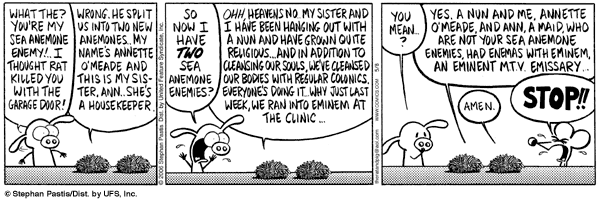
I love puns. They're great fun, and word play often shows a sophisticated grasp of language. The comic strip Pearls Before Swine is a master of puns. Above is a recent one (click on it to enlarge):

Coincidentally, the same day I was reading Kutscher's article on "anemone". It's another word that I didn't know has a Semitic origin. Here is its story:

In Yeshayahu 17:10 we find the following:

כִּי שָׁכַחַתְּ אֱלֹהֵי יִשְׁעֵךְ, וְצוּר מָעֻזֵּךְ לֹא זָכָרְתְּ; עַל-כֵּן, תִּטְּעִי נִטְעֵי נַעֲמָנִים, וּזְמֹרַת זָר, תִּזְרָעֶנּוּ.

"Truly, you have forgotten the God who saves you
And have not remembered the Rock who shelters you;
That is why, though you plant a delightful sapling,
What you sow proves a disappointing slip."

What the JPS translates as a "delightful sapling" in Hebrew is נטעי נעמנים - nitei na'amanim. The identification of namaanim as delightful derives from the Hebrew word noam נעם - pleasant. But what is the connection between the na'amanim plants and the idol worship described in the prophecy?

As described in depth here and here, there were spring and summer Caananite rituals in honor of the god Adon. This worship was common all over the Middle East. In Babylonia, the god was known as Tamuz (see Yechezel 8:14), and from his name we get the name of the summer month. The Greeks, who adopted many things from the Phoenicians (including of course the alphabet), also took on a number of their gods. They took the god Adon and he became Adonis.

Part of the ritual involved the red flowers known in English as anemones. According to Kutscher, the Greek word anemone does not come from the Greek anemos meaning wind, but is actually an adaptation of the Hebrew na'amanim. Support for this theory comes from the fact that the Arabic name for anemone is shaka'ek al-No'man - which in Arabic preserves the root נעמן.

In modern Hebrew the flowers are known as כלניות - kalaniot, meaning "little brides".

For some great photos of a field of kalaniot, go here.

Tuesday, May 16, 2006

kumzits

It is very common around the Lag B'Omer bonfire to have a sing-along called a kumzits (also spelled kumzitz or kumsitz). As this article describes, kumzits is an unusual word. On the one hand, it is widely known that the origin is from Yiddish for "come [and] sit". However, the word does not appear in Yiddish dictionaries. Why is that?

It turns out that kumzits is a Yiddish word that exists only in Hebrew. It was adopted by the early pioneers in Israel, despite the establishments opposition to use of Yiddish words. Hebrew replacements were suggested such as shevna שבנא - "please sit" and the Talmudic tozig טוזיג. But nothing ever managed to displace kumzits from its place beside the fire.

Sunday, May 14, 2006

traffic

Lately in my area of Israel there's been a lot of complaints about traffic. In general, when I have to wait in long lines in Israel - in traffic, at a government office or at the bank, I try to recall this verse from Yeshayahu (49:20) -

עוֹד יֹאמְרוּ בְאָזְנַיִךְ, בְּנֵי שִׁכֻּלָיִךְ: צַר-לִי הַמָּקוֹם, גְּשָׁה-לִּי וְאֵשֵׁבָה.
"The children you thought you had lost shall yet say in your hearing, 'The place is too crowded for me; Make room for me to settle"

The idea here is that just 100 years ago who would have believed there would be so many Jews in Israel that we would have traffic jams!

Only recently did I discover that the English word "traffic" has a Semitic origin. Klein writes in his CEDEL:
MF, trafique (F. trafic), fr. It. traffico, which prob. derives fr. Arab. tafriq, "distribution," verbal noun of farraqa, "he distributed," II (= frequentive or intensive conjugation) of faraqa, "he split, divided"; influenced in form by assumed L. traficere (for *transficere), "to make over" (see trans- and fact). Arab. faraqa is rel. to Heb. paraq, "he tore away (esp. the yoke), he rescued," peraq, "he tore off," Aram. peraq, "he rescued," Syr. peraq, "he withdrew (intr.); he redeemed, rescued," Ethiop. faraqa, "he set free". Derivatives: traffic, intr. and tr. v. (= F. traffiquer), traffic-able, adj., and traffick-er, n.
The root he is referring to is פרק. In addition to the verbs that Klein lists, we also have the word perek, meaning chapter ( from division), which can also mean "crossroads", which leads to such phrases as omed al haperek - עומד על הפרק - "to be on the agenda". We also find the word purkan פורקן - "salvation, redemption", which is known from the prayers על הניסים ועל הפורקן "Al HaNisim V'Al HaPurkan" and יקום פורקן "Yekum Purkan".

So I guess my association between traffic and redemption goes has an etymological connection as well...

pulke

The Yiddish term for "chicken leg" or "drumstick" is pulke (פולקע), and it has entered Hebrew as well (פולקה). Stahl writes that the origin is in the Russian word pol, meaning half or side. This root is found in a number of Slavic languages, including Czech, where it appears as pul. This is the source of the dance Polka - which according to this site, is Czech for "half-step", referring to the rapid shift from one foot to the other.

On this site we find that pul derives from a more ancient Indo-European root meaning "split or half", which leads to many words in the various languages of the Indo-European family, including such words as split and splice.

Thursday, May 11, 2006

eser

The Hebrew word for ten is eser עשר (and the masculine form is asarah עשרה). Does this number derive from an earlier word?

Klein follows the BDB, and writes about the root עשר:

The orig. meaning of this base prob. was 'gathering, collection, union'. cp. Arab. 'ashara (= he formed a community), 'ashirah ( = tribe), ma'ashar (=a group of ten men). Accordingly, Heb. עשר (eser), Arab. 'ashr, etc. prob. meant orig. 'a group collection', whence 'a group of ten', and ultimately 'ten'.


Rav Hirsch (Bereshit 14:20) follows the same line of thought, and mentions that other similar sounding roots also have related meanings: אסר, אצר, עצר, אזר, עזר.

Steinberg, in Milon HaTanach, has a different theory. He says that עשר is related to עצר, meaning "to stop". He therefore writes that eser got it's name because it is where you "stop" counting (when you're counting on your fingers.)

Strong takes a slightly different approach. He writes:
A primitive root (ident. With ashar); to accumulate

Should we accept the connection with the words ashir עשיר - wealthy, and osher עושר - riches? At first we might reject this approach because one has the letter sin and the other has the letter shin. But we can see here that many Semitic languages have the "sh" sound in their word for ten: esher in Akkadian, `asharah in Arabic.

So to determine if there is a connection, we should use Horowitz's advice (and Lonnie's Biblical Hebrew teacher's), and see how each term is used in Aramaic. Ten in Aramaic is עסר (asar), where rich in Aramaic is עתיר (atir) - a term still used in Modern Hebrew.

So it would seem that Strong's theory is hard to accept. However, the Rabbis did make use the similarities between "ten (or tenth/tithe") and "riches" to provide a play on words.

Jastrow provides two examples. One is from Shir HaShirim Raba:
אם זכיתם תעשירנה ואם לאו תעשירנה - "If you deserve well 'you make her rich', if not 'you reduce her to one tenth'.

The other source, from Shabbat 119a and Taanit 9a would seem to provide an opposite message:

עשר בשביל שתתעשר - "Give tithes in order that you become rich".

tesha

The Hebrew word for nine is tesha (pronounced more like "taysha") תשע, and the masculine form is tisha תשעה (as in Tisha B'Av). Philologos discusses the masculine / feminine forms here, along with a joke about:

newly religious Israeli who informs his boss that he isn't coming to work the next day because it's "Tesha be'Av."


He (who is he? she?) uses this column to present a theory about why numbers have a different gender pattern than nouns, verbs and adjectives:

The reason for this odd turnabout, which exists in Arabic and other Semitic languages as well, is obscure and goes back to the prehistory of the Semitic family. A hint can perhaps be found in certain languages of the Cushitic group, a large family in the Afro-Asiatic phylum to which Semitic belongs. There are some Cushitic languages in which nouns have the gender of their adjective reversed when they go from the singular to the plural. Thus, for instance, in Sidamo, a language spoken in the highlands of East Africa, the adjective ko, "this," is used with a singular masculine noun and te, "these," with a masculine plural, whereas the order is reversed with feminine nouns, te modifying the singular and ko the plural. Something similar seems to have affected the numbers in proto-Semitic.

I have to admit, I don't entirely understand it myself.

As I've mentioned earlier, I don't think that the words for most numbers in Hebrew derived from earlier sources. But Strong does provide an interesting theory:

perhaps from sha'ah through the idea of a turn to the next or full number ten


I suppose this would be similar to the Roman numeral IX being nine - almost ten. According to Steinberg שעה sha'ah has it's roots in the word תעה, meaning to become lost. He defines שעה as to look around, turn from place to place. Steinberg says it is the source of שעשע - to take delight (although Klein does not agree.) In modern Hebrew, we have the derivative hashaya השעיה - "suspension, temporary removal".

Sha'ah meaning "hour" is unrelated.

Wednesday, May 10, 2006

shmoneh

The Hebrew word for the number eight is שמונה - shmoneh. A word that might seem to have the same root is shemen שמן - "fat, oil". Are they connected?

Strong seems to think so:

apparently from shamen through the idea of plumpness; a cardinal number, eight (as if a surplus above the "perfect" seven);


I suppose the idea here is similar to the slang phrase in English - "everything else is gravy".

And there are no shortage of drashot about Chanuka that connect the number eight (the days of
Chanuka) with shemen (the oil used in the miracle.)

But I'm inclined here to accept Horowitz's opinion. He writes:

Two different sounds are represented by the Hebrew letter ש (shin). One is originally and really ש (shin); the other is a "th" sound that coalesced into ש (shin) in Hebrew. Scholars write this second sound ת (tav). Here, if you have studied a little Talmud, you will be familiar with many Hebrew words that Have ש (shin) in them but in Aramaic are written with a ת (tav) ... So, therefore, don't try to connect the following roots that have ש (shin) in them ...

שמן (shamen) - fat
שמונה (shmonah) - eight. The ש here was originally a "th". In Aramaic the word eight is תמני.

By the way, according to Klein, the Hebrew word for octopus, tmanun תמנון - derives from the Aramaic tmanya תמניא (eight) and nun נון (fish).

Monday, May 08, 2006

sheva

The Hebrew number for seven is שבע - sheva. A homonymic root is שבע - "to swear, to take an oath". Is there a connection between the two? There seems to be. Klein says the verb derives from sheva (seven) and "prob. meaning lit.: 'to bind oneself by seven things, or by seven oaths'." Steinberg writes that the number seven was holy to the ancient peoples, based on their view that there were seven planets (they included Sun, Moon, Mercury, Venus, Mars, Jupiter, and Saturn). The connection between "seven" and "oath" becomes clear in the stories relating to the founding of Beer Sheva, both with Avraham and with Yitzchak. The name appears both as meaning "Well of Seven" and "Well of Oath".

Of course a major derivative of sheva is shavua שבוע - meaning week. R' Hirsch goes so far as to say that the connection mentioned above between seven and oath is also related to shavua: "An oath thus obligates a person through everything that was made in the seven days of creation " (Bereshit 21:31).

One last note: an occasional error (found here for example) is to think that the mourning period known as shiva derives from the Hebrew root for sitting - ישיבה. The actual root is the masculine form of the number - שבעה - shiva, for the "seven days of mourning."

shesh

The Hebrew word for six is shesh שש (masc. shisha שישה). The Hebrew and English words sound similar, and in other languages there is even a greater resemblance - seis in Spanish, sheshi in Lithuanian, and shesh itself in Persian.

(Persian is the origin of the shesh in shesh-besh, the Hebrew term for backgammon. Besh is five in Turkish, and according to Stahl, those two numbers are used because they are the highest ones on the die, and are taken from two separate languages because of the rhyme.)

Is there a connection between the Semitic languages and the Indo-European ones here? There are those who use this to prove their theory that Hebrew is the source of all languages, but most find the general theory far-fetched, and it is included here in a list of "false cognates". This article , from the 1911 EncylcopediaBritannicaa claims that:


Six is in Hebrew shesh, almost exactly like the Sanskrit and modern Persian shash, the Latin sex, &c. But the Indo-European root is sweks, or perhaps even ksweks, whereas the Semitic root is shidth, so that the resemblance is a purely accidental one, produced by phonetic change.


However, in the sci.lang newsgroup there was a serious discussion about the development of shesh. One poster claimed there that Indo-European borrowed the word from Semitic. But haven't we said earlier that words for numbers should be so basic that no borrowing would be required? His response is that perhaps the original Indo-European counting system was base 5 (the number of fingers in the hand), similar to Roman numerals. I have no conclusion one way or another. Perhaps a reader has access to further research on the subject?

Two homonyms that aren't related to the number six are shesh (the fabric) and shayish שיש(marble). Shesh the fabric refers to white linen, and despite the drasha in Yoma 71b that connects it to the number six (a six ply linen thread) - Klein and Steinberg point out that both shesh (linen) and shayish are originally Egyptian words. (Perhaps related to each other, both being white?)

One interesting possible derivative of shesh is the Hebrew word for lily - שושנה / שושן shoshana (or shoshan). This is a common name for women in Hebrew, and is the source of the English name Susan. Ibn Ezra connects shoshana to shesh in his commentary on Shir HaShirim 2:2 -


It is a white flower of sweet but narcotic perfume, and it receives its name because the flower has, in every case, six [shesh] petals, within which are six long filaments.


Klein backs up this theory, tracing shoshan to the Akkadian shushu - six-sided.


From this picture (click for larger version) we can see exactly where the name came from.

Sunday, May 07, 2006

chamesh

The Hebrew word for the number five is חמש - chamesh. Another set of words that would seem to have the same root are chamush חמוש - armed and tachmoshet תחמושת - ammunition. Is there a connection between them?

The earliest source that might provide an answer is Shmot 13:18 - וַחֲמֻשִׁים עָלוּ בְנֵי-יִשְׂרָאֵל, מֵאֶרֶץ מִצְרָיִם. "Bnei Yisrael went up, chamushim, from the land of Egypt". Most translators and commentaries explain chamushim here as meaning "armed". (There are some exceptions. The Septuagint translates chamushim as "the fifth generation", despite translating chamushim in Yehoshua 1:14 as "armed". Apparently the unusual translation is due to the difficulty explaining the source of the armaments. And as far as the midrash that Rashi quotes, that only one fifth of Bnei Yisrael left Egypt, it is appropriate to quote Ibn Ezra's response: "We have enough trouble explaining to the Arab scholars how 55 males could have 600,000 males over the age of 20 within 210 years - and there's even more when you include women and children!")

So is there a connection between the two meanings of חמש? Klein believes that there may be. In his entry for חמוש, he writes:

Of uncertain origin. It is possibly related to חמשה (= five), and refers to the division of the army into five parts: van, body, rear and two wings. Hence related to Arab. hamis (= army; properly 'army divided into five parts') from hams (= five.)


Steinberg, in his Milon HaTanach, says that חמש in Arabic means "collection and connection", and this is the source of the number chamesh, which means "clenching of the five fingers". He gives examples from other languages where the same word means hand and five, for example piast' and piat' in Russian. He therefore explains the meaning of chamush as armed, because the soldiers are gathered and collected together. (We saw something similar in our explanation of the connection between lechem and milchama.)

I thought perhaps there was a similar development in English, between arm (limb) and arm (weapon), but although they come from the same Indo-European root, there doesn't seem to be the same type of sense development as in Hebrew.

Friday, May 05, 2006

arba

The Hebrew word for four is arba ארבע (masculine arba'ah ארבעה). The root of the word is רבע, which leads to such words as reva רבע - quarter, rvi'i רביעי - fourth, and m'ruba מרובע - square. This is fairly straightforward.

However, as we progress in our discussion of numbers, many words for numbers will appear to be very similar to other Hebrew words. In some cases it is just a coincidence, and we will be able to prove it. In other cases the connection is much more strong. There are those that claim that the words for numbers derive from these other roots. In general, I am not inclined to accept these theories - although I will present them here for you to view for yourselves. If anything, I think it is more likely that the words for numbers came first. Hebrew is an ancient language, and it seems very unlikely that Hebrew would lack such basic words as the numbers from one to ten, and need to borrow them from other words.

Arba is a good example of this discussion. There is another meaning for the root רבע - to lie down, mostly for animals and as Klein writes "in Heb. it usually refers to copulation, mostly unnatural." Its cognate is the root ravatz רבץ (the ayin and tzadi switch in Hebrew) - also meaning to lie down or to crouch, generally for animals. Klein makes no connection between "to lie down" and "four", but others do. Steinberg, in the Milon HaTanach, writes that ravatz means to lie on hands and feet - on "all fours".

Strong (or is it the BDB?) writes that רבע is:

A primitive root (rather identical with raba' through the idea of sprawling "at all fours" (or possibly the reverse is the order of deriv.).


As I mentioned earlier, I think it is much more likely that "sprawling on all fours" derives from the number than the other way around.

Another meaning of רבץ / רבע is "to irrigate, to sprinkle". Klein does not appear to connect this root with either previous meaning. Jastrow does connect "to lie with" and "to inundate for the sake of improving the soil" - both have the meaning "to cover". From the meaning "to irrigate", Jastrow derives the term to teach Torah - מרביץ תורה - marbitz torah. This is the origin of the name of the prestigious Biblical studies journal, Tarbiz.

In colloquial Hebrew, marbitz also has the meaning "to hit, to spank", I assume because it may cause someone to lie down on the ground. In even more recent slang, marbitz means "to really do or make something". Rosenthal includes such entries as:

הרבצנו מיץ תפוזים - we drank a lot of orange juice
הרביץ הופעה - dressed very impressively
להרביץ קפה - to make coffee
נרביץ תמונה - let's take a picture

I suppose the best slang equivalent in English would be "knock". To "knock out" can mean "to hit" or "to exert or exhaust (oneself or another) to the utmost" and "to produce in abundance".

Thursday, May 04, 2006

shalosh

The feminine form of three in Hebrew is שלוש shalosh, and the masculine form is שלושה shlosha. All the numbers from three to ten follow this pattern, where the masculine ends in ה ָ (ah) and the feminine does not. This is the exception to the general trend - with most nouns, verbs and adjectives the feminine ends in ה ָ (ah) and not the masculine. What's the story here?

As of now, the only explanation I could find is in Steinberg's Milon HaTanach (in the entry for ארבע). He says he discusses it more in מערכי לשון עבר - Maarchei Lashon Avar 127, 28 - which was published in 1884. He claims that originally the suffix ה ָ (ah) was used for both masculine and feminine numbers. He gives examples from Melachim I 7:30, Yechezkel 7:2 and Yirmiyahu 36:23. In time when they began differentiating between genders for numbers, they dropped the last syllable in the feminine form. He says a similar development occurred with the male word for "you" - אתה atah, and the feminine את at.

A derivative of shalosh is shalish שליש. This word has three meanings:

a) A dry measure of volume (found in Tehilim 80:6, and Yishayahu 40:12). Klein states it is likely a third of an ephah.

b) A musical instrument, as mentioned in Shmuel I, 18:6. This was either three-sided (like the triangle in English) or three-stringed.

c) An officer in the army, first used in the Torah to describe Egyptian officers, and still used today in the IDF. There are those who claim that the word is not connected to the number three (Onkelos, Rashi on Shmot 14:7) and the Daat Mikra mentions that shalishim in Ugaritic refers to soldiers who were trained to shoot arrows from a moving chariot. However, there are two other theories that do connect shalish to shalosh. One claims that the shalish was third in command, and another theory states that there were three soldiers in every chariot.

Another derivative of shalosh is shilshom שלשום - the day before yesterday. Klein says it literally means "three days ago".

Monday, May 01, 2006

shnayim

The Hebrew word for two is shnayim (shnaim) שניים. The feminine form is shtayim (shtaim) שתיים, and just like with the switch between echad and achat, we need to explain this one as well.

I have seen two explanations as to how the gender transformation developed. According to Steinberg in his Milon HaTanach, the original form was shintayim שנתים, but as we've seen before, the nun has a tendency to drop out of the middle of words.

Klein, however, writes that:

According to the opinion of several scholars, שתים is the abbreviation of אשתים. If it were really so the 'daghesh' in the ת of שתים would be accounted for. I am convinced that שתים is really the shortened form of אשתים and owes its form to the masculine equivalent שנים. I am of the opinion that אשתים is nothing but the dual form of עשתי, אשתי (=one), related to Akka. ishten (=one). אשתים as the dual of אשתי, accordingly lit. means 'two ones' (i.e. 'one taken twice'). cp. מאתים (=two hundred), אלפים (=two thousand), etc.


I have to admit that I'm not sure I follow Klein's entry, and I believe there might be a typographical error. Is he convinced that shtayim comes from eshtayim or not? If not, then perhaps he does agree with Steinberg.

The "several scholars" that he quotes likely includes Ibn Janach. According to this site, back in the 11th century, Ibn Janach noticed that shtayim is the only word in Hebrew that has a dagesh kal after a shva nach. (For more information about these terms, look at the Wikipedia article on Hebrew vowels.) He therefore concluded that the original form of the word was eshtayim, but the alef dropped off with time. (See also the Radak on Shoftim 16:28). The author of this essay (unfortunately I don't know who it is), mentions two other terms where the alef dropped off an original term, and the shva nach remained in place:
אשמורה > שמורה
אתמול > תמול

Steinberg also noticed this anomaly, but explains that because people were accustomed to saying shintayim, the dagesh remained in place.

Klein claims that shnayim derives from שנה - "to repeat", which also means "to teach". From here we get the word mishna משנה , and from the Aramaic cognate תנא - the Tanaim תנאים (the teachers of the Mishna.)

The Hebrew word for second (1/60th of a minute) - shniya שניה - is a loan translation from the Latin pars minuta secunda (= second small part of an hour).

The homonymic root שנה meaning "to change" is not related. According to Horowitz's approach, we can see this because of the transformation from Hebrew to Aramaic. Where שנה meaning "to repeat" becomes תנא, the root meaning "to change" maintains the shin. According to Klein, the word for year, שנה shana, originally meant 'change; period of changing seasons'.

And lastly, the word for sleep, shena שינה, derives from an entirely different root - ישן.

Sunday, April 30, 2006

echad

Since we're in the midst of counting the Omer, over the next several days let's learn a bit about the Hebrew numbers from one to ten.

The Hebrew word for one is echad אחד. The feminine form is achat אחת. How did this unusual transformation occur? Rav Yehoshua Steinberg, in his Milon HaTanach, explains. The "proper" feminine form would be achadt אחדת, but that would be very difficult to pronounce. We see this in Shmuel I 4:19 - הָרָה לָלָת "was pregnant; about to give birth". The word appears as lalat ללת instead of ללדת laledet, because the dalet is "swallowed up" by the tav. Try saying achadt, and you'll see how easily that happens.

Klein points out that אחד is related to yachad יחד and lechud לחוד. These related words lead to a large number of adjectives with similar but distinct meanings. As I often get confused between them, I thought this would be a good place to list all the ones I can think of, and their translations. (Please feel free to add additional ones in the comments.)

  • echad אחד - one, single
  • achid אחיד - unified, uniform
  • meuchad מאוחד - united
  • ke'echad כאחד - jointly, like one
  • yachad יחד - together, in unity
  • yachid יחיד - sole, individual
  • yechidi יחידי - alone, singular
  • yechidai יחידאי - unique
  • yichudi יחודי - exclusive
  • meyuchad מיוחד - special
  • lchud לחוד - apart, singly

Friday, April 28, 2006

grush

Many people who don't know Hebrew find it hard to imagine reading a language without vowels. Yet young children master it easily and adult students of Hebrew also find it not terribly challenging after some study. However, there are still some occasions where I end up misreading a word due to the lack of vowels.

For example, yesterday there was a headline in the newspaper that read:

כל גרוש שלישי מתחמק ממזונות

I first thought it meant that "every third coin (grush) escaped alimony". Only after a second reading did I realize that it meant "every third divorcee (garush) avoids paying alimony".

For some reason this root - גרש - leads to occasional misunderstandings, and that's what I would like to explore today.

The Hebrew root גרש means "to expel, to drive away". An related meaning is "to divorce". Divorce is gerushin גירושין and a divorcee is a garush גרוש. The connection between expulsion and divorce led to some humor during the protests over the Gaza disengagement. A popular bumper sticker read: יהודי לא מגרש יהודי - "A Jew does not expel another Jew". But someone read the sticker to me and said, "I thought it was the Catholics that don't divorce..."

Another connected term is migrash מגרש - a plot of land. Klein explains the origin as "orig. meaning 'pasture land', i.e. 'the place whither cattle are driven'." Evyatar Cohen has a different explanation. He points out the verse in Moshe's blessing of Yosef (Devarim 33:14):

וממגד תבואת שמש וממגד גרש ירחים "With the bounteous yield of the sun, and the bounteous crop (geresh) of the moons"

Geresh here is a hapax legomenon - it only appears once in the Bible. Therefore the meaning of the word is hard to define, and the translation of "crop" is based on the parallel tevuah תבואה - yield. Driver defines geresh as "that which the earth thrusts forth or tosses up". Cohen sees a parallel between tevuah and geresh - what is brought in (תבואה from בוא) and what goes out (גרש). He therefore concludes that the root גרש can mean both coming in and going out. This provides him with a different explanation as to the origin of migrash. A migrash is the area near a city or a house, also known in Hebrew as a mavo מבוא - entrance, deriving from the root בוא, coming in. (We used the fact that migrash and migaresh are homographs to make an Emily Litella type skit in a Purim play last year.)

Another meaning of geresh is apostrophe; gershayim גרשיים is two, and means quotation marks. While in modern Hebrew they are used as punctuation marks, their origins are in the taamei ha-mikra, the Biblical cantillation marks. While the origins of some of the teamim are clearly due to their shape or their sound, Klein says the etymology of geresh is unknown. While I could not find any other explanation, the etymology of the English word apostrophe might be helpful:

from M.Fr. apostrophe, from L.L. apostrophus, from Gk. apostrophos (prosoidia) "(the accent of) turning away," thus, a mark showing where a letter has been omitted, from apostrephein "avert, turn away," from apo- "from" + strephein "to turn"

Certainly the Hebrew meaning of גרש - to turn away is rather similar. It is also important to note the difference between gershayim and merchaot מרכאות. Both refer to the punctuation mark ", but according to this Hebrew expert:

Don't confuse Hebrew gersayim and merchaot - they have different meaning, different uses, and when using high quality typesetting - look differently. Gershayim is used for acronyms. Merchaot is used for quoting sentences. Similarly, geresh and single quotes aren't the same thing. Geresh is used for abbreviations, single quotes are just a typographical variant of merchaot (used when you have merchaot inside merchaot, for example).


So geresh is used only to break up a word or indicate an abbreviation. Therefore apostrophe is an appropriate translation, and perhaps the etymology is the same. I'd be happy to hear from anyone who can confirm (or deny) this theory.

What about the term grush that I quoted in the beginning of this post? A grush is a very small coin, but in modern Hebrew slang doesn't refer to any specific denomination. Ein lo grush אין לו גרוש - means he has no money at all, and shaveh kol grush שווה כל גרוש means worth every penny. The term originates in Yiddish, but there are cognates in many European languages - Russian groš, Polish grosz, the Czech grosh, and more. This site gives the following etymology:

The word is adopted from Latin (Denarius) Grossus: lit. "A thick coin" where grossus being "thick"


You can find additional discussion about the nature of the term grush here.

Wednesday, April 26, 2006

help with greek and arabic

While I have a decent number of Hebrew and English resources available for research for this site, I have found that one limitation I have is the lack of ability to read Greek and Arabic. I don't think - at this stage - that I need to learn Greek and Arabic grammar and vocabulary. But often etymological dictionaries for English, Hebrew and Aramaic will refer to a Greek or Arabic cognate, and I would like to know how to accurately transliterate them into Latin or Hebrew letters. And as far as Arabic is concerned, if each Arabic letter is cognate to a Hebrew one, I would like to learn about how that works as well.

If anyone is familiar with any relevant resource - book or website, in Hebrew or English - please let me know by email or in the comments.

balagan and blech

This is actually not the story of a Semitic root, but rather of an Indo-European one - and maybe two. But since this is Balashon, we will examine the root via Hebrew and Jewish words.

Answers.com defines a blech as:


A blech (from Yiddish) is a sheet of metal used by many observant Jews to cover stovetop burners on Shabbat (The Jewish Sabbath), as part of the precautions taken to avoid violating the halakhic prohibition against cooking on the Sabbath.

What is the origin of the term? In German, blech means "sheet metal". This site points out that the origin is the Indo-European root bhelg or bhleg, meaning “sparkle” or “shine" - I suppose because of the shiny nature of sheet metal. This root is the source of dozens of words including bleach, bleak, blind, blond, blank, blush, blue and even black (shine leads to burn, and burnt leads to black).

Another Hebrew word that comes from an Indo-European root is balagan. It entered Hebrew from Russian, and means a chaotic mess. According to this site, the etymology is as follows:

"balagan" is Hebrew/Yiddish/Polish "mess" - Russian/Turkic "wooden house" - Persian balakhaana "external room". But "balakhaana" can be derived from OIE (Old Indo-European) *bhelg which means "wooden plank". This ancient word's direct descendant in English is "bulk". And from this same root we have the Polish word "belka" (direct decendant) and the English "balk" (came via Old-Norse) - both have the meaning of "wooden beam", "girder", "tie-beam", "rafter" - (compare "fulcrum" which is a Latin relative to these two words).An even more interesting, the English word "balcony", Polish "balkon" (which came to both our languages from Old Italian (to Polish via French) where it came from Old Germanic, and which means "wooden platform", "scaffold". Although the word "balcony" does not come directly from the Parsian "balakhaana", but it is a similar type of derivative in another ancient language belonging to the same family, and nowadays it still keeps the similar sound and meaning.


So bhelg/bhleg can mean both "shine" and "plank or beam". Perhaps they are two separate roots that appear very similar. Or maybe burning wood leads to shine and glow? (This site - s.v. Fulginiae - maybe hints that it does.) Does anyone have any decisive information one way or another?

Monday, April 24, 2006

jacket

As I mentioned yesterday, the word jacket also has its origins in Hebrew. Horowitz points out that the English word jacket derives from the French jacquette. Jacquette is a diminutive of the common French name Jacques, which was used to refer to Frenchmen in general, and Horowitz mentions that the jacquette was worn by French soldiers and peasants. Jacques is the French version of the English Jacob, which of course derives from the Hebrew Yaakov יעקב.

Stahl presents another theory where the name Jacques and Jack actually derives from John (which comes from Yochanan יוחנן). John became Jack via the nickname Jankin, but as often happens in both Hebrew and English, the middle letter "n", dropped out in time.

Stahl presents another theory, also mentioned in the Online Etymology Dictionary:

possibly associated with jaque (de mailles) "short, tight-fitting coat," originally "coat of mail," from Sp. jaco, from Ar. shakk "breastplate."


Stahl points out that the Arabic root is שכה - I assume related to the root סככ - meaning to cover.

In German jacket was known as Jacke. Stahl explains how this later became the nickname for German Jews - yekke. The German Jews adopted Western dress before the Eastern European Jews, and this included shorter jackets than were previously worn. Originally this term was derogatory, but after the Shoah, it was not viewed appropriate to call Jews from Germany "German", the way Jews from other countries were called (Russians, Moroccans, Yemenites). From that point the term Yekke lost its derogatory edge.

Sunday, April 23, 2006

cotton

According to the American Heritage Dictionary, the root of the English word cotton is from a similar sounding Semitic one:


cotton, from Arabic qun, quun, cotton, perhaps akin to Akkadian qatnu, to be(come) thin, fine (of textiles)


Yechezkel Kutcher in his book "Milim V'Toldotehem" explains that the earlier Hebrew name for cotton was tzemer gefen צמר גפן, because cotton leaves looked similar to grape leaves. In the Talmud (Shabbat 105a), there is a distinction between wide and fine strings, and the fine ones are called קטיני katinei in Aramaic. Prof. Kutcher claims that the term katinei went from the specific meaning of fine strings to the meaning of strings of cotton in general. He also says that the word migrated, as did many others from Aramaic to Arabic.

So if cotton is related to katan קטן - small, why is the Hebrew word for cotton, kutna, spelled כותנה?

Klein says that the spelling was influenced by the Aramaic kitan כיתן - flax, linen and Hebrew kutonet כתנת - coat (and "coat" doesn't seem to be connected, although we'll get to "jacket" in a future post.)

Jastrow claims that kitan derives from the root כתת, meaning to crush or pound, since this is how the flax was prepared (see Yoma 71b).

Kutonet itself originates from the same Semitic source according to Klein, and therefore originally referred to a linen garment. Kutonet was borrowed by Greek for their word chiton and by Latin for tunic (with a switch of letters.)

Klein also points out that the German word kittel (meaning frock, but adopted by Yiddish for the white cloak worn on certain religious occasions) also has its roots in the Arabic qutun.

Friday, April 21, 2006

sapir

In my post about Hebrew words with the root ספר, I forgot one of the most important ones for anyone interested in linguistics - the gem ספיר - sapir. According to Klein, the Hebrew word sapir is cognate to the Sanskrit sani-prijam, meaning "dear to Saturn". The word prijam derives from the Indo-European root pri, meaning "to love", and is also the source of such English words as free, friend and Friday.

The Greeks took this Semitic root and returned it to the Indo-European family, by changing sapir into their sappheiros, which became the Latin sapphirus, and finally the English sapphire. This is still the basic translation for sapir, although it is also translated as Lapis Lazuli. It is also the origin of the surname of language columnist William Safire.

Tuesday, April 18, 2006

sefira

One of the customs during the period known as sefirat ha'omer - ספירת העומר - is not to get a haircut - להסתפר - l'histaper. Is there an etymological connection between the two terms that share the same three letters in their root - ספר?

Jastrow believes that they do, while Klein maintains that they do not. Let's look at various Hebrew words with the root ספר SFR - and see where from where they derive:

1) Throughout the Bible, the root ספר means "to count, number, to recount, tell, narrate". From this root come such basic words as sefer - book, sofer - scribe, mispar - number and sippur - story. Jastrow explains the development of the word as "to cut, to mark, -> to write, to count". We'll see the significance of that order in the following paragraphs. Klein however gives a different explanation. He writes that sefer comes from the Akkadian shipru, meaning letter, which in turn comes from shaparu, meaning "to send." This Semitic root is related to the Arabic word safar - journey, which later gave the Swahili word safari.

2) As I mentioned before, the root ספר can also mean "to cut". Tisporet תספורת - haircut, and misparaim מספריים - scissors are derivatives. Naturally, this fits in rather well with Jastrow's theory above, but Klein says it is related to the word shafra(h) - meaning "large knife, blade of a sword" (he doesn't say which Semitic language.)

3) The word sfar in Hebrew means border, frontier. Jastrow connects it with the previous terms by pointing out that a boundary is marked. (However, he also includes a definition of צפירה as "border", and certainly the tsade and samech could have switched place over time.) Klein says it is related to the Akkadian supuru, meaning "wall, fence" and the Aramaic ספרא meaning "shore".

4) The kabbalistic term "sefira" (meaning "the ten creative divine forces") does not derive from Hebrew, but rather from the Greek sphaira, meaning "ball, globe", and besides giving the English word sphere, is also the second element of such words as atmosphere and stratosphere.

5) In English the noun "super" usually refers to a superintendent of an apartment building, but in Hebrew the noun סופר - super indicates a supermarket.

6) Lastly, the English words cipher and zero derive from from an Arabic root - safira - meaning "void" or "empty". From here it would appear that there is no connection from that root to an existing Hebrew word, but maybe one of the readers here has an idea?

Sunday, April 16, 2006

hamsin

The weather in Israel at this time is often characterized by hot winds. In Hebrew the more "proper" name is sharav שרב - but the popular name is the Arabic hamsin (or khamsin). The name hamsin has nothing to do with the Hebrew word cham חם - hot.

The word hamsin in Arabic actually means fifty. This derives from an Arabic tradition that there are 50 days of these hot winds. Judaism has a similar tradition. To understand this, it's important to note that despite Hebrew words for the four seasons known in English, the climate in the Land of Israel really only includes two seasons - summer and winter. Between each season there is a transitional period that is a very sensitive time for agriculture. Untimely heat, rain or winds can cause great damage to the crops. As part of the prayer for a successful transition, both periods include mitzvot that involve waving in all the directions of the wind. The Rabbis explain both the waving of the lulav and the omer as connected to a prayer that the winds be favorable.

The transition from winter to summer is longer than the one six months later, and therefore is more sensitive. Prof Jacob Milgrom notes:

that counting betrays anxiety. The spring harvest coincides with the end of the rainy season but also with the onset of a period when Israel is often buffeted by the hot, dry east wind called Sirocco, blowing across Egypt. The contemporary Israeli name for this feared phenomenon is Hamsin, which derives from the Arabic word hamsun and is related to the Hebrew cognate hamishim, all meaning 50. The Mishna preserves the ancient angst: "At Passover the world is judged in terms of the grain harvest." Hence, from April to June (roughly a 50-day period), the earth's bounty stands in jeopardy of being depleted by the withering winds of a Hamsin.

Each day counted therefore constitutes both thanks to God that the previous days passed without damage to the crops, and a prayer that the remaining days will be successful.

Wednesday, April 12, 2006

chametz

The word chametz (or hametz) derives from the root חמץ - meaning "to be sour, to ferment, to be leavened". Jastrow claims that perhaps the original meaning was "to be hot", which led to another meaning - the color red. Jastrow gives the example from Moed Katan 23a, where they mention בחימוצתא רומיתא סומקתא - which he translates as "Roman dyed red garments".

Other words that derive from the same root חמץ include hometz (or chometz) חומץ - vinegar, and its derivative humtza חומצה - acid. One example of hometz in the Tanach is in Megilat Rut (2:14), where Boaz tells Rut to: וְטָבַלְתְּ פִּתֵּךְ, בַּחֹמֶץ - "dip your bread in the vinegar". This sounds like an unusual dip for bread, and the Daat Mikra suggests that perhaps hometz here meant sour milk.

I have heard however a different explanation that has more linguistic significance. The Arabic term for chickpea dip - commonly known in English as hummus - has the same root as hometz - חמץ. In the Talmud, there is reference to a legume known as himtza חימצא (or חימצי). So perhaps Boaz was suggesting something a little more tasty - bread with hummus.

Does himtza also derive from the same root as chametz? Klein says that it probably does. I'm not 100% sure - in Aramaic chametz is chamiya חמיעא. Horowitz (p. 108) teaches that the letter tsade is a "triplet letter" - having once had three different pronunciations. Aramaic acts as a mirror into the original Hebrew pronunciation. He points out that sometimes Aramaic preserves the current sound of tzade - צרח is the same in Hebrew and in Aramaic. Occasionally tsade has the sound of tet - נצר in Hebrew is נטר in Aramaic. And then there are cases where tsade is like ayin - ארץ in Hebrew is ארעא in Aramaic. So while the Aramaic word himtza חימצא preserves the tzade, chamiya חמיעא - has it replaced with an ayin. This could very well point to different origins.

kitniyot

While I expressed gratitude that I do eat gebrochts on Pesach, I regret that I can't say the same about kitniyot (or kitniot) - קטניות. Jastrow defines kitniyot as "small fruit, pulse, beans, peas", and states that the term derives from the word katan קטן - small. This term appears in Talmudic literature far before the medieval prohibition of eating it on Pesach.

As often happens, an etymology can often help to better understand the nature of a term. Richard Israel did so in this essay in regards to kitniyot:

In general, kitniot are those small (kitniot - from katan) seeds or beans which look a little like grains and which need to be cooked to be eaten. Though frequently translated as legumes, aside from peas and peanuts, they are NOT legumes. And some legumes, like alfalfa leaves which can be used for salad, ARE NOT kitniot. Legumes are plants whose root nodules make nitrogen. Since "teensy-weensies" or "tinies" are not translations that are very likely to make it into ordinary English parlance, the most appropriate translation for kitniot, it seems to me, is kitniot.


Now obviously an understanding of kitniyot as being small enough to look like grain has an impact on what could or should be considered to be included in the prohibition. But that's beyond the scope of Balashon...

Monday, April 10, 2006

gebrochts

Some Jews will not eat anything cooked with matza on Pesach - including matza meal. (I'm not included in that group, BH.) They refrain from eating any food that is gebrocht. (The Hebrew term is matza shruya, but since this custom originated in Eastern Europe, the Yiddish name is used much more.) When I asked about the etymology of the term, someone guessed that perhaps it was related to bracha - blessing. That's not correct, but we'll get back to that association later.

The term gebrocht means broken - as one would break matza into soup. As this site explains, "The past participle of Yiddish verbs is formed by adding the prefix ge- and the ending -(e)n or -t to the base of the verb." So gefilte fish is filled (stuffed) fish: "ge-fill-t". And broken matza is "ge-broch-t". Since German and English are closely related languages, we can easily see how these words developed.

A slang term for bankrupt is "broke", and this leads to a question that appears on those list of silly questions floating around the internet: Why the man who invests all your money is called a broker?

Take Our Word For It explores the origins of the term broker:

One school connects it with tapping into or broaching a wine cask in order to sell the wine - in fact, this school claims that broker derives from the same source as broach. Both words supposedly come from French broche "awl" (from Latin broccus "projecting"). The Latin derives possibly from Gaulish, as there is an apparent Gaelic cognate: brog "awl". Incidentally, even if broker does not derive from the French broche, the word brooch (which was spelled broach until quite recently) certainly does.
Another school propounds the theory that the word comes ultimately from an Arabic source. The Anglo-Norman form of the word is thought to have been brocour, and a variant was abrocour. There was a Spanish word alboroque "sealing of a bargain" as well as Portuguese (one of the most interesting sources of English words) alborcar "barter", both likely coming from Arabic (with the al representing the Arabic definite article). Earnest Weekley notes that we see the Spanish word as early as 1020 and that its derivation from Arabic (or Hebrew) is supported by the fact that many brokers in the Middle ages were Arabs or Jews.
Weekley notes another possible explanation (though he favors the Arabic source): Anglo French broucour "one who broaches a wine cask and sells the wine". There was a variant, abroucour, whose Medieval Latin equivalent was abbrocator, and this may have been confused with or influenced by Medieval Latin abbocator "a broker" or literally "one who brings a buyer and seller mouth to mouth", boca being Latin for "mouth".


What Arabic root are they referring to? The American Heritage Dictionary gives the following etymology:

Middle English, from Anglo-Norman brocour, abrocour; akin to Spanish alboroque, ceremonial gift at conclusion of business deal, from Arabic al-barka, the blessing, colloquial variant of al-baraka : al-, the + baraka, blessing, divine favor (from braka, to bless)


So you can see there is at least one theory that provides a connection between a word sounding like "broke" in English, and bracha in Hebrew.

Here's one more, although I'm not sure whether I believe it. There are those who think that the origin of the term "break a leg" (a way to wish luck to someone before a performance) is in Hebrew.

How so? There are a number of explanations out there - here's the one from World Wide Words:

Germans say Hals- und Beinbruch, “neck and leg break”, as ways of wishing someone good luck without any fear of supernatural retaliation. It is sometimes said that the German expression is actually a corruption of a Hebrew blessing hatzlakha u-brakha, “success and blessing”, which may have been borrowed via Yiddish. Whatever its source, the most plausible theory is that Hals- und Beinbruch was transferred into the American theatre (in which Yiddish- or German-speaking immigrant Jews were strongly represented) sometime after World War I.


Doesn't sound too likely to me, but I'll buy it before I stop eating gebrochts...

Sunday, April 09, 2006

matza

There are two theories about the etymology of matza (or matzah) מצה.

Some say that it comes from the root נצה - meaning "to hasten", and therefore matza would mean "that which was made in haste." While Klein doesn't mention it, I assume there is a connection to the root אוץ - which also means to hasten, and is the root of such words as מאיץ and תאוצה (acceleration).

The other more popular theory is that matza derives from the root מצץ, meaning "to squeeze, to suck, to drain out". According to this approach, matza receives its name from its dry nature. This root also is the source of the word mitz מיץ - juice, tamtzit תמצית - essence, and mitzui מיצוי - originally squeezing, but later took on a sense of "getting as much as possible out of something". This led to a nice linguistic drasha, that appears here (among other places):

The Hebrew word Matza has the same root as Mitzui (realization of potential), while the Hebrew word Chametz (leaven) has the same root as Hachmatza (missing an opportunity).


As an aside, Onkelos translates matza as פטיר or פטירא (patir or patira). Jastrow explains that term as "free from admixture" - in the case of matza, free of leaven.

Thursday, April 06, 2006

karpas

Karpas and "carpet" have something in common - and no, carpet is not the Sefardi pronunciation.

We all know karpas כרפס is the vegetable - often parsley or celery - eaten as a sort of appetizer at the Pesach Seder. What is the origin of the word?

There are those that claim it comes from the Persian word karafs (or karats, according to Klein), meaning parsley. Others claim that it derives from the Greek karpos, meaning "fruit of the soil." Karpos originates in the Indo-European root kerp, meaning "to gather, to harvest." Other words from the same root include "harvest", and "carpet", because it was made of unraveled, "plucked" fabric.

One very similar word that does not appear to have any etymological connection (some interesting drashot notwithstanding) is the word karpas appearing in the Book of Esther (1:6), meaning "fine cotton or linen". I won't go into detail about that meaning of karpas, since a big post on cotton should be coming up soon. However, Mar Gavriel presents an interesting theory here, that the pronunciation of karpas the vegetable was influenced by karpas the fabric:

According to Prof. Guggenheimer (in his book The Scholar's Haggadah), the words karpas (fine white linen) and karafs (celery) are both Farsi. Whoever provided the vowel-points for the mediaeval song "Qaddêsh u-Rechatz" only knew the consonants KRPS from the Meghilla, so he vocalized them as he had found them there.

Obviously this only fits the theory that כרפס the vegetable derives from the Persian and not Greek, but it's interesting in any case.

afikoman

The afikoman אפיקומן is perhaps the most misunderstood part of the seder meal. The Mishna in Pesachim (10:8) states:

ואין מפטירין אחר הפסח אפיקומן

Which can be loosely translated as "After the Pesach (sacrifice) one should not end with afikoman". To this there are two major questions. One, what is this afikoman? And two, isn't the afikoman actually the last thing we eat at the seder?

First, let's find out what afikoman means. While there are a number of midrashim and folk-etymologies, the most commonly accepted answer is that it comes from the Greek word epikomion, meaning the "festal procession after the meal". Epi means "after" (as in epilogue), and komos means "banquet, merrymaking" (and is the root of the word "comedy").

Professor Eliezer Segal explains here the development of this understanding of afikoman:

The reference is to a custom known as epikomion, a Greek word meaning "after dinner revelry" ... Normally this would involve going off to someone else's house, whether or not you have been invited, and indulging in another party.
What the Mishnah is saying is that, in spite of some of the apparent similarities between the seder and a pagan banquet, one should not treat it light-headedly as the Romans and Greeks would their own feasts. This meaning was understood by the Rabbis of the Palestinian Talmud, who lived under Roman rule. By contrast, the Babylonian Talmud (whose authors lived farther away from the Greco-Roman world) came to understand the afikoman as a "dessert," translating the Mishnah as "One should not eat anything after the Passover Afikoman."

So now the question remains, even if we accept the Babylonian Talmud's understanding that we are not supposed to eat after the afikoman, why do we call the last piece of matza we eat "the afikoman"?

It was accepted by most halachic authorities that in order to fulfill the intention of the above mishna, the last thing eaten at the seder should be a quantity of matza. In the times of the Geonim, there was no mention that this piece needed to come from the broken and hidden piece of the middle matza. But by the time of the Rishonim (Rashi, Rashbam and others), it was emphasized that the last piece of matza eaten should come from the broken and hidden piece. This is the origin of the siman (step) tzafun צפון - meaning "hidden".

Then, starting in the time of the Rishonim (Machzor Vitri, Sefer Rokeach, and others), the afikoman began to refer to the piece of matza eaten during tzafun.

So the meaning afikoman changed from a forbidden act of revelry, to a dessert, to a required piece of matza during the meal. Anyone who could have guessed that really deserves an "afikoman present"...

Wednesday, April 05, 2006

maror

The etymology of maror מרור (in the Tanach, it never appears in the singular but rather as the plural merorim מרורים) is simple - it means "bitter herbs", from mar מר - "bitter".

What English word also derives from the same Hebrew root? The spice myrrh gets its name from the Hebrew word mor מור. This spice was burned at the altar in the Temple, and appears numerous times in Shir HaShirim. Rashi (Bereshit 22:2), following Onkelos, explains the etymology of Har HaMoriah as coming from the spice mor. While other explanations are given, Shir HaShirim (4:6) does mention Har HaMor.

This of course leads to the question: why would such a central spice be named after something so bitter? This site seems to give the answer:

Myrrh is a gum resin produced by trees and shrubs of the family Burseracea, most notably Commiphora myrrha, Commiphora abysinica, and Commiphora schimperi. The resin is obtained from Arabia and adjacent Africa, and is taken from the small, prickly gray-barked trees. Pearls of myrrh are brown, red or yellow, with an oily texture, becoming hard and brittle with age. It has a pleasing fragrance, very much like balsam, and a lasting, bitter, aromatic taste, hence the name mor, which signifies bitterness.

I'm sure there's a nice drasha that can be made about how mor is sweet to smell but bitter to taste. If someone knows of one, please let me know; otherwise feel free to write your own...

Monday, April 03, 2006

hag'ala

A number of years ago I was working on a kibbutz, helping to prepare the kitchen for Pesach. One of the tasks was to rinse the vessels and utensils in boiling water - known as hag'alat kelim - הגעלת כלים. When someone asked me what I was doing, I said ani mag'il אני מגעיל - which also means "I am disgusting." While the story would have been funnier if I had not known the meanings of both words, the question remains - what is the connection between rinsing in boiling water and disgust/rejection? Does the root געל have one meaning or two?

Klein seems to indicate that there are two meanings, but doesn't fully explain the etymology of each. If I recall correctly, one of the kibbutznikim offered me a convincing explanation. Both words indicate repulsion. When something disgusts me or someone rejects me - I am repelled away. When I do ha'galat kelim - I repel, remove, the chametz from the vessel.

Sunday, April 02, 2006

hakheh

Many people are surprised by the violent answer to the wicked son in the Haggadah, when we are told to "hit him in the teeth". However, that is a mistranslation. The text says הקהה את שיניו - "blunt his teeth" - not הכה את שיניו - "hit him in the teeth." What is the meaning of the verb hakheh?

The root קהה means to "be blunt, be dull." The connection to teeth appears In Yirmiyahu (Jeremiah) 31:28-29: אָבוֹת אָכְלוּ בֹסֶר; וְשִׁנֵּי בָנִים, תִּקְהֶינָה - "Parents have eaten sour grapes and children's teeth are blunted." This blunting of teeth is referring to the opposite of the ideal state - healthy teeth are assumed to be sharp. The midrash in Yalkut Shimoni (Eicha) describes Yitzchak as הבן שנתן לו בקהיות שנים למאה שנה - "the son that was given to (Avraham) when his teeth were blunt (i.e. he was in his old age), when he was one hundred years old." Jastrow provides a number of examples of the use of the root קהה - and while they differ, they all derive from the same meaning - dull or blunt.

The root קהה seems to be connected to the similar sounding root כהה - which means "to grow dim, faint" and later "to become dark". Both קהה and כהה are according to one theory the root of a word that many strongly associate with Pesach - coffee. The American Heritage® Dictionary claims that coffee comes from the Arabic word qahwa meaning "dark stuff", and is related to the Arabic word kahiya, "to be(come) weak", which is connected to both קהה and כהה.

This is certainly not the only theory. Many others say that the word coffee comes from the Ethiopian region of Kaffa. Stahl and others say that qahwa originally referred to a type of wine. Now, imagine how awake you'd be after four cups of coffee at the end of the Seder!

Saturday, April 01, 2006

pesach

It might seem that the etymology of the word Pesach is so obvious that it doesn't deserve an entry here. Pesach = "pass over", no? Well, until I started researching it, I would have agreed. However, it turns out that the origin and meaning of pesach is one of the most complicated topics I've dealt with yet.

It is clear that Pesach is connected to the verb pasach פסח. But what does pasach mean?

Both pesach and pasach appear for the first time in Shemot (Exodus), chapter 12:

יא וְכָכָה, תֹּאכְלוּ אֹתוֹ--מָתְנֵיכֶם חֲגֻרִים, נַעֲלֵיכֶם בְּרַגְלֵיכֶם וּמַקֶּלְכֶם בְּיֶדְכֶם; וַאֲכַלְתֶּם אֹתוֹ בְּחִפָּזוֹן, פֶּסַח הוּא לַהשם.

יג וְהָיָה הַדָּם לָכֶם לְאֹת, עַל הַבָּתִּים אֲשֶׁר אַתֶּם שָׁם, וְרָאִיתִי אֶת-הַדָּם, וּפָסַחְתִּי עֲלֵכֶם; וְלֹא-יִהְיֶה בָכֶם נֶגֶף לְמַשְׁחִית, בְּהַכֹּתִי בְּאֶרֶץ מִצְרָיִם.

In order not to influence your understanding of pasach, I won’t translate the phrases, but in short, verse 11 states that “you will have a pesach to God” and in verse 13, God says that “I will pasach over (or “on”) you.”

There are three main explanations to the word pasach – “to have compassion”, “to protect” or “to skip over.”

Let’s review each of the opinions.

To skip over - לדלג: This is the most commonly known definition. How did it become so popular? According to Nahum Sarna in Exploring Exodus (page 87), this translation became predominant because the Latin Vulgate version translates pasach as “pass over” – transire in Latin. (Interestingly, it was the 16th century Christian scholar William Tyndale who coined the term Passover. Previously pesach was translated by Christians as paschal or pask.) This understanding explanation was adopted by the Septuagint, Josephus, Rav Yoshaia in the Mechilta (who connects פסח with פסע) Rashbam, and Rashi brings it as one of the options (כל פסיחה לשון דלוג וקפיצה).

To have compassion לחוס : This is the translation provided by Onkelos, an unnamed source in the Mechilta (אין פסיחה אלא חייס) and Rabbi Yonatan in the Mechilta (פסחתי עליכם – עליכם אני חס) and is also offered by Rashi (פסחתי – חמלתי). Sarna feels this is the oldest and most reliable. Dov Rappel and others suggest that Onkelos translated פסח as חוס because it would not be respectful to describe God as “jumping”.

To protect להציל, להגן: This explanation appears in Tosefta Sota (Chapter 4), Targum Yonatan, the Mechilta, and is supported by Yishayahu (Isaiah) 31:5:
כְּצִפֳּרִים עָפוֹת--כֵּן יָגֵן ה' צְבָאוֹת, עַל-יְרוּשָׁלִָם; גָּנוֹן וְהִצִּיל, פָּסֹחַ וְהִמְלִיט.
“Like the birds that fly, even so will the Lord of Hosts shield Jerusalem, shielding and saving, protecting (פסח) and rescuing.”
There is certainly a strong connection between to protect and to have compassion, and one understanding might have developed from the other.

A word from the same root is piseach פיסח - meaning lame. Amos Chacham in Daat Mikra (Shmot) (and earlier the Radak in Sefer HaShorashim) quotes the verse in Yishayahu (35:6):

אָז יְדַלֵּג כָּאַיָּל פִּסֵּחַ, וְתָרֹן לְשׁוֹן אִלֵּם:
“And the lame shall leap like a deer, and the tongue of the dumb shall sing out loud”
Chacham goes on to say that perhaps the sacrificial lamb itself is called “pesach” because it jumps and skips. However, Samuel Loewenstamm in The Tradition of the Exodus in Its Development rejects that explanation based on the same verse. He points out (page 86) that the verse describing a miraculous state, but it is not the way of the piseach to jump, just as the deaf do not usually sing. (A neighbor of mine suggested that perhaps piseach is related to pasach (to jump), but is used to describe a lame person in a euphemistic way.)

Loewenstamm mentions an Arabic root connected to pasach which means to expand. (He brings the root in Arabic, but unfortunately I can’t read Arabic.) He states that the same verb also has the meaning “to save” (and therefore is another proof for him that the translation “to protect” is the most authentic.)

Rav Uri Dasberg in Shabbat B’Shabbato quotes the same Arabic root to explain a difficult passage in the Hagada Shel Pesach. The Seder opens with the invitation:
כל דצריך ייתי ויפסח
This is generally translated as: “anyone who needs it may partake of the Pesach sacrifice.” However, the law states that the sacrifice is distributed only to those who reserved a portion before it was slaughtered. Once the seder has begun, it is too late to add participants.

Dasberg explains that the entire “invitation” is intended for non-Jewish foreigners. The Talmud states the Jews of Babylon were required by law to invite soldiers of the king into their homes in times of crisis. This is a reason that the invitation is in Aramaic. In order to avoid the prohibition of cooking for a non-Jew on a holiday, the invitation was extended after the meal had begun (since no more food could be added.)

According to Dasberg, perhaps the meaning of ויפסח was to make room (like the Arabic root), so the invitation said “we will make room for anyone who needs” and did not refer to the Pesach sacrifice at all.