
Tuesday, June 04, 2024

tallit

The background to how I began exploring the etymology of tallit טַלִּית is complicated, but perhaps more interesting than simply the bottom line. Therefore, I’ll tell it more like a story, and hopefully it will be fascinating to you as well.

It began when I was watching a video from the wonderful Jewish history YouTube channel by Sam Aranow. This video is called The Revival of Hebrew? (1879-1908), which focuses on the contributions of Eliezer Ben-Yehuda and others in the modern revival of Hebrew.


To get a better perspective on the Hebrew language, Sam brought on Yair from the Che Languages YouTube channel. At 2:20, they mention words originating in Egyptian, Persian, Greek, and Latin. Many of those words I’ve written about here before. But one word caught my eye - tallit, which they claimed had a Greek origin.


I had never heard such a suggestion before. I was only familiar with the etymology provided by Klein:


טַלִּית f.n. Post-Biblical Hebrew 1 cloak. 2 prayer shawl. [Prob. from טִלֵּל (= he covered, roofed).]


In fact, I had mentioned that as a tangent on a post a while back:


The letters tzade and tet can switch between Hebrew and Aramaic, as can also be seen in the words tzel צל - "shade" and טלל - "to overshadow", the root of talit טלית.


But where was this Greek origin theory from?


It turns out that Yair had found the Greek origin for tallit on the Wiktionary page for טלית. The page provides two possible etymologies. One the one that I had heard, and the other claiming Greek origin:

Etymology

Unclear. Suggestions include:


  • From the Aramaic root ט־ל־ל (t-l-l) (related to the Hebrew root צ־ל־ל (ts-l-l); compare צל (tsél)).

  • From Ancient Greek στολή (stolḗ, “garment”).


The only source given on that page was a 2001 post on the Avodah email discussion list by Rabbi Dr. Seth Mandel entitled Tallit/talles (a follow up from an earlier post of his and in response to a Philologos column). This is the relevant section from his post (links and italics are mine):


Furthermore, there is another, less well-known word in the Mishna which is certainly associated in meaning (remember, in the Mishna, tallet/t'lit does not mean exclusively "prayer" shawl). The word in most modern printed editions is vocalized itzt'lit: aleph, tzadi, lamed, tav, with some immot qriah thrown in as well. Look in Yoma 7:1 and Gittin 7:5. That word in the manuscripts is written in various ways: the Kaufmann ms. has estalet, with no yod at all, a segol under the aleph, then a samekh, then a tzere after the lamed (which has no dagesh). The Rambam own hand ms. of the Mishna also has the word without a yod before the tav, indicating the vowel is not a hiriq. That word, as the various spellings give away, is the Greek word stolé (also borrowed in English, by way of Latin, as meaning robe, commonly used as in mink stole). Aramaic and Leshon Hazal could not tolerate two consonants together beginning a word, and so a proclitic vowel was added to such Latin and Greek words, as also in words like itztadion (stadium) and many others. That Greek word, with the feminine Aramaic ending, was then estaleta/estalet or estalit. It seems clear that tallet was either a shortened form of this loan word, or some original Aramaic word from the root tll (which word is unattested) became influenced by the Greek loanword and its pronunciation. That would explain both tallet and t'lit: the Greek loanword had a short a vowel (commonly used as a reflex of the Greek omicron), so it either became a shva in Hebrew (and hence the Teimani form) or a pasah (which would require doubling of the lamed with a dagesh). Not only does a foreign origin explain the varying forms of tallet/t'lit


[He then goes on to explain why tallit is often pluralized as talleisim in Ashkenazic Hebrew, for more details, read the rest of his post.]


Mandel is claiming that the word tallit derives from the from the Talmudic word itztela אִצְטְלָא meaning “robe, cloak,” which in turn comes from the Greek “stole.” The English word “stole” has the same origin. It either means a long scarf or shawl, particularly used by women, or it can  refer to a liturgical vestment worn by Christians, which some say was influenced by the tallit.


It’s certainly an interesting theory, and Mandel’s explanation is certainly detailed and well thought-out. The words itztala and tallit could be connected linguistically, and certainly have a similar meaning. And the tallit was, as Mandel notes, a garment for general use - not only for prayer as it is today. But is the etymology his original idea, or did he base it on previous scholarship?


I intended to ask Rabbi Mandel directly, but sadly he passed away while I was researching the issue. But despite that loss, and hopefully to perpetuate his memory (and our shared love of Hebrew language history), I felt it was important to continue the search.


I first noticed that Rashi (Sanhedrin 44a, ד”ה איצטלא דמילתא) explains that itztela means tallit. That helps in identifying that the words have a shared meaning, but doesn’t necessarily speak to the etymology (and Rashi certainly does not make such a claim.)


I looked at more recent scholars for clues. Jastrow supports the טלל origin (not surprisingly, since he generally leans in the direction of Semitic roots for Hebrew and Aramaic words, even when more recent scholarship doesn’t justify it.) Kohut prefers a Persian origin (again, that seems to be his default preference.)


Ben Yehuda’s entry for טלית is interesting. The footnote (likely edited by Tur-Sinai) says that the origin of the word is unclear. It brings the טלל theory, but rejects it. (This makes Klein’s adoption of the theory surprising, since in general he follows the Ben Yehuda dictionary.) 


In support of this rejection, he quotes an 1890 article by the scholar David Günzburg in the journal Revue des Études Juives. In the article, “Origine du mot Talit”, Gunzburg explores a number of possibilities as to the etymology of tallit


Full disclosure, I wasn’t able to get a fully readable English version from online translation tools. If I’m not mistaken, he suggests a possible connection to the Latin trilix, meaning a three-threaded garment. That seems far-fetched, and I can see why Ben-Yehuda didn’t quote it.

But one claim of his did draw my attention. Just as Mandel had argued, Gunzburg also writes (page 18) that tallit is a masculine noun (not feminine as we use it today), which proves that it is a non-Semitic root. (In other words, the ת at the end is not a suffix, but part of the word.) But neither Gunzburg, nor Ben-Yehuda, offer a conjecture as to what that non-Semitic word might be.


Gunzberg didn’t, but Ginzberg did. I’m referring to the scholar Louis Ginzberg. I found a 1916 Festschrift for Adolf Schwarz, edited by the linguist Samuel Krauss. In the book, Ginzberg has a long essay (329-361) where he discusses the etymology of various Hebrew and Aramaic words. On page 359, he has a paragraph about the origin of tallit. He quotes Gunzburg, and accepts the non-Semitic origin of the word. He then goes on to propose that tallit derives from itztala


Here’s where it gets a little confusing. Ginzberg cites Krauss (the editor of the Festschrift). Once again, full disclosure - I’m relying on online translation for Ginzberg’s German. Here’s the original:


The translation seems to indicate that Krauss a) acknowledged the derivation from itztala but rejected it, and also b) accepted that explanation in another source. 


However, in Tosefet HeArukh (of which Krauss was one of the editors) the entry for tallit quotes Ginzburg in the Festschrift:
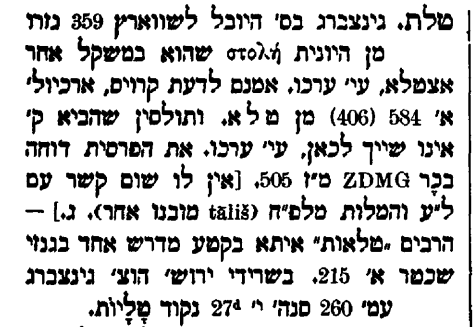


This entry also quotes Krauss (so maybe he didn’t write it? or it was written by committee?), and it says Krauss gives it an entirely different origin (the root טלא - “to patch”.) It also goes on to reject Kohut’s Persian origin (significant because one of the other editors was George Alexander Kohut, the son of the author of the Arukh HaShalem).


So it seems that Krauss was aware of the idea before Ginzburg. Did he come up with it only to reject it (a hava amina of sorts?), only to have Ginzburg remain convinced? Or was he quoting someone else?

I suppose more research needs to be done. And of course, the question remains: did Rabbi Mandel know about the theories of Krauss and Ginzberg? Either way, his scholarship is impressive. If he found their research, that must have taken a good deal of effort (certainly prior to the ease of internet searches which I benefited from). If he came up with it on his own, then he displayed creativity combined with serious intellect. 


And now I’m at the end of my journey. I started off being surprised by a claim in a video from 2023, and ended up finding debates from the turn of the 20th century. I hope you enjoyed the ride!


Thursday, May 30, 2024

edut, od, moed, and muad

The Hebrew word for testimony is edut עֵדוּת. Two related words are ed עֵד - "witness" and teudah תְּעוּדָה - originally also meaning "testimony," but today means "certificate, document.". Klein provides two possible roots for the etymology of edut:

Prob. from עוד and lit. meaning ‘exhorting sign’, ‘reminder’. Several other scholars derive עֵדוּת from יעד (= to appoint, to fix), and compare Akka. adē (= statements, commandments).
Each of those roots provides many familiar Hebrew words. Let's look at each of them.

Klein defines עוד as "to return, repeat, do again." Therefore, he writes that the verb העיד (the source of edut) means "to affirmed solemnly", and originally meant "to repeat." Other meanings of that root include "to warn" and "to bear witness, attest, testify." 

From the more general sense of "to return, repeat," we get from עוד the verbs עודד and התעודד - "to be restored, strengthened." As a noun, it appears as idud עִדּוּד - "encouragement."
 
Two  words deriving from the root עוד are:
  •  od עוֹד - an adverb with a number of meanings, such as "more, another," "yet, still," and "already." According to Klein, it was originally a noun meaning "duration, continuance."

  • eid עֵיד - a Talmudic word for an idolatrous festival. It is cognate with the Arabic eid which simply means "festival." Klein writes that the word literally meant "that which returns (every year)." Klein adds that a variant spelling is אֵיד, likely due to an association with the homonym אֵיד, which means "calamity, misfortune," but is unrelated etymologically to eid deriving from עוד.

Now let's take a look at the other root that might be the source of edut: יעד. Klein defines this root as "to appoint, fix, assign, designate." In the noun form, it appears as yaad יַעַד - "aim, target, destination" or yiud יִעוּד - originally "appointment, assignment," now "destiny, mission."

Other related words include:
  • moed מוֹעֵד - this is either an appointed time, like a holiday or festival (like the moadim listed in Vayikra 23) or an appointed place, like the ohel moed ("tent of meeting", the tabernacle sanctuary that the Israelites built in the desert). This latter meaning was used by Itamar Ben-Avi (Eliezer Ben-Yehuda's son) to coin moadon מוֹעֲדוֹן - "meeting place, club."
  • edah עֵדָה - "assembly, congregation." Klein writes that the original meaning was "a group assembled together by appointment." Today it frequently refers to an ethnic group.
Klein notes that the post-biblical root ועד is related to יעד. It also means "to appoint." It gave us three words that all originally meant "meeting", but today have distinct meanings: vaad וַֽעַד - "committee," vaadah וְעָדָה - "commission," and veidah וְעִידָה - "conference, convention."

Lastly, we have a word I was familiar with, but didn't realize it actually was a homonym pair: muad מוּעָד. In the Talmud (Mishna Bava Kama 1:4) there is mention of a shor hamuad שׁוֹר הַמּוּעָד, an ox who has caused damage in the past, and so the owner is considered fully responsible for any damage in the future. Klein provides two entries for muad, each from a different root:

  1. PBH forewarned, cautioned. [Part. of הוּעַד (= was forewarned), Hoph. of עוד ᴵ.] 
  2. adj. directed. [Part. of הוּעָד (= was set, was placed), Hoph. of יעד.] 
Each of these could have presumably been the meaning of the shor hamuad - either the owner was forewarned of its dangerous behavior (definition 1), or it was designated as a dangerous animal (definition 2). But it's clearly definition 1 as seen from the verse where the concept originates:

וְאִם שׁוֹר נַגָּח הוּא מִתְּמֹל שִׁלְשֹׁם וְהוּעַד בִּבְעָלָיו וְלֹא יִשְׁמְרֶנּוּ וְהֵמִית אִישׁ אוֹ אִשָּׁה הַשּׁוֹר יִסָּקֵל וְגַם־בְּעָלָיו יוּמָת׃ 

"If, however, that ox has been in the habit of goring, and its owner, though warned, has failed to guard it, and it kills a man or a woman—the ox shall be stoned and its owner, too, shall be put to death." (Shemot 21:29)

This translation follows Rashi:


והועד בבעליו. לְשׁוֹן הַתְרָאָה בְעֵדִים, כְּמוֹ הָעֵד הֵעִד בָּנוּ הָאִישׁ (בראשית מ"ג): 

"This is an expression of warning through witnesses, as in 'The man warned us' (Bereshit 43:3)

Every translation and commentary that I found says that וְהוּעַד here means either "warned" or "testified." It's rare to find such a consensus. 

Well, nearly every translation. One well-regarded Torah translation, by Everett Fox, follows definition 2:

But if the ox was a gorer from yesterday [and the] day-before, and it was so designated to its owner, and he did not guard it, and it causes the death of a man or of a woman, the ox is to be stoned, and its owner as well is to be put to death.

I was very surprised by this translation. On the one hand, I find Fox incredibly reliable in providing a literal translation that very effectively captures the rhythm and syntax of the original Hebrew text. But on the other, I found no one else who provides a similar opinion, and unlike in other occasions, Fox did not provide any additional commentary explaining his choice. My only possible idea is that Fox was influenced by an earlier verse in that chapter (21:8) which uses the root יעד and everyone translates it as "designated." But that seems to be a very different context, so I don't see why it would influence his choice here. It's certainly possible I missed an earlier source or resource that justifies this translation. If any of you are aware of one, please let me know.

Thursday, May 23, 2024

halva'ah and livui

The root לוה has two meanings in Modern Hebrew: "to borrow" and "to accompany, escort." Are they related?


Many modern linguists do not make a connection. For example, Klein lists them as seperate roots:

1) to borrow [Arab. lawā (= he delayed payment of debt).]
2) to join [Aram.-Syr. לְוָא (= he accompanied)]

He does however, note that a third use of לוה, "to wind, turn, twist" is associated with meaning 2 (to join, accompany). For that meaning he provides this etymology: "Arab. lawā (= he wound, turned, twisted), Akka. lamū, lawā (= to surround, encircle)."

There are some scholars, however, who do suggest a common origin. Mitchell First, in his book Words for the Wise (p. 243) notes that both  Mandelkern and TDOT say that a connection is possible. He quotes Mandelkern:
[He] points out that in Lain, a debt is called an "obligation." This word comes from a Latin word leig that means "to bind."

TDOT (Vol 7, p. 477) adds:

Arabic lawa(y), "put off a creditor, delay payment, fail to pay a dept" ... suggests that the basic meaning of the root lwy, "twist, turn" may well be the point of departure for the meaning of the Arabic verb and that Hebrew lawa is likewise just a a special development of this root lwy. We arrive at the same conclusion if we follow Jacob Levy in understanding lawa, "borrow" in the sense of "as if it were attached to or by..."

As often happens in these cases, it's difficult to determine with any certainty whether or not there is a connection between these meanings. 

Each of the uses of the root לוה has provided us with a number of derivative words. Let's take a look at them.

Our first meaning of לוה is "to borrow," or in its piel form "to loan." A loan is a halva'ah הַלְוָאָה, a lender is a malveh מַלְוֶה and the borrower (or debtor) is a lo'veh לוֶֹה. This meaning of לוה is one of those cases where Hebrew has more specific meanings for words than English does. The verb לוה in Hebrew indicates a loan where the actual thing being borrowed is not necessarily expected to return to the loaner. The most common example would be money - when money is lent, there is no expectation that the same coins or bills given to the borrower will be used to repay the debt. 

There is, however, a different root in Hebrew which does refer to the lending of an object which is expected to be directly returned: שאל (and it is not used in regards to money). In English שאל is translated as "to borrow" and the hif'il form, השאיל, means "to lend." In English, there is no such distinction found when using the words "lend" and "borrow," but it is important for Hebrew speakers to choose the word proper for the context of the loan.

The second meaning of לוה is "to join, accompany, escort." This gives us such words as livui לִוּוּי - "escorting, accompanyment" and melaveh  מְלַוֶּה - "accompanier, escort." It's also the origin of the Hebrew word for funeral. A search on the Morfix website provides halvaya הַלְוָיָה for "funeral." However, most dictionaries will offer both halvaya and levaya לְוָיָה. Klein notes that "The more exact form is לְוָיָה." Horowitz (p. 330) goes even further:

הַלְוָיָה  is a funeral, but the word should be לְוָיָה from לוה, escort. The verb הלוה, which would give rise to הַלְוָיָה  means lending. It has nothing to do with escorting. In Yiddish the word is still correctly לְוָיָה.

However, this more recent review by the Hebrew Language Academy points out that neither word (in the sense of "funeral") appears in either Biblical or Talmudic literature, and that both appear for the first time in Medieval rabbinic literature. After reviewing the history of the words, it determines that both forms are legitimate. 

Other more modern words from this meaning include lavyan לַוְיָן - "satellite" (a loan translation of the Russian sputnik, meaning "traveling companion") and lavay לְוַאי - "side" or "after" (as in a side effect or aftertaste.)

The third meaning, "to wind, twist, turn," does seem not appear directly with that meaning as a verb. From what I can tell, it is assumed based on the Arabic cognate of the same meaning (lawa) and the Hebrew words that derive from it. Klein provides three: 

  • לִוְיָה livya and לוֹיָה loya  - both meaning "wreath" (the first in Mishlei 1:9 and 4:9, the second in Melachim I 7:29,36)
  • לִוְיָתָן livyatan - the creature "Leviathan". Klein writes that it literarlly means "tortuous." It is variously identified as a serprent, dragon, crocodile, or whale. Feliks, in Nature and Man in the Bible (pp 267-269) notes that in the book of Iyov (from 40:25 to 41:26) there are verses where the livyatan is clearly a crocodile (e.g, 40:29) and others where it is clearly a whale (e.g., 41:11-12). Feliks concludes that "the author of the Book of Job ... decided to synthesize two wondrous creatures of great strength, and invented the leviathan."
Lastly, we have the name Levi לֵוִי. This son of Yaakov and Leah gets his name in Bereshit 29:34 -

וַתַּהַר עוֹד וַתֵּלֶד בֵּן וַתֹּאמֶר עַתָּה הַפַּעַם יִלָּוֶה אִישִׁי אֵלַי כִּי־יָלַדְתִּי לוֹ שְׁלֹשָׁה בָנִים עַל־כֵּן קָרָא־שְׁמוֹ לֵוִי׃

The translation of this verse is affected by the understanding and use of the root לוה. JPS translates it as:

Again she conceived and bore a son and declared, “This time my husband will become attached to me, for I have borne him three sons.” Therefore he was named Levi. 
This translation understands לוה as "attached" as we saw in sense 2 ("to accompany.") Other translations, like Fox and Alter, have the phrase as "my husband will join me" or "will be joined to me." 

Tawil, however, in his An Akkadian Leixcal Companion for Biblical Hebrew, leans closer to sense 3:

"and she (Leah) declared, 'this time my huband shall encircle (i.e., accompany) me', therefore he was named Levi (i.e., the one who encircles" (Gen. 29:34). [...] Whereas Anchor Bible Dictionary asserts that "the meaning of the name is uncertain," it seems that the equation with the Akk. lawu "to encircle, to move in a circle" depicts the actual function of the Levites, whose task was to encircle, i.e., protect the Tent of Meeting, e.g., וְנִלְווּ עָלֶיךָ וְשָׁמְרוּ אֶת־מִשְׁמֶרֶת אֹהֶל מוֹעֵד לְכֹל עֲבֹדַת הָאֹהֶל וְזָר לֹא־יִקְרַב אֲלֵיכֶם׃ "they (the Levites) shall move in a circle around you and discharge the duties of the Tent of Meeting, all the service of the Tent, but no outsider shall intrude upon you" (Num. 18:4)
This is in contrast as well to Sarna in his JPS commentary on Genesis 29:34, who wrote:

The true origin of this name is obscure. A similar word in Akkadian and in Minaean inscriptions from northern Arabia designates a special class of temple servitors, but the present midrash, unlike that of Numbers 18:2,4 contains no hint of any future sacral role. The name is given a purely secular twist, for it articulates the mother's yearning for her husband's companionship. 
It seems to me that Sarna looked at the same evidence that Tawil did, but came to very different conclusions. I find it difficult to agree that the verse "contains no hint of any future sacral role." Perhaps it does not spell it out visibly, but anyone familar with the sense provided by the Akkadian and Arabic roots would understand the foreshadowing of the role that appears for the Levites in Bamidbar, as Tawil sensibly points out. 


Sunday, January 14, 2024

tiron and turai

After a soldier enlists in the Israeli army, there are two words to describe him (or her, although I'm providing the male forms of the words): טִירוֹן tiron - "new recruit" and טוּרַאי turai - "private" (his initial rank). While the two words apply to a similar time in the military, and look somewhat similar, they are actually not related etymologically.

Tiron entered Hebrew in the rabbinic period, borrowed from the Latin tiro. The English word "tyro" has the same meaning and origin:

"a beginner in learning anything," 1610s, from Medieval Latin tyro, variant of Latin tiro (plural tirones) "young soldier, recruit, beginner"

That Online Etymology Dictionary entry says that the pre-Latin origin is unknown, but Nicholas Ostler, in his book Ad Infinitum, says derives from Etruscan, which provided other military terms to Latin as well.

The more general sense of "novice" is seen in the early uses of tiron in Hebrew. For example, see this midrash:

 בְּשָׁעָה שֶׁנִּגְלָה הַקָּדוֹשׁ בָּרוּךְ הוּא עַל משֶׁה טִירוֹן הָיָה משֶׁה לַנְּבוּאָה

"At the moment that The Holy One blessed be He appeared to Moses, Moses was a novice at prophecy" (Shemot Rabbah 3:1)

Today as well tiron can have that meaning, but it seems to me that it may be more influenced from its use in the military (since so many Israelis serve in the army) as opposed to its more ancient origins.

In contrast, turai is of much more recent coinage. Linguists such as Gilad and Rosenthal note that it was coined by Ze'ev Jabotinsky and Edwin Samuel in World War I. Rosenthal is quoted here:

In later years, Ze’ev Jabotinsky – who served in the Jewish Legion in World War I together with Edwin Samuel, the son of the first High Commissioner of Palestine Herbert Samuel – published a two-page glossary of commands in Hebrew. One of their innovations was the rank of turai (private) since they marched in line formation (tor).

Others, such as Kutscher, point out that turai was likely influenced by the Russian word for "private" (not surprising considering Jabotinsky's background.)

That Russian word is рядовой (ryadovoy), related to the word meaning "row." It also has the sense of "rank and file," which has a similar meaning in English:

1590s, in reference to the horizontal and vertical lines of soldiers marching in formation, from rank (n.) in the military sense of "number of soldiers drawn up in a line abreast" (1570s) + file (n.1). Thence generalized to "common soldiers" (1796) and "common people, general body" of any group (1860).

So based on the Hebrew tur טור - "row", Jabotinsky and Samuel came up with turai. Rosenthal adds that there was actually a suggestion to change it to shurai שוראי or shuran שורן, from the synonym for row in Hebrew, shura שורה, but that was never adopted.

Monday, January 08, 2024

bedimos

How did the word בְּדִימוֹס bedimos (sometimes pronounced bedimus) come to mean "retired, emeritus "?


In Talmudic literature, we find the word dimos דִימוֹס meaning "pardoned, acquitted." For example:

 אמר לו הואיל והאמנתי עליך דימוס פטור אתה

"The officer said to him: Since you put your trust in me, you are acquitted [dimos]; you are exempt." (Bavli Avoda Zara 16b)

 בְּנוֹהַג שֶׁבְּעוֹלָם מֶלֶךְ בָּשָׂר וָדָם יוֹשֵׁב וְדָן כְּשֶׁהוּא נוֹתֵן דִּימוּס הַכֹּל מְקַלְּסִין אוֹתוֹ

"Usually in the world, if a king of flesh and blood sits in judgment, if he dismisses [dimus] (=throws out the indictment), everybody acclaims him." (Yerushalmi Berachot 9:5)

Klein provides the following etymology:

דִּימוֹס m.n.  PBH  1 he was freed, was acquitted.   NH  2 he resigned (from office).  [Probably from Latin dīmissus, p. part. of dīmittere (= to send away, dismiss, release), from – (= apart, asunder), and mittere (= to send). .] 
This makes dimos cognate with the English "dismiss":

early 15c., dismissen, "release from court restraint or legal charges;" late 15c., "remove from office, service, or employment," apparently from Latin dimissus, past participle of dimittere "send away, send different ways; break up, discharge; renounce, abandon," 
But I asked about the form bedimos. Where does it come from?

We also find it in Rabbinic Hebrew. For example here:

בִּשְׁתֵּים עֶשְׂרֵה יָצָא בְּדִימוּס. אָמַר הַקָּדוֹשׁ בָּרוּךְ הוּא לְאָדָם, זֶה סִימָן לְבָנֶיךָ כְּשֵׁם שֶׁעָמַדְתָּ לְפָנַי בַּדִּין הַיּוֹם הַזֶּה וְיָצָאתָ בְּדִימוּס, כָּךְ עֲתִידִין בָּנֶיךָ לַעֲמֹד לְפָנַי בַּדִּין בְּיוֹם זֶה וְיוֹצְאִין לְפָנַי בְּדִימוּס, אֵימָתַי בַּחֹדֶשׁ הַשְּׁבִיעִי בְּאֶחָד לַחֹדֶשׁ.

"In the twelfth [month], [Adam] was pardoned [yatza bedimus]. The Holy One, blessed be He, said to Adam, 'This is a sign for your children: In the same way that you stood in front of Me in judgement on this day and were pardoned, so too in the future will your children stand in front of Me in judgement on this day and be pardoned in front of Me.'" (Vayikra Rabbah 29:1)

This is the meaning until modern times. Why then, did it change from "pardoned" to "retired"?

The linguist Elon Gilad answers the question in this article. He notes that the first time we find the modern sense of the word is in 1890, when Nahum Sokolow wrote in his newspaper that "before Bismarck retired [yatza bedimos]..." After writing that phrase, "יצא ביסמארק בדימוּס", he adds the following word in parentheses: דימיסיאן. Sokolow does not note what language this foreign word is being transliterated from. 

Gilad proposes it's a Yiddish word, coming from the Polish dymisja, meaning "resignation" or "dismissal" from a position. His theory is that this Yiddish meaning is what influenced the change in meaning in Modern Hebrew. Zuckermann here concurs, noting other European languages with cognate words with similar meanings, including Russian demissiya, French demission, and Italian dimissioni. All of these words derive from the Latin dimissio and dimittere (to send away, dismiss) - just as the Hebrew dimos does. The only difference is that dimos took on the sense of "freed from judgement," while the European words also included "freed from a position," i.e., "resigned."

In Gilad's article, he continues by writing that the phrase yatza bedimos spread widely in the early 20th century, and by the 1930s, retired officers were already being referred to simply with the phrase bedimos (without the verb yatza). By the middle of the century, bedimos had generally replaced yatza bedimos. It is typically used to refer to people who retired from high-level positions, like judges or military officers. The word dimos, without the preposition be, is rarely, if ever, found in Hebrew today.


Tuesday, January 02, 2024

andarta

What is the origin of the word andarta אַנְדַּרְטָה - "monument, memorial"?

The word first appears in rabbinic Hebrew, where it was spelled אַנְדְּרָטָא. The meaning in those sources in the Talmud, midrashim, and Targumim is "statue" and usually had the negative associations with idolatry and worshipped statues of emperors and kings.

That original meaning is reflected in the etymology as well. Here's Klein's entry:

PBH, respectively NH feminine noun. statue, image, bust.  [Gk. andrias, genitive andriatos (= the image of a man, statue), from aner, genitive andros (= man), which is cognate with Old Indian náram (= man), na’ryaḥ (= virile). compare דֶּנֽדִּי and the first element in אַנְדּֽרוֹלוֹמוּסְיָא, אַנְדּֽרוֹמֶדָה and in אַנְתּֽרוֹפּוֹלוֹגֽיָה.] 

The reference to the Greek andrias and andros ("man") makes andarta cognate with such English words as anthropology, android, and the name Andrew.

But did you notice that Klein only gave the definitions "statue, image, bust"? Those are indeed the meanings found in rabbinic Hebrew, as we mentioned. But why not "monument, memorial"? Here Klein is likely following Ben-Yehuda, who has no entry for andarta in the dictionary compiled in the first half of the 20th century. So when did it take on its current meaning?

Both the linguist Ruvik Rosenthal and the columnist "Philologos" wrote about this. Philologos writes :

With the end of Greco-Roman antiquity — and with it, the custom of publicly displayed royal statuary — the word andarta disappeared from the Hebrew language. In the first volume of Eliezer Ben-Yehuda’s monumental Dictionary of the Hebrew Language, which came out in 1908 and included all Hebrew words starting with the letter alef, andarta did not even appear. The first prominent modern memorial to fallen Jewish heroes in Palestine, Abraham Melnikov’s 1934 statue of a roaring lion, commemorating the pioneers who died in the 1920 battle of Tel Hai in the Galilee, was not called an andarta, either. It was referred to as a matseva — a word traditionally designating the headstone on a grave.

It is hard to say just when andarta entered Hebrew as the accepted word for a war memorial of the sort found all over Israel today. The earliest documented use of it is, oddly, in some light verse published in 1950 by Nathan Alterman, a leading 20th-century Hebrew poet with a strong grasp of Jewish sources. Reacting to a government refusal to cancel purchase taxes on books and paper because they were not considered crucial commodities, Alterman wrote that if this was the official attitude, it was time to erect an andarta shel even, “a stone monument,” to the printed word. Perhaps it was he who reintroduced andarta to modern Hebrew; perhaps there were others before him. 

Rosenthal notes that the new meaning (along with the modern spelling) began after the founding of the State of Israel, when people began commemorating the many fallen soldiers in memorial monuments. He adds that in 1952, in the journal Leshonenu La'am, a reader asked about the origin of the word andarta, noting that it was recently being used to describe memorials. In response, the linguist Eli Eitan wrote that the new use of the word was objectionable, since the memorials weren't statues of people, and so better alternatives would be the Hebrew words מצבה matzevah or יד yad

Neither columnist, however, really explains why this new meaning of andarta was introduced and became so popular that it overruled the objections of official linguists.

My theory is one that I've mentioned many times. Just as nature abhors a vacuum, the Hebrew language abhors synonyms. When two words have the same meaning, one will begin to take on a new meaning, particularly one that there's no good match for at the time.

It's true that the original meaning of andarta was "statue." But Hebrew already has its own word for statue - pesel פסל. And yes, as Eitan noted there are already words for monument - matzevah and yad. Yet the common meaning of matzevah is "tombstone," not the more general "monument". And while yad does mean "memorial" (as in the biblical source of the name of the museum Yad Vashem), certainly the word yad is overwhelmingly associated with its primary meaning, "hand." 

So when some clever individual (or individuals) saw that andarta was up for grabs, they "converted" it into its modern meaning of "memorial monument of a person or event". Nothing unusual here - that's just how language works!


Tuesday, December 26, 2023

ukhlusiya

What is the origin of the word אֻכְלוּסִיָּה uchlusiya - "population"?

This is a word that entered into Hebrew in the Talmudic period (for example, Yevamot 36b) with the sense of "multitudes", borrowed from the Greek ochlos, meaning "crowd."

Klein says that the Greek word is "perhaps related to ochein (= to carry), and cognate with Latin vehere (= to carry, convey)." 

In the entry for the the related word ochlocracy - "government by the rabble", the Online Etymology Dictionary adds the following:

"government by the rabble," 1580s, from French ochlocratie (1560s), from Greek okhlokratia (Polybius) "mob rule," the lowest grade of democracy, from kratos "rule, power, strength" (see -cracy) + okhlos "(orderless) crowd, multitude, throng; disturbance, annoyance," which is probably literally "moving mass," from PIE *wogh-lo-, suffixed form of root *wegh- "to go, move."  "Several possibilities exist for the semantic development: e.g. an agent noun *'driving, carrying, moving', or an instrument noun *'driver, carrier, mover'. ... An original meaning 'drive' could easily develop into both 'stirred mass, mob' and 'spiritual excitement, unrest'" [Beekes]. For sense development, compare mob (n.). Related: Ochlocrat, ochlocratic; ochlocratical. Greek also had okhlagogos "mob-leader, ochlagogue."

While the Greek word and its English descendants have a negative connotation, implying orderless rabble, the Hebrew uchlusia doesn't have those associations. (Perhaps because the Hebrew word המון already connects means "crowd" and has the sense of a noisy group.) However, beyond the meaning "population" (as in the total number of people in an area), ukhlusiya can also refer to the specific inhabitants of that area, in the collective sense.