Friday, September 12, 2008

dod

The Hebrew word for uncle is dod דוד (aunt is doda דודה). It is also a biblical word for lover. What's the connection between the two?

Klein suggests that the meaning uncle came first. He provides the following etymology:

Related to Syriac דדא (=uncle; beloved), Mandaic, Nabatean and Palmyrene dada (=father's brother), Arabic dad (=foster-father), dad (=play, game, joke), Akkadian dadu (=beloved child). All these words probably derive from infants' babbling 'dad'.
"Dad" as a word deriving from baby talk can also be found in English:

recorded from 1500, but probably much older, from child's speech, nearly universal and probably prehistoric (cf. Welsh tad, Ir. daid, Czech, L., Gk. tata, Lith. tete, Skt.
tatah
all of the same meaning).
Horowitz (pg. 50) offers a similar origin, although he says lover preceded uncle:

Dod is the most ancient Hebrew word for love. It is probably a primitive caressing syllable taken from the sound da-da that babies make. Babies' sounds are alos the origin of words like אמא - mamma, אבא - papa. This accounts for words like these being found in so many different languages.

דוד dod - lover, has come to mean "uncle". Next to the mother and father, the uncle was the lover and guardian.
As pointed out here (and discussed in the comments on this post), a connection between lover and uncle might be found in the fact that it was common, perhaps encouraged, for uncles to marry nieces in ancient times.

Horowitz also connects dod to the mandrake flowers known as dudaim דודאים because "women believed these flowers stimulated their husbands' love for them." I did find a source that tried to connect dud דוד - "kettle" (in Biblical Hebrew, now "boiler") to dod:

dod {dode}; from an unused root meaning properly, to boil, i.e. (figuratively) to love;
However none of my dictionaries connected dud to dod, and the Encyclopedia Mikrait says that dud actually comes from Egyptian.

A different view of the origin of dod can be found in Sanmartin-Ascaso's extensive article on dod in the Theological Dictionary of the Old Testament. He writes:

Etymology. Little can be said with certainty about the etymology of Heb. dodh, pl. dodhim. It is possible that dodh is an onomatopoeic word (dad[u]) which arose out of repetition of the da, as is often the case with words that denote kinship. It is quite likely that dodh is a nominal form derived from the root w/ydd "to love" (-> ידד yadhadh). The question whether w/ydd can be traced back to an original onomatopoeic word (cf. Hurrian tat[t], "love") must remain open, as must also that of a possible connection between dodh and s/dad, "breasts".

He then goes on to describe how the different Semitic languages had different meanings for dod. In the Eastern languages, such as Akkadian, the word
means "beloved, darling" and denotes a (personal) object of love.
However, the Western Semitic languages such as Arabic
all use dwd in the sense of "(paternal) uncle"
He then presents the development of the word as follows:
One must assume a development form an original onomatopoeic word, perhaps *dada, "darling", to a verbal root (w/y)dd, "to love", from which the substantives dwd and ydd arose. If one assumes that the "uncle" played an important role in the Semitic family as provider and helper, the shift to uncle is easily understandable. In the East and Northwest Semitic region, dd retained the meaning "darling". But among the Aramean and Arabian tribes, where the way of life was influenced for a longer time by (semi-)nomadism and the family ties were stronger, the meaning "uncle" became predominant.
Sanmartin-Ascaso here provides a connection between the root ידד and dod. Klein, however, does not connect the two, but only writes the following in his entry for yadid ידיד - "friend, beloved":

Related to Ugaritic ydd (=friend, beloved), Syriac ידד, Arabic wadda (=he loved), Old South Arabic ודד ( = to love), Akkadian namaddu (=beloved).
Returning to Sanmartin-Ascaso, he points out that:

An initial survey makes it clear that in the OT two different meanings of dodh come together. One coincides with the Aramaic and Old South Arabic usage; here dodh means "(paternal) uncle".
The other corresponds to the meaning of the word among the old, sedentary and civilized peoples of Mesopotamia and Syria, viz. "darling, beloved".
We can now see three meanings of two (possibly) related words. In the Tanach, we find dod having only one of two meanings - uncle or romantic lover (very common in Shir HaShirim). In addition, we find the word yadid which seems to have only the platonic meaning of "friend". (This is also the meaning in modern Hebrew. When a girl says she has a chaver חבר, it means "boyfriend". If she wants to say just "friend", with no romantic connotations, she would say yadid. The same applies to chavera חברה and yedida ידידה for a boy.)

Gesenius brings two proofs that dod can mean "friend". I find this difficult. First of all, his only textual proof is from Yishayahu 5:1, and this is a difficult verse, but as Sanmartin-Ascaso writes (pg. 150):

To translate dodh by "friend" here would falsify the meaning and purpose of Isaiah's composition. In this context dodh means "beloved" in its fullest sense.
Gesenius then brings two parallel examples from other languages. He mentions the Aramaic חביבא as meaning "friend" and then "uncle". This is found in Bava Batra 41b, where Rav Chiya calls his uncle Rav by that term. However, Steinsaltz mentions a theory that חביבי might be a contraction of אחי אבי - "my father's brother". He also mentions that the Latin word for aunt, amita, is related to amata, "beloved". However, we've already seen that amita may very well be related to the Hebrew em. In any case, nothing he wrote convinces me that the Biblical dod means anything other than uncle or lover.

This division may help me solve my oldest etymological puzzle. For those that don't know, my name is David. I remember from when I was very young, I had a small framed card in my room, upon which it said that the name David meant "beloved". That seemed very nice - certainly "beloved" is a compliment. However, when I started learning Hebrew, that etymology seemed a little strange to me. I knew ahuv אהוב as "beloved", and that dod had connections to "love", but what was this strange form דוד (or דויד)? I know that it can be more difficult to determine the origins of names than other words - but why beloved? Why not "lover" or "loving"?

Most sources I've checked have connected david to dod. But the article on David by Carlson in the Theological Dictionary gave me some additional insight. It mentions that David, while mentioned 790 times in the Tanach, is associated exclusively with the king. Carlson writes that the meaning is "darling". He rejects a number of theories, including those that say that David wasn't his original name (but rather Elchanan) or that the name derives from the Akkadian word dawidum (found in the Mari tablets) meaning "(to inflict) defeat" (see the Encyclopedia Mikrait on David). He does write that:

From a linguistic point of view, the name Davidh can be understood as an imitation of yadhidh (homophony). It is less likely that Davidh is a passive participle of a verb dudh or that dodh was changed to davidh after the pattern of mashiach, "anointed one, messiah", or nasi, "chief, prince."
The suggestion that David derives from yadid and not dod, makes sense to me. As I mentioned earlier, in the Bible dod only means "uncle" or "romantic lover" - neither of which would be the likely source of the name David. There is also some textual evidence to support this. For example, we find that David's son Shlomo was also known as Yedidya (Shmuel II 12:24-25):

תֵּלֶד בֵּן, ויקרא (וַתִּקְרָא) אֶת-שְׁמוֹ שְׁלֹמֹה, וַה', אֲהֵבוֹ. וַיִּשְׁלַח, בְּיַד נָתָן הַנָּבִיא, וַיִּקְרָא אֶת-שְׁמוֹ, יְדִידְיָהּ--בַּעֲבוּר, השם.

She bore him a son and named him Shlomo. The Lord loved him, and he sent a message through the prophet Natan; and he was named Yedidya at the instance of the Lord.
In addition, we find that Binyamin was also called yadid of God in Moshe's blessing (Devarim 33:12). What is the connection between Binyamin, David and Shlomo? Carlson writes:

It is significant that the youngest brother often receives the name "darling". In the OT, Solomon's name "Jedidah" reflects this custom (2 S. 11:27, 12:24f). The youngest of the Jacob tribes, Benjamin, receives the epithet yedhidh yhvh, "the beloved of God" (Dt. 33:12). Therefore, it is understandable that the eighth (1 2. 16:10f; 17:12; according to 1 Ch. 2:13-16, the seventh) and youngest son of Jesse is given the name Davidh, "darling".
Tigay, in the JPS Devarim on 33:12, noticed the connection as well, but offers a slightly different explanation:

Beloved of the Lord: If this means that God favored Benjamin politically, it could reflect the tribe's prestige when Ehud the Benjaminite was chieftain, when Samuel's leadership was centered in the Benjaminite territory, or the choice of the Benjaminite Saul as Israel's first king (note that the future King Solomon was called Yedidyah, "Beloved of the Lord" [2 Sam 12:25].)
So either yadid referred to the youngest son or it meant the one chosen for the kingship. Perhaps it even meant both, since usually the oldest son would be chosen for leadership, and here, yadid designated a chosen, youngest, darling son. (A proof of my objectivity is that despite me being the oldest son and a David, I put forth that theory.)

Jastrow translates yadid as "chosen". His etymology is rather far-fetched so I won't go into it, but the usage in Rabbinic literature does seem to fit that definition. For example, in Mechilta Beshalach 2:5, it describes ידידי טובעים בים - I think the translation "my chosen ones are drowning in the sea" works better than "my friends are drowning in the sea."

In modern Hebrew, dod has no romantic connotation at all. When not used for "uncle", it can mean "buddy" in slang.

In biblical Hebrew we find the phrase ben-dod בן דוד for "the son of the uncle", i.e. cousin. Apparently at the time of the 1943 kinship terms dictionary (discussed here), it was decided that a better term for cousin would be dodan דודן (the female is dodanit דודנית). I'm not sure what motivated the change - perhaps they felt that ben dod wasn't accurate enough, since a cousin could be the son of an aunt, or even a second cousin (not the descendant of an uncle or an aunt.) But in any case, the term is rarely used, and Safa Ivrit says it is usually found only in translated literature.

Tuesday, September 02, 2008

saba and savta

There's a certain Hebrew kinship term that I've been putting off writing about because it's rather complicated. So I thought I'd write about saba סבא - "grandfather" and savta סבתא - "grandmother" instead, because they seemed much simpler. As often happens, I greatly underestimated the complexity of these "simple" words.

The only thing I can say with certainty is that in modern Hebrew, saba and savta are the words commonly used. (Note that it is savta, and not safta. I think that switch - also found between Rivka and Rifka - is due to both v and f being labiodental fricatives, one voiced and one voiceless, and when followed by a stop consonant like k or t, sound very similar.)

However, the term seems fairly recent. The 1943 official dictionary of kinship terms in Hebrew (as I discussed here) lists "grandfather" as sav סב and "grandmother" as savah סבה, but adds the following note:


השמות סַבָּא, סַבְּתָא מותרים ככינויי חיבה, וניקודם בבית דגושה אע"פ ששרשם ע"י, מתוך היקש למלה אַבָּא

The names saba and sabta are permitted for use as terms of affection, and the letter bet is accented [not sure what this part means - any ideas?] due to the similar sound of the word abba.

They then add a smaller line (I assume added after 1943):

השמות סַבָּא, סָבְתָא (בי"ת בלא דגש) מותרים גם בשימוש כללי ולא רק ככינויי חיבה.

which justifies the general usage of the words, and allows the common pronunciation savta, where the bet does not have an accent.

Horowitz (page 100) describes the word saba as follows:

It is a word created by the little children in Israel, following closely the word "abba". The children were told to call this relative סב (sav) but it was simply much easier for them to link both these older loving male adults with these two similar sounding names, אבא (abba) and סבא (saba).


However, Ben Yehuda, in his dictionary which was written not long before, does not list sav, saba, sava or savta as meaning grandfather or grandmother. I don't have the ability to do a full text search through the entire 17 volume dictionary (but wouldn't that be amazing?). However, I did see that one of his definitions for zaken זקן is "grandfather", so perhaps that was his preferred word.

I'd really like to know what was the common word in Hebrew for grandfather in the first half of the 20th century. Perhaps one reason why zaken wasn't adopted can be found in the entry for the generic "grandparents" in the Vaad HaLashon list. They suggest the term הורים סבים horim savim, and explain:

שם כולל לסב ולסבה; עדיף השם הוֹרִים סָבִים מן השם הוֹרִים זְקֵנִים שעלול להטעות כאילו הכוונה לגיל ההורים

A general term for the grandfather and the grandmother; the name horim savim is preferable to horim zekenim הורים זקנים because the later is likely to confuse people who will think that it refers to the age of the parents.
Both zaken and sav mean "old". Sav is originally Aramaic, and corresponds to the Biblical Hebrew sav שב. This word is closely related to the word seiva שיבה - meaning "old age" and "grey hair". But in these biblical mentions (Iyov 16:10, Melachim I 14:4) it doesn't mean grandfather - only "old person". In fact, I couldn't find one example in the entire Tanach where a word was used to refer to "grandfather"! I find this very surprising. I know we've seen an example before of a Biblical Hebrew word that didn't make it into the Bible, but I figured that grandfather would be a much more common word.

As far as Talmudic Hebrew, Jastrow has sav and sava as "grey, old; elder; ancestor; scholar". He does have one mention of savta as grandmother - Bava Batra 125b. His third definition of zaken is "grandfather, ancestor", although his example is of the word being used as an ancestor, not a literal grandfather. Neither Ben-Yehuda nor Even-Shoshan bring Talmudic examples of sava meaning "grandfather". However, in the course of researching this post, I did find a few examples where sava clearly meant grandfather: Ketubot 72b, Yevamot 38a and 40b. (I also found a few examples of zaken, as well as avi av אבי אב - "father's father".) Here too, the ability to perform a comprehensive search of all Hebrew literature would help determine what names were used when for grandfather and grandmother.

What about great-grandfather and great-grandmother? The 1943 list suggests av-shilesh אב-שילש and em-shilesha אם-שלשה. However, these names weren't adopted, but instead the recommended terms are saba raba סבא-רבא and savta-rabta סבתא-רבתא. Rabta is the Aramaic feminine plural, and is therefore more correct. However, if usage is any indication, the proper form might not win out. Look at the following Google results:

  • סבתא רבא has 11,000 results
  • סבתא רבה has 7,910 results
  • סבתא רבתא has 3,350 results
So it could be in the not so distant future that savta-raba will be the official term...

Tuesday, August 26, 2008

gis

The Hebrew word for brother-in-law is גיס - gis, and sister-in-law is גיסה - gisa. Klein takes the conservative view, and writes:

Aramaic-Syriac גיסא, aphetic for אגיסא, which is of uncertain origin
He was probably following Ben-Yehuda, who also wrote that the origin of the word is unclear, but then added that
there are those who say that it comes from gis גיס in Aramaic, which means "side"
Gis as side is familiar from the Aramaic phrases chad gisa חד גיסא - "the one side" and idach gisa אידך גיסא - "the other side". Avshalom Kor (Yofi Shel Ivrit, page 84) agrees with this explanation, and writes that gis is a "relative on the side".

None of the modern dictionaries connect gis to gayis גייס - "troop", which is the source of giyus גיוס - "draft". For example, Klein only points out that gayis is related to the Arabic word jaysh - "army".

However, Jastrow has a more extensive etymology for gis that connects it to gayis as well. He says that both are from the root גוס, which means "to come in contact, touch, be connected, meet". The Aramaic verb גוס does mean "meet" in Pesachim 110b and Gittin 65b - I couldn't find anyone who disagreed with that. He then goes on to say that gisa גיסא meaning "neighborhood, side" derives from that root (I guess sides are connected to one another), and then connects brother-in-law to side, as we've seen before.

He connects gayis as well, by saying that it means "troop", but "especially ravaging troop, invaders, robbers". The connection here seems to be that an invader comes in contact with the area he invades.

But there is one thing I don't understand in Jastrow's theory. He also writes that the root גוס is the source of another meaning of גיס - "intimate, familiar". He brings examples from Ketubot 85b and Kiddushin 81a, where the phrase גיס ביה - "familiar with him" is used. It seems clear to me that this is just the Aramaic form of the Hebrew -gas ba גס בה. However, Jastrow says that the Hebrew gas comes from an unrelated root, meaning "to be bold", so gas ba means "he may be become bold towards her" (Ketubot 12a).

This etymology of gas isn't too far from Klein, who says that it originally meant "coarse, bulky" and then meant "vulgar, impolite, discourteous". But what caused Jastrow to miss the obvious connection between the Aramaic and the Hebrew? Was it his need to tie in gisa and gayis, and explain the meaning of gis as "meet"? Does anyone have a more charitable explanation?

Tuesday, August 12, 2008

neched and achyan

While some of the kinship terms we've looked at so far have changed their meanings over time, we haven't seen a basic term that needed to be "invented". However, in 1943, the Jewish National Fund (KKL) asked the Vaad HaLashon for a Hebrew term that to us might seem obvious - nephew.

In this letter, they write (my translation):


In the listings in the memorial books of the KKL, it is customary to note the relationship between the dedicators and the dedicatees, as in: So-and-so is recorded by his parents, brother, etc ... It is not clear to us if the word nin נין means the son of the grandson or granddaughter, which is the popular usage, but is opposed to the opinion of the commentators.

Also, as to the new words dodan דודן and achyan אחין - it is questionable whether to accept them, and if we do, what is their feminine form.
The question was put to a committee headed by Tur-Sinai. In response, they wrote a dictionary of family terms, which can be found on this site (unfortunately, I can't link directly to it - to access it, click on the link הצגת מלון on the right, and then in the drop down menu choose משפחה).

Most of the terms in the dictionary just have a simple translation - English to Hebrew / Hebrew to English. But a few of them have notes - with the longest one being for their translation of "nephew". They translate nephew as nechdan נכדן (and niece as nechadnit נכדנית) and write:

The committee suggests the word nechdan נכדן (not achyan אחין), on the basis of the fact that in our Medieval literature the word neched נכד had that meaning (nephew), and it is still used in the linguistic traditions of some ethnic groups. It is also worth pointing out that the Latin word nepos, from which are derived the words "nephew" and Neffe (German), is used for both meanings: the son of the son (or son of the daughter) and the son of the brother (or son of the sister). By adding a nun at the end (of neched), as was done with dodan דודן (cousin) from dod דוד (uncle), we achieve the necessary distinction needed today.
We'll discuss dod and dodan at a later time, but first a couple of points about their note. The word neched appears three times in the Tanach (Bereshit 21:23, Yishayahu 14:22, Iyov 18:19) - each time paired together in a phrase together with nin נין. We've already noted that while in Modern Hebrew nin means "great-grandson", in Biblical Hebrew it appears to mean "son". According to most commentators, neched in Biblical Hebrew does mean grandson. It doesn't appear much in Talmudic Hebrew (Jastrow offers first "offspring", second "grandson" - and only brings one example.) But the Medieval use of neched as nephew that Tur-Sinai mentions can be found in the Rashbam on Bava Batra 108a.

And to elaborate on the various meanings of the English word "nephew", here's the Online Etymology Dictionary entry:
c.1297, from O.Fr. neveu (O.N.Fr. nevu) "grandson, descendant," from L. nepotem (nom. nepos) "sister's son, grandson, descendant," in post-Augustan L., "nephew," from PIE *nepot- "grandchild," and in a general sense, "male descendant other than son" (cf. Skt. napat "grandson, descendant," O.Pers. napat- "grandson," O.Lith. nepuotis "grandson," O.E. nefa, Ger. Neffe "nephew," O.Ir. nia, gen. niath "son of a sister").
"Niece" derives from nephew:

1297, from O.Fr. nièce (12c.), earlier niepce, from L. neptia, from neptis "granddaughter," in L.L. "niece," fem. of nepos "grandson, nephew". Replaced O.E. nift, from P.Gmc. *neftiz, from the same PIE root. Until c.1600, it also could mean "a granddaughter" or any remote female descendant.
And the word nepotism is also connected:

"favoritism shown to relatives, esp. in appointment to high office," 1662, from Fr. népotisme, from It. nepotismo, from nepote "nephew," from L. nepotem (nom. nepos) "grandson, nephew". Originally, privileges granted to a pope's "nephew" which was a euphemism for his natural son.
According to Almagor-Ramon (Rega Shel Ivrit #19), the double meaning of the Latin term nepos influenced the Hebrew usage of neched in the Middle Ages.

However, the official suggestion of nechdan ran into trouble early on. In 1948 Avinery wrote (published in Yad Halashon, page 389) that we shouldn't be surprised that there was no word for nephew in Hebrew. Ancient people weren't as careful about family titles as we are today, and even terms like av אב, ach אח and dod דוד didn't always mean father, brother and uncle (respectively).

He continues to say that he agrees with the committee's rejection of achyan for nephew, but nechdan has not caught on either - either in speech or in literature. His suggestion? To use the word nin for nephew. On the one hand, he prefers the Biblical shilesh שילש - "one of the third generation" - for great-grandson. On the other hand, he brings a few examples from the 1930s where nin or nina נינה was used for nephew or niece. For example, in 1931, HaAretz referred to Lord Balfour's niece, Blanche Dugdale, as his nina.

But this suggestion also didn't stick. The common term used today for nephew is achyan, and achyanit אחיינית is used for niece. It's not clear to me when (or why) achyan gained its popularity. I asked a neighbor of mine, who's in his sixties, if he grew up using the word achyan. He said no, when he was growing up, he'd say ben-ach בן-אח, and that achyan has only been used in the past 30 years or so.

Despite its new usage as nephew, the word itself goes back to Biblical times - it was the name of a member of the tribe of Menashe, listed in Divrei HaYamim I 7:19. As with most Biblical names, there is no clear etymology. Some sources suggest it meant "brotherly or fraternal"; others (Who's Who in the Jewish Bible by David Mandel) offer "younger brother". Yehuda Kil in Daat Mikra mentions that "some say" that it means nephew. I'm very curious who suggested that theory, and whether they were influenced by the modern meaning of the word...

Thursday, August 07, 2008

teomim

We've discussed ach and achot - brother and sister. Now lets look at a word for a subset of siblings - twins. The Hebrew word for twins, teomim תאומים - appears four times in the Tanach: twice in Bereshit (25:24, 38:27) and twice in Shir HaShirim (4:5, 7:4). The singular form - תאום teom - never appears. According to Ben-Yehuda, it never appears in the singular in Talmudic Hebrew either - but that's much harder for me to confirm, since I don't have a complete concordance of Talmudic Hebrew as I do for Biblical Hebrew. Jastrow does mention the singular feminine form - teuma תאומה - but not the singular masculine teom. Ben-Yehuda also notes that it isn't clear from the Biblical usage whether the word only meant two children born at the same time, or if it would be used for triplets or quadruplets as well.


The parallel verbal root תאם finds its way into a number of verbs:

  • תאם - to be duplicate, to be similar, to resemble, to correspond
  • תיאם - to coordinate, so tium תיאום is coordination
  • התאים - to suit, fit, match. According to some, the Biblical use (Shir HaShirim 4:2, 6:6) meant "to give birth to twins". Jastrow writes that in Talmudic Hebrew "to be twin-like, joined, adjoining." Klein adds that in Medieval Hebrew, this form of the verb was causative, and meant "he fitted, suited, conformed, adapted". In Modern Hebrew it took on the passive form, and began to mean "was fit, was suited, was adapted". The expression matim li מתאים לי means "it suits me" or, better, "it works for me".
One English word is related to the Hebrew word teom: the name Thomas. The Online Etymology Dictionary shows how the name came from the cognate Syriac תאמא:

from Gk. Thomas, of Aramaic origin and said to mean "a twin" (John's gospel refers to Thomas as ho legomenos didymos "called the twin;" cf. Syriac toma "twin," Arabic tau'am "twin"). Before the Conquest, found only as the name of a priest. After 1066, one of the most common given names.
Horowitz (p 284) adds that:

Tom like Jack is used to indicate the male of the species. Thus we have "tom Turkey" or "tom cat", the male and tougher variety of those interesting animals. A "tomboy" is a girl who acts like a boy.
(It should be noted that there are other explanations for "tomboy" - there are those that connect it to the word "tumble", because the girl dances - tumbles - around like a boy.)

Interestingly, a popular name for boys in Israel is Tom תום (pronounced "tome"). I'm guessing that Israelis like it because it has only one syllable (very common in secular Israeli first names) but also because it sounds more like an English name. I wonder how many of them know that this word too has Hebrew origins...

Friday, August 01, 2008

ach and achot

Continuing in this series, let's look at the Hebrew words for brother and sister - ach אח and achot אחות. (The generic word for "sibling" is achai אחאי). Ach is certainly related to the verb אחה - meaning "to join, to stitch". Despite the fact that the verb only appears in post-Biblical Hebrew, Klein writes that there is debate amongst scholars whether the verb derived from the noun, or the noun derived from the verb. Steinberg expands the root meaning "to join" to other words - ach אח - "fireplace", where people gather around, and achu אחו "reeds" (later "meadow"), which were used to make ropes for binding. However, modern scholarship has determined that both of these words were borrowed from Egyptian.

In addition to "brother", ach can also mean "kinsman" or "friend", and in Medieval Hebrew - "friar". In addition to "kinswoman", achot can also mean "sweetheart, companion, mate". Parallel to ach meaning friar - achot took on the meaning "nun" in the Middle Ages. In Modern Hebrew it also means "nurse". Ben-Yehuda doesn't mention that in his dictionary; but this 1956 article mentions that:

Under the influence of the German and British use of the word "sister" for "nurse," the Hebrew is now using the word achot (sister) also to mean "nurse."
(Interestingly, the Wikipedia entry for nurse writes that "the professional courtesy title 'sister' has fallen into disuse and disapproval, even though it was formerly used by both male and female registered general nurses.")

Achot is an unusual word. Despite it being a singular noun, it ends in -ot, which is usually the plural suffix of feminine nouns. We found a similar phenomenon in another kinship term: chamot חמות - "mother-in-law". How did this develop?

According to this book, the words ach and cham חם, as well as av אב, originally had three letters, not two. The last letter was a vav (in some forms changed to a yud), and can still be seen in the smichut (construct) form - avi- אבי, achi- אחי, chami- חמי (e.g. avicha אביך - "your father", and not אבך, achiv אחיו - "his brother", not אחו) as well as the familiar Abu prefix meaning father in Arabic. According to the author, the original form of ach was אחו (similar to the Akkadian ahu), which became achot אחות in the feminine. The last letter in the masculine form dropped off, but we still have the strange ending in the feminine.

Ben Yehuda explains it slightly differently - he says the original form of achot was achat אחאת, which is אחא with the tav added on as the feminine suffix (I assume he's connecting the word to the Aramaic אחא - acha "brother"). He writes that already in ancient times the patach ("a") changed to a cholam ("o").

Whether or not the original ach had three letters, there are a number of other words in Biblical Hebrew ending in -ot that are actually single, not plural. Here are some that I've found (some commentaries explain them otherwise):

  • מכות - Micha 1:9
  • חכמות - Mishlei 9:1
  • בהמות - Iyov 40:15
  • עדות - Tehilim 132:12
Each of these may have a different explanation, but it does show us that our initial assumption that -ot at the end of a word means plural is not always correct.

One common mistake by new Hebrew speakers (I remember making it myself) is to say achot when you mean "sisters". The correct term in Hebrew is achayot אחיות, but those who make the mistake are actually close to ancient Hebrew. David Talshir of Ben Gurion University wrote an article called "The Forms ‘ahot and ‘edot in Ancient Hebrew" where he discusses the plural of achot. The absolute form of the plural never appears in the Tanach. Achayot does appear in the Tanach, but only in the later books. In the earlier books (like Hoshea 2:3, and the ketiv of Yehoshua 2:13), the plural is אחות. He writes:

The two forms considered above, עֵדוֹת and אָחוֹת, are feminine nouns ending in –ot. This is also the common plural ending for feminine nouns. In Hebrew of the First Temple period, the form אֲחָוֹת / אַחֲוֹת was used as the plural of אָחוֹת.

This situation evolved further in the Second Temple period. Since consonantal waw tended to be elided between vowels, the plural form of אָחוֹת resembled the singular form (אֲחָוֹת/אַחֲוֹת > אֲחוֹת), and so dissimilation gave rise to an unambiguous alternative: *אֲחָווֹת > אֳחָיוֹת. The latter took the place of the ancient form in the later books of the Bible – the prose framework of Job and the book of Chronicles (besides an early precursor in Ezek 16:2), and then in RH.
He also explains how the vocalization of the word developed:

The plural of ‘ahot in Hebrew of the First Temple period was ‘ahawot. The written forms that the masoretes, following the pronunciation tradition of their time, vocalized, conceal forms that were sometimes pronounced differently at an earlier stage in the evolution of Hebrew. Thus, the ketiv אחותי in Josh 2:13, which stand for the plural ‘my sisters,’ should have been vocalized as אַחְוֹתַי; while ולאחותיכם in Hosh 2:3 should have been vocalized וּלְאַחְוֹתֵיכֶם.

So in ancient Hebrew, sister was achot, but sisters was achvot. To avoid the confusion, a newer pronunciation developed for sisters - achayot.

We see from this that linguistic confusion is nothing new. It is interesting though that there are those who fight strongly against changes to make language easier, when such changes were made even back in Biblical times...

Friday, July 18, 2008

hora and horim

After discussing av and em, lets discuss the more generic term for mother and father: horim הורים - "parents". An informal survey I took of both native and non-native Hebrew speakers found that many of them thought that word was related to the word for teacher - moreh מורה and teaching - horaah הוראה. However, the word has a different root altogether. Moreh derives from the root ירה - "to teach", which is also the root of the word תורה - torah. Horeh comes from the root הרה - "to conceive, become pregnant". From this root we get the word herayon הריון - pregnancy.

The word is of biblical origin, but the story is a little strange here. Twice in the Tanach we find the word hora הורה - in Shir HaShirim 3:4 and Hoshea 2:7. In both instances, the word clearly means "mother". And that makes sense - the one who becomes pregnant is indeed the mother.

We do find the word horim, actually horai הורי, in one verse - Bereshit 49:26, in Yaakov's blessing to Yosef:

בִּרְכֹת אָבִיךָ, גָּבְרוּ עַל-בִּרְכֹת הוֹרַי, עַד-תַּאֲוַת, גִּבְעֹת עוֹלָם

The JPS translates this as: "The blessings of your father surpass the blessings of my ancestors [horai], to the utmost bounds of the eternal hills."

However, Sarna comments on the translation "my ancestors":

Hebrew horai is so rendered based on postbiblical usage. However, the stem h-r-h in the Bible can only mean "to become pregnant" and is, of course, solely used in the feminine. Seeing that "mountain(s)" - "hill(s)" is a fixed pair of parallel terms in Hebrew poetry, occuring more than thirty times in that order, Rashbam is undoubtedly correct in connecting horai here with har, "mountain." The Septuagint indeed reads here "ancient mountains," joining the word to the following 'ad. The phrase harere 'ad, "ancient mountains," appears in Habakkuk 3:6 in parallel with give'ot 'olam, "eternal hills." The Blessing of Moses to Joseph in Deuteronomy 33:15 employs the same imagery, though in variant form: "With the best from the ancient mountains, / And the bounty of hills immemorial..." Therefore it is best to render here, "the blessings of the ancient mountains".
I find Sarna rather convincing here. Hora certainly seems to mean mother, and the verse in Bereshit does look like it is referring to mountains. So biblically we only had a word referring to the mother, and in post-biblical Hebrew the generic term horeh for "parent" developed. The word "parent" itself in English had a similar development:

from O.Fr. parent (11c.), from L. parentem (nom. parens) "father or mother, ancestor," noun use of prp. of parere "bring forth, give birth to, produce," from PIE base *per- "to bring forth"
I haven't seen proof of this, but it wouldn't surprise me if the Latin parentem (or an earlier version) originally meant "mother", since she is the one who gives birth.

What I do find strange is how the words are listed in the dictionary. Both Klein and Even-Shoshan have listings for hora, horeh and horim. Even if they accept the more traditional understanding of Bereshit 49:26 as "my parents", I don't see why they need to have a separate entry for the plural form of the word. I suppose it's to say that the singular horeh means "father", not "parent", whereas only the plural horim is truly generic. But that's not the way it is used in Modern Hebrew. The popular online Hebrew-English dictionary Morfix translates horeh only as "parent", and doesn't have an entry for hora - as mother - at all.

Morfix does, of course, have an entry for another meaning of hora - the folk dance. And no, they're not related. As Philologos discusses here:

Hora” comes from ancient Greek khoros, which also gives us such words as “chorus” and “choir.” Traditional circle dances deriving their names from khoros can be found all over the Balkans and southeastern Europe. They include the Turkish and Romanian hora, the Bulgarian horo, the Montenegrin and Macedonian ora, and the Russian khorovod, and they are all very old and highly similar in the way they are danced.

And the Online Etymology Dictionary provides the following background to "chorus":

from Gk. khoros "band of dancers or singers, dance, dancing ground," from PIE *ghoro-. In Attic tragedy, the khoros gave expression, between the acts, to the moral and religious sentiments evoked by the actions of the play.

And just in case I have any readers who are accustomed to the Ashkenazi kamatz - there is also no connection to the hora found in the terms "loshon hora" or "yetzer hora". I'll be sure to let you know if I stop using Israeli pronunciation...

Friday, July 11, 2008

av and em

I'd like to start a new series about kinship terms. I've written about some of them before, and you can find all of them by clicking on the label below this post, or in the categories section in the sidebar.

I think the Hebrew terms for mother - אם em, and father אב av. Klein writes that both of them "probably derive from a child's word", i.e. baby language. Similar sounds are used in many languages. In modern Hebrew we have the terms aba אבא - "dad" and ima אמא - "mom". Klein writes that they come from Aramaic, where they mean "the father" and "the mother" respectively. However, Kutscher points out that in Talmudic Hebrew aba and ima can mean "my/our father/mother". As a proof of this, he brings the story from Pesachim 4a (according to the version of Rabbeinu Chananel), where Rabbi Chiya asked Rav if "Abba" is alive. Rav didn't want to say anything offensive - so he said "Abba" is alive. Kutscher writes that Rabbi Chiya was asking if his own father was alive, and Rav knew that he wasn't. So when Rav said "Abba" was alive, he meant, "yes, my father is alive".

Because of the similar sounds in other languages, it can be difficult to determine if a word in a non-Semitic word that sounds like em or av was borrowed from Hebrew or a related language. However, there are a few examples where this seems to have happened.

For example, the Online Etymology Dictionary claims that the English word "aunt" might be connected to em:

from Anglo-Fr. aunte, from O.Fr. ante, from L. amita "paternal aunt" dim. of *amma a baby-talk or non-I.E. word for "mother" (cf. Gk. amma "mother," O.N. amma "grandmother," M.Ir. ammait "old hag," Heb. em, Arabic umm "mother").
While the origin of aunt is questionable, the words "abbot" and "abbey" definitely come from Hebrew. Kutscher, quoted here, writes as follows:

Another instructive example is the use made in Christian times of words derived from the Hebrew אב (av – “father”). In Mishnaic Hebrew we find the Aramaic אבא (abba), the earliest written form of which appears in the New Testament in Mark 14:36. The word followed hard in the wake of the spread of Christianity throughout Europe. In medieval Latin it took the form of abbas, a name for a monk, whence abbatia, a monastery, still retained in French abbaye. Furthermore, by the addition of a Greco-Roman suffix a feminine form was created, abbatissa. In English one finds abbot (and abbess), in German Abt the head of a monastery, in French abbé a priest. Likewise we have in German Äbtissin head of a nunnery by adding in, a German feminine suffix.
It is strange that the female head of an abbey would have a title deriving from the Hebrew word for "father" - but that's how language goes!

Tuesday, July 01, 2008

neter and nitrogen

In my last (real) post, I discussed the origin of the word soda, and its derivative sodium. Well, have you ever noticed that the chemical symbol for sodium is Na (as in NaCl - sodium chloride)? Clearly Na is not an abbreviation for "sodium", so where did it come from?

Let's discuss the development of the symbol. It might not surprise you to see that there's a connection to Hebrew here as well...

We begin with the Egyptian word ntr (I've also seen it spelled netjeri / netjry /ntrj / ntry). The word originally meant "divine" or "pure". It referred to a salt called sodium carbonate, also known as "washing soda" or "soda ash" (and sometimes simply "soda"). It was found in the area of Wadi El Natrun (apparently the wadi was named after the salt, not the other way around), in salt lakes. It was used both for soap as well as in the process of mummification.

From Egyptian the word was borrowed into Semitic languages - Akkadian nit(i)ru, Aramaic nithra, and Hebrew neter נתר. This word appears twice in the Bible - Yirimiyahu 2:22, where it talks about its use in cleaning and Mishlei 25:20, where it describes the effect of mixing it with vinegar (remember those volcano experiments from grade school where you mixed baking soda - sodium bicarbonate - and vinegar? Same thing here.)

However, in Israel, outside of Egypt, neter didn't only refer to soda (sodium carbonate) but primarily to potash (potassium carbonate), which was derived from plant ashes. (Note that we've previously discussed the Semitic origin of the symbol K for potassium, and its connection to plant ashes.) By Talmudic times (Shabbat 90a), they distinguished between the two types: Alexandrian neter, which came from the Egyptian salt lakes, and Antipatrisian neter, which came from the town of Antipatris - made from the ashes of plants.

The Greeks also had a term for this kind of soda - nitron (sometimes spelled litron). There's some debate as to whether the term was directly borrowed from Egyptian or perhaps entered Greek via Hebrew / Phoneician. From Greek the word entered Latin as nitrum and Arabic as natron.

If we continue following the word in the European languages, we see that from here it splits into two different paths. The Arabic natron enters as is into Spanish and then French, where it meant both potash and soda. The word natron is still used in English (where it appeared first in 1684), but mostly to refer to the older use of the salt.

In the 18th century, chemists began the process of identifying the various chemical elements. As discussed here, there was a split between Germanic speaking countries and the English and French speaking countries. Sir Humphry Davy was able to isolate the element sodium. As it came from "soda" - sodium was the name he chose, and this is the name used in French and English speaking countries. However, the Germanic speaking countries follow the chemists Gilbert and Klaproth who first called the element natronium (the suffix -ium means "metal", i.e. this is the metal component of soda), and then later Berzelius who came up natrium. And as we saw with Potassium and K, while the name of the element is sodium in English, the symbol of Berzelius was adopted - Na.

In Hebrew the word for sodium is natran נתרן. I haven't seen its coinage discussed extensively, but I imagine that on the one hand the influence of German science is felt here, as well as a desire to connect it to the Biblical word neter.

We've now followed the path of the word natron. However, we find another word that derived from the Greek nitron and Latin nitrum in European languages - nitre. The word is first found in French, and from there to English, where it is spelled nitre in the UK and niter in the US. Nitre does not refer to sodium or potassium carbonate, but potassium (or sodium) nitrate - better known as saltpeter (US) or saltpetre (UK). This substance isn't used as a detergent, so the translations of the Biblical neter as nitre are incorrect. Nitre was used as a fertilizer and as an explosive (for an interesting description about the connection between fertilizers and explosives, read Pollan's The Omnivore's Dilemma.)

Again in the 18th century, Rutheford discovered the chemical nitrogen, but the name was given by the French chemist Chaptal because it produces ("generates") nitre. So we actually have two elements - nitrogen and sodium, that derive from the same word.

The only question that still remains is why did nitre come to mean potassium nitrate instead of sodium carbonate? I've seen a few theories. This book (The World's Greatest Fix: A History of Nitrogen and Agriculture by G. J. Leigh, page 89) tells us that

the alchemists who first described these salts were not then able to distinguish clearly between the two types of salt.
It also points out that "nitre" stopped meaning "natron" in English in the middle of the 17th century, around the time that English began using the word natron (which must have helped with the clarity necessary to begin identifying elements like sodium and nitrogen in the following century).

This article indicates that the confusion between nitre (saltpeter) and natron (sodium carbonate) goes back very far:

It seems established that Greek nitron and Latin nitrum were used for both saltpeter and soda, which were not recognized as different substances. Pliny definitely used nitrum for both.
...
With better chemical knowledge, brought to the West by the Arabs, came also an Arabicized form of nitron, natrun, which existed beside the native Arabic word for soda, qali, meaning a plant ash, or milh qali "ash salt." As now two words were available, and two substances were distinguished, soda was called natron, while nitrum was specialized for saltpeter.

One other theory is presented by this book from 1844 (I don't know how well it has aged):

Their nitrum, however, must have been exceedingly various in its properties. For this incrustation is not always calcareous saltpetre; it is often soda, mixed with more or less calcareous earth ; and sometimes it consists of salts of sulphuric acid.
...
Substances so different ought not indeed to have been all named nitrum ; but before natural history began to be formed into a regular system, mankind in general fell into an error directly contrary to that committed at present. Objects essentially different were comprehended under one name, if they any how corresponded with each other even in things accidental. Whereas at present every variety, however small, obtains a distinct appellation; because many wish to have the pleasure, if not of forming new species, at any rate of giving new names. The elephant and rhinoceros were formerly called oxen ; the sable and ermine were named mice, and the ostrich was distinguished by the appellation of sparrow. In the like manner, calcareous saltpetre and alkali might be called nitrum. The ancients, however, gave to their nitrum some epithets, but they seem to have been used only to denote uncommon varieties.
...
But were the ancients, under the ambiguous name of nitrum acquainted with our saltpetre? There is certainly reason to think that it became known to them by lixiviating earths impregnated with salts. There are, as already said, not only in India but also in Africa, and particularly in Egypt, earths which, without the addition of ashes or potash, give real saltpetre, like that of the rubbish-hills on the road from new to old Cairo, and like the earth in some parts of Spain. It is a knowledge only of this natural kind of saltpetre, which required no artificial composition, that can be allowed to the ancients, as it does not appear by their writings that they were sufficiently versed in chemistry to prepare the artificial kind used at present.

But even admitting that they had our saltpetre, where and by what means can we be convinced of it ? Is it to be expected that any of the before-mentioned characters or properties of this salt should occur in their writings? They neither made aquafortis nor gunpowder; and they seem scarcely to have had any occasion or opportunity to discover its deflagration and the carbonization thereby effected, or, when observed, to examine and describe it. No other use of our saltpetre which could properly announce this phenomenon has yet been known. How then can it be ascertained that under the term nitrum they sometimes meant our saltpetre? Those inclined to believe too little rather than too much, who cannot be satisfied with mere conjectures or probabilities,but always require full proof, will acknowledge with me, that the first certain accounts of our saltpetre cannot be expected much before the invention of aquafortis and gunpowder. It deserves also to be remarked, that the real saltpetre, as soon as it became known, was named also nitrum ; but, by way of distinction, either sal nitrum, or sal nitri, or sal petrae. The first appellation, from which our ancestors made salniter, was occasioned by an unintelligible passage of Pliny, which I shall afterwards point out. The two other names signify like sal tartari, sal succini, a salt which was not nitrum but obtained from nitrum. Sal-nitri, therefore, or salniter, was that salt which, according to the representation of the ancients, was separated by art from nitrum, yet was essentially different from the nitrum or soda commonly in use. Birin-goccio says expressly, that the artificial nitrum, for the sake of distinction, was named, not nitrum, but sal nitrum.
...
In the course of time men became acquainted with the purer, more useful, and cheaper mineral alkali which was furnished, under the name of soda, by the Moors and inhabitants of the southern countries, who had learned the method of preparing it. The vegetable alkali also was always more and more manufactured in woody districts, as an article in great request, and sold under the name of potash, cineres clavellati. All knowledge of the impure alkali from the incrustation of walls was then lost ; and as there was no further need of guarding against confusion, it was not longer thought worth while to name saltpetre sal nitri: it was called nitrum and the oldest signification of this word being forgotten, it was admitted without further examination, that the nitrum of the ancients was nothing else than our saltpetre.
At this point the answer of when the terms diverged is not entirely clear. But I do very much like the quote above: "many wish to have the pleasure, if not of forming new species, at any rate of giving new names". I suppose if it wasn't so, I would have a lot less to write about...

Monday, June 23, 2008

twitter on balashon

When I started this site over two years ago, I often wrote a post daily. Since then, my knowledge in the field has increased, and with that has come exposure to more and more resources, both online (websites, Google Books, JSTOR) and offline (I have no room in my house for any more dictionaries!). Additionally, I've met a great number of very knowledgeable people through this site, many of whom I like to consult before publishing a post.

So the research needed to prepare a post has increased dramatically. That, together with my consistently shrinking "free time", has made my posts less frequent. From once nearly daily, I'm down to one a week - on a good week.

But it is important for me to let my regular readers and the new ones who visit this site all the time (Hi! Welcome!) that my interest obsession with Hebrew words and their history is constantly active.

So I've joined the site Twitter (would that be צִיּוּץ in Hebrew?). Twitter here will sort of serve as a "blog inside a blog". You can find it in the sidebar to your right, and I'll try to update it frequently with a sentence or two about the words I'm thinking about, questions I have, sources I'm looking for, etc. Feel free to email me with any ideas you have about my Twitter updates.

And one unrelated side note: Firefox 3 was recently released, and I found that Balashon was linked to in a Mozilla forum as an example of problems with Hebrew in the new version. I'm not sure there's anything I can do from my side, but if you have trouble reading the Hebrew, or the vowels don't show properly, please let me know.

Friday, June 13, 2008

sod

We're now at the last of the posts on the PaRDeS words, and we'll be discussing the word sod סוד. Unlike remez which doesn't appear in the Tanach at all, and derash which has many possible meanings in Biblical Hebrew, sod has two usages. Even Shoshan's concordance lists 16 verses where the word means "assembly" and five where it means "secret" - the more common meaning today. The development between "secret" and "assembly" isn't very hard to grasp, when we place the term "secret advice" in between them. A parallel set of terms in Hebrew is moetza מועצה - "assembly" and etza עצה - "advice". In English we also have the related terms "council" and "counsel".

However, for our purposes, it is important to determine which meaning came first. Without looking at other evidence, I can easily see either one leading to the other. But if we want to see if there are related words in Hebrew or in other Semitic languages, we need to know which meaning came first.

In this regard, we have a number of opinions amongst the sources I've checked. Klein, for example, provides the following order:

1. counsel
2. secret counsel
3. council, assembly
4. (Post Biblical Hebrew) secret

And he gives this etymology:


Related to Syriac סודא, סוודא (= friendly, confidential speech), Arabic sawada (= he spoke in secret).
Kaddari has a similar order: 1) secret thought, 2) consultation with trusted friends, 3) consultation with a group, 4) assembly.

The Theological Dictionary of the Old Testament in its comprehensive entry on sod, writes that the word might be related to the Arabic root swd, meaning "to be black". If this is the case, it would be related to the country Sudan:

from Arabic Bilad-al-sudan, lit. "country of the blacks," from sud, pl. of aswad (fem. sauda) "black."
As well as the word "soda" (and the related "sodium"):

"alkaline substance," from It. sida (or M.L. soda) "a kind of saltwort," from which soda is obtained, probably from Arabic suwwad, the name of a variety of saltwort exported from North Africa to Sicily in the Middle Ages, related to sawad "black," the color of the plant.
(It should be noted, however, that Klein gives a different etymology for "soda":

Med L. soda, from sodanum, lit: "headache remedy", from soda (=headache), from Arabic suda, in vulgar pronunciation soda (= splitting headache), from sada'a (=he split).

I have not found a Hebrew cognate for this Arabic root.)


However, the Daat Mikra claims that the primary meaning of sod is assembly (and actually gives a higher percentage of usage to that meaning than does Even-Shoshan.) For example, Amos Chacham writes on Tehillim 25:14 that "sod in Biblical Hebrew means proximity and connection, not necessarily in secret, but even in public, as in Tehillim 111:1 - אוֹדֶה ה', בְּכָל-לֵבָב; בְּסוֹד יְשָׁרִים וְעֵדָה. - 'I praise God with all my heart; in the assembled congregation of the upright'".

Jastrow seems to follow this same line of thought, and writes that sod derives from a root סדד, meaning "to join". He lists a number of other words from this root. One is sad סד, a Biblical word meaning "stocks for torturing, blocks", which he connects to the Arabic sadda - "to obstruct, to block". This is the source of the English word "sudd" - "a floating mass of vegetation that often obstructs navigation in tropical rivers". Jastrow also writes that the word sadan סדן - "block, anvil" is related to sad. From here we get the modern word sadna סדנה - meaning "workshop".

(Klein connects Arabic sadda to the Hebrew שדד, meaning to "overpower, rob". I would therefore assume he would not connect sadda to sod.)

Another derivative he provides is yesod יסוד, meaning "foundation". According to Jastrow, the development is "to join, to fasten, to found, to establish". From here we get the word musad מוסד - "establishment, institution", well known as the Mossad - Israel's intelligence agency (institution).

Steinberg has a similar theory to Jastrow - also connecting sod, sad and yesod. However, unlike Jastrow, who writes that the common root means "to join", Steinberg feels it means "to establish on a base, to sit in a place". Therefore the original meaning of sod was "sitting together of friends". He also connects the word sadin סדין to the same root. This I have trouble with. I can put aside the fact that current research says that sadin derives from a Sumerian word, since I'm guessing Steinberg didn't have access to that information. However, while in Mishnaic (and current) Hebrew sadin means "sheet", in Biblical Hebrew sadin meant "garment". His attempts to show that based on Mishnaic use the word originally meant "sheet" (which covers the the base where one sleeps) is a bit of a stretch.

However, Steinberg does present a theory which I did find some more modern support. He writes that the root סוד - meaning "to establish, sit" has Indo-European cognates, in the Sanskrit sad, the Latin sedere, and the English "sit". He's referring to the base *sed, which is the source of many related words in English. Starostin connects the IE root here to our Semitic root here (although if I follow it correctly, only to yesod, not sod.) Of course all the normal caveats apply to the Nostratic hypothesis, but Steinberg might have been on to something.

So we can see from here that if sod originally meant "secret", then it might be related to "soda". If it originally meant "assembly", then there's a chance it's related to "sit". But there's almost no possibility it's related to both.

Another thing to rule out is my own theory from before I started researching this post. I thought perhaps the original root meant "to cover up" - which would have connected it to the Biblical word sid שיד - "whitewash". In Talmudic Hebrew the root becomes סוד, but no one makes any connection to our sod. I did even find a theory that the town Sedom (Sodom) סדום is related to שיד, as it was found in Emek HaSidim עמק השדים.

Had that theory worked out, I would have been able to connect sawad - black to sid - white, via sod. But while that connection didn't work out, if you'd really like to connect black to white - you can read this post from almost two years ago that did the same thing...

Friday, June 06, 2008

derash

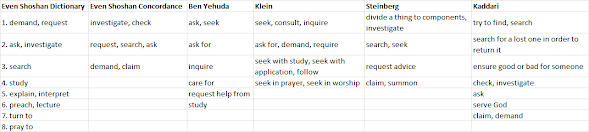
The next word in our series of PaRDeS words is derash דרש -'interpretation" or "exegesis". The root דרש is unlike the previous word, remez. First of all, רמז does not appear at all in the Tanach, where as דרש appears well over 100 times. And the meaning of remez is fairly simple - "hint", but darash has many definitions, of which none can explain all of the occurrences. Sometimes when a word has a variety of usages, it is possible to point to the earliest, "original", meaning. This does not seem to be easy with darash. The dictionaries didn't help much. I looked at six Hebrew dictionaries, all of which pay attention to the history of the word. Usually, the first definition listed is considered to be the original one. But as you'll see below, each dictionary came up with a different list, with a different order:


Most of these meanings appear somewhere in the Tanach (with the exception of "preach, lecture"). So we can't claim biblical usage as a sign of original meaning.

Klein actually provides an etymology:


JAram.-Syr. דרש, Mand. דרש (= he examines; he instructed, taught). Arabic darasa (= he learned, studied), Ethiopian darasa (= he expounded, interpreted) are Aramaic loan words. The original meaning of this base probably is 'to tread, trample, rub', hence ultimately identical with base דרס.

Klein defines דרס as "to tread, trample" but doesn't explain the connection to darash there either. Perhaps one of you can see the connection between דרס and דרש, but nothing seems obvious to me.

Stahl, in his Arabic dictionary, connects דרש to both דרס and also to דוש, which means "to tread, thresh" (possibly based on Gesenius here). He writes (my translation):


studying requires repetition, as does the threshing of grain

He points us to the word "studio" for similar development. From the Online Etymology Dictionary for the word "study":

c.1125, from O.Fr. estudier "to study" (Fr. étude), from M.L. studiare, from L. studium "study, application," originally "eagerness," from studere "to be diligent" ("to be pressing forward"), from PIE *(s)teu- "to push, stick, knock, beat"

The problem with this theory is that darash only appears once in the Tanach with the meaning "to study" - in Ezra 7:10. This seems to be a pretty late source, and none of the dictionaries put that meaning near the top. Heschel, in Heavenly Torah: As Refracted through the Generations,   (pages 251-252) describes the shift of meaning in Ezra's time:


Scripture says that Ezra "dedicated himself to seek out the meaning [lidrosh] of the Torah of the Lord" (Ezra 7:10)

and in footnote 45, there continues:


It is worth noting that this verse expresses something of historic importance. Previously, the root drsh was used for seeking out God, that is, for consulting an oracle, a priest or a prophet. Now it is used for the teaching of God, for the Torah. Ezra begins to inquire of a test, and thus we are signaled that the era of prophecy is at an end.

The Encyclopedia Judaica article on "Midrash" (found here), also points to the Latin studium, but has a somewhat different description than Stahl:


The term Midrash itself derives from the root drsh (דרש) which in the Bible means mainly “to search,” “to seek,” “to examine,” and “to investigate” (cf. Lev. 10:16; Deut. 13:15; Isa. 55:6; et al.). This meaning is also found in rabbinic Hebrew (cf. BM 2:7: “until thou examine [tidrosh] thy brother if he be a cheat or not”). The noun “Midrash” occurs only twice in the Bible (II Chron. 13:22 and 24:27); it is translated in the Septuagint by βίβλοs, γράφη i.e., “book” or “writing,” and it seems probable that it means “an account,” “the result of inquiry (examination, study, or search) of the events of the times,” i.e., what is today called “history” (the word history is also derived from the Greek root ίστορὲω which has a similar meaning). In Jewish literature of the Second Temple period the word Midrash was first employed in the sense of education and learning generally (Ecclus. 51:23), “Turn unto me, ye unlearned, and lodge in my house of Midrash,” which the author’s grandson translated into Greek, “house of instruction or of study”; compare the similar development of the Latin studium which originated in the verb studeo which means “to become enthusiastic,” “to make an effort,” “to be diligent,” etc. and only in a secondary sense, in the post-Augustan era, in the sense of learning (with diligence and the noun studium passed through the same stages of meaning; cf. Ger. studium; Fr. étude, etc.).

So if I understand Moshe David Herr's EJ article, he says that first the word darash meant "to search" or "to seek", and from there developed to the sense of "to study", with a similar pattern in Latin. However, that leaves an obvious question. Where would the connection to דרס fit in to Herr's theory?

In the Theological Dictionary of the Old Testament, Wagner has an extensive discussion about the usage and meaning of the root דרש, on pages 293-307. In the section on etymology, he writes:


The root drs is found in several Semitic languages: Aramaic, Arabic, Ethiopic, Syriac and Mandean, and is attested in Ugaritic (as yet only once, according to Bauer's reconstruction). It is debatable whether Akkadian darasu has anything to do with the same root. The original meaning of drs is hard to determine. It is probably correct to translate it by the English words "seek," "ask," "inquire (of)" (Ugar. "interrogate, question"?). The root must have undergone a change of meaning in the course of its use. In late Semitic languages such as Middle Hebrew, Jewish Aramaic and Syriac one encounters meanings like "interpret," but also "tread," "trample".

So Wagner basically reverses Klein's theory and says that דרס followed דרש.

Gesenius supports Klein, by saying that the original meaning was "to tread a place, i.e. to go or come to it, to frequent" and from there "to seek, to search for". I'm not sure who's right. Gesenius is the only one to flush out Klein's theory (of course Klein read Gesenius, not the other way around), but it seems somewhat forced. And the fact that darash never actually means "to tread" in Biblical Hebrew leads me to give more weight to Wagner's theory.
Regardless of the original meaning, by Talmudic times the verb darash came to be almost exclusively associated with study, meaning "to expound, interpret" or "to teach, lecture". The former sense gave us the word מדרש midrash (actually appearing once in the Tanach - Divrei Hayamim II 13:22) meaning "homelitical interpretation", and the latter sense we find in both the words derasha דרשה - "sermon" and beit midrash בית מדרש - "house of study".
This Philologos column discusses the connection between the Hebrew beit midrash and the Arabic madrasah - "school":
Madraseh, like many terms used by the world's Muslims, comes from Arabic, in which it is a nominal form of the verb darasa, "to study." In contemporary Arabic, however, madrasa does not necessarily mean a religious seminary. It is the generic word for "school," so that a second-grader learning to read and write is attending a madrasa, too. It is only in non-Arabic languages spoken by Islamic peoples that the word specifically refers today to a religious institution of higher learning.
...
As for the Jewish beit midrash, or "house of study," it comes from the verb darash, "to seek" (exactly as the talib of "Taliban" comes from talaba, "to seek"), and goes back to early rabbinic times in Palestine — that is, to the very beginning of the Common Era. Jewish education in this period began with a beit sefer, a "house of the book" (the generic Hebrew word for "school" to this day) in which young children were taught reading, writing and Bible; continued with a beit talmud, or "house of learning," in which some Mishna and simple rabbinic jurisprudence was taught to older children, and progressed to a beit midrash, in which advanced students sat at the feet of famous rabbis. The original beit midrash was thus similar to what eventually came to be known among Jews as a yeshiva, literally, "a sitting." Over the centuries, however, as the word yeshiva replaced beit midrash for an institute of higher Jewish learning, beit midrash came to denote an informal place of study in which anyone could sit and learn on his own in the presence of a library of sacred books.
...
The interesting question is whether the linguistic connection between the Muslim madrasa and the Jewish beit midrash is more than a matter of the general kinship between Arabic and Hebrew and actually has a causal element — i.e., whether the word madrasa was modeled on beit midrash. Although I can't think of any way of proving or disproving this, my instincts tell me that it was probably what happened. Rabbinic Judaism had an enormous influence on early Islam, and many Islamic institutions and concepts were knowingly or unknowingly taken from it. Moreover, when one reflects that pre-Islamic Arab society had no system of formal education at all; that the word kuttab is allied to kitab, "book," like sefer in beit sefer, and that the original beit midrash was an institution of higher religious learning just as the madrasa was, it seems likely that early Islam borrowed its terminology for different kinds and stages of schooling at least partly from Jewish sources.
In Modern Hebrew, as often happens, we've returned to the Biblical sense, and the most common usage of דרש is "to require".
In the spirit of seeking and studying, I'd like to ask (not demand!) from my readers some help. In the course of researching this post, I found this page. In the section discussing Sanskrit, they write:
Among the derivative verbal systems are the causative and the desiderative ("desire to"); the former has an affix -ay- (gam-ay-a-ti "makes to go," kar-ay-a-ti "has do") or, after roots in -a, -pay- (stha-pay-a-ti "sets in place"). The desiderative is formed with -sa- and reduplication (repetition of a part of the root)--di-drk-sa-te "desires to see" (root drsh). The desiderative also has an agent noun in -u--di-drk-s-u "who wishes to see."
Does anyone know if there's a suggested connection between the Sanskrit and the Hebrew drsh? Let's keep the suggestions in the realm of peshat, not derash...

***********
Update: I've given the question of darash / daras some more thought, and I think I overlooked something. In addition to daras, we have another verb that clearly means "tread" - דרך darach. Klein says that darach is related to דרג - also meaning "to walk". So now we have three roots that mean "to tread/ walk", which leads me to believe that perhaps we're talking about an early two-letter Hebrew root. We might also be able to add דדב - "to be accustomed, be trained" and דרר - "to flow abundantly, run swiftly". In that case, it's not so farfetched to think that darash is also connected, maybe similar to Gesenius. First "to walk", then "to seek".